
A quarter of a century since the Rambouillet Conference – fait accompli, a show, or missed opportunity?
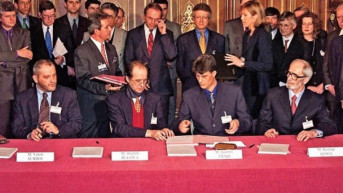
Twenty-five years ago, on February 6, the peace conference began at the Rambouillet Castle near Paris, aiming to peacefully resolve the crisis related to the situation in Kosovo. Representatives of the then-authorities in Serbia and Kosovo Albanians attended the Rambouillet talks, with the presence of international officials, but after 17 days, they left without an agreement. From a quarter of a century away, the views of the participants in this event and analysts differ on whether the conference could have had a different outcome.
For some, the offer on the table was imposed, a pre-prepared solution, while others see it as a compromise.
After Rambouillet, a new round of Kosovo negotiations began on March 15 in Paris and failed after only four days. On March 18, the two delegations signed two different agreements. The bombing of the then-Federal Republic of Yugoslavia followed.
Professor Ratko Markovic, the former head of the Serbian team in Rambouillet (who has since passed away), wrote five years ago that these negotiations had been a mere hoax and lie because there were no negotiations, and it had been just a show for the external world.
Nikola Sainovic, one of the representatives of the Serbian delegation in the negotiations, states that even today, he could not sign what was demanded from the Serbian side. On the other hand, Wolfgang Petritsch, a former representative of the European Union in the Contact Group, told Kosovo Online that Rambouillet had been good for Serbia.
Serbian Minister of Foreign Affairs Ivica Dacic, in a statement to Kosovo Online, said that the conference in Rambouillet had been an ultimatum for Serbia to voluntarily accept Kosovo’s independence.
"Rambouillet would officially and legally make Kosovo a state. Kosovo unilaterally declared independence in 2008, and in 2024, they still don't have a majority in the UN General Assembly. If we had accepted Rambouillet, first and foremost, the formulation that they have the right to a referendum on independence would have been accepted. There is no doubt that in that referendum, they would vote for independence, and that would put an end to that issue," Dacic emphasized.
He emphasized that, despite all the opinions related to Slobodan Milosevic, which showed a lack of understanding of the fundamental issues, they disguised the essence of all those demands to enable Kosovo's independence.
"That was already present at that time, and that's why I think no government would have accepted Rambouillet," Dacic concluded.
Recalling the events at the castle near Paris, Nikola Sainovic points out that FR Yugoslavia was then offered to accept, with a single signature, the occupation of the entire country and the mechanism for declaring independent Kosovo. He notes that at that time, the collective West devised a new way of warfare - warfare through agreements.
He points out for Kosovo Online that the negotiations in Rambouillet were not a singular event and that things started happening before that. In that sense, he mentions that the negotiations in Rambouillet followed negotiations with Ibrahim Rugova regarding education in 1998, as well as negotiations with Rugova mediated by Christopher Hill on the drafting of a self-governance document in Kosovo.
All of that, he says, lasted until the autumn of 1998, and then suddenly 'America changes sides'.
"America abandons Rugova, abandons Vatican mediation on education, and Christopher Hill, along with Holbrooke, sits down with that bearded member of the KLA in Junik with Kalashnikovs and demonstrates that America has switched to the armed side within the Albanian corpus. Then battles ensue, and the pacification of the KLA, Walker arrives, who was initially cooperative but then works to bring back the KLA and prepare a new conflict for us. Meanwhile, NATO is preparing for the conflict, and in those preparations, formal negotiations are made. Why formal – because we never sat down to talk with the other side. Rugova and their academic, Rexhep Qosja, came as leaders. They were left out in the rain, and Madeleine Albright declared Hashim Thaci as the leader of the Albanian side. There were no negotiations," Sainovic says.
As he says, the content of the negotiations was the surrender of the sovereignty of FR Yugoslavia, not Kosovo but the entire country, to a group of countries.
"They gave us a treaty with 'NATO Political Council' written on it, signed by foreign ministers, supposed to represent the NATO government. We give them the entire territory; they come with weapons and have the right to arrest whoever they want. It's a classic occupation, valid for three years, and after those three years, the Kosovo problem will be resolved according to the will of the people. Initially, it said 'referendum,' and we said, 'What referendum?' and then the will of the people was left. We were supposed to accept, with that one signature, both the occupation and the mechanism for declaring independent Kosovo. We refused," he said.
As he emphasizes, even today, if someone proposed something like that to him, he would not be able to sign it.
After those negotiations, as Sainovic recounted, other agreements followed, such as Resolution 1244, then the Brussels Agreement, and the Ohrid Agreement...
In that regard, he explains that the collective West devised a new method of warfare, which was warfare through agreements.
"I give you an agreement, you fulfill yours, I don't fulfill mine, and when you object, I offer you a new agreement in which it's the same again. And here we are today, with the ban on the dinar, and the arrest of a group of doctors and medical workers because, as they say, they provided medical services without authorization, and that's how we came to violate everything that has been until now. Rambouillet was just one segment of that process," Sainovic points out.
He states that back then, the Serbian side managed, through resistance, to compel the great power to return us to the UN and adopt Resolution 1244.
"We managed to get Resolution 1244 adopted, stating in it that sovereignty over Kosovo of FR Yugoslavia and Serbia is undisputed, it is written in the resolution proposed by America, while Russia was weak at the time. It remains a question for history why they didn't give us Resolution 1244 in Rambouillet. We would have accepted it reluctantly, but we would have had to accept it because sovereignty would have remained, because part of our forces would have remained in Kosovo, and there was also the disarmament of the KLA," he notes.
Sainovic also highlights that in Resolution 1244, they gave what the Serbian side said in Rambouillet as its red lines, without which it couldn't accept anything.
"After 78 days of war, they gave us that; we accepted it. They violated it on the first day, and the violation of agreements continues, and injustice grows," he adds.
He says Rambouillet is only a part of the strategy usually referred to as a conspiracy theory, emphasizing that it's not a conspiracy theory because a theory is on paper, and this is realized, and it's not a conspiracy but a plan. That plan, he says, is being implemented in phases, pointing out that there was first the Rugova phase, then the phase of the KLA leaders, and now it's the Kurti phase, which, in quotes, is democratic.
"In fact, it's been the same goal the whole time," Sainovic says, pointing out that the ideological basis of the KLA is the Marxist-Leninist Party of Albania, while the ideological basis of Kurti is Adem Demaci. “It is the same strategy rooted in 'Greater Albania' and it is still on the scene. When we older ones said that Kurti was the political grandson of Adem Demaci, many said, 'Ah, you're telling the same stories now,' and he came to Skopje and made Adem Demaci Street instead of Brigades Street, which liberated Skopje," Sainovic notes.
On the question of whether there is any connection between the events then and the present, given that the US Ambassador to Serbia Christopher Hill and Assistant Secretary of State for European Affairs James O'Brien participated in the Rambouillet talks, Sainovic says there is and that they are a part of the Biden administration, which is the continuation of the plan.
"At that time, Hill was at a mid-level, he was the ambassador to Macedonia, O'Brien was a young advisor, ambitious. I saw him in Rambouillet, dealing with legal issues. The Biden administration is a continuation, Hill was brought back from retirement, and O'Brien was brought back toward the end of his career to the same job. There's no doubt, there's no conspiracy theory, everything is a process and a plan," Sainovic concludes.
Former representative of the European Union in the Contact Group, which initiated the negotiations in Rambouillet, Wolfgang Petritsch, says to Kosovo Online that the negotiations in Rambouillet were the last chance for a peaceful resolution of the Kosovo issue. At the same time, he adds that Kosovo's independence probably would not have been stopped later, but there would have been a "peaceful transition" if Rambouillet had a happier ending.
Reflecting on those events exactly 25 years later, Petritsch tells Kosovo Online that the Contact Group's compromise, which included a representative from Russia, aimed at returning a high degree of autonomy to Kosovo within the framework of Yugoslavia.
"Without independence, as the Russians were not in favor of it, and even the Europeans said - let's try to do this because the situation has escalated. The decisive point was the massacre in Racak, which is still controversial today. At that time, we determined that they were civilians. We know it's difficult, and we carry this knowledge from the war in the Gaza Strip. Often it's hard to distinguish between civilians and terrorists. There it was established because there were many older people and children. This raised an alarm in Washington and Europe. It must be known, that in 1999, it was about preventing another Srebrenica. It was the fear of the international community, which Slobodan Milosevic was aware of, which is why there was never a similar massacre like Srebrenica, but the international community couldn't be sure," he recalls the context, from the perspective of international intermediaries, in which a solution was sought for the Kosovo crisis a quarter of a century ago.
According to Petritsch, when Racak happened, the Americans said - enough with negotiations.
"For months, Christopher Hill and I were on the road, aiming to find a compromise. The Americans said military intervention should be carried out, but the Europeans were against it and advocated for every possible attempt to find a peaceful solution. And that was Rambouillet," Petritsch says.
In response to why Rambouillet failed, he answers that it is still a valid and tragic question today, which he can personally feel. The reason lies in the failure to adopt a good, already negotiated compromise - autonomy for Kosovo without independence, the disbandment of the KLA, and the withdrawal of the Yugoslav Army from Kosovo. The responsibility for security would be taken over by an international military mission.
"That was the formula that was clear from the beginning and to which we came very close. I published all letters and documents after the failure of Rambouillet and Paris. From them, it is evident that in Rambouillet, the Serbian, or Yugoslav delegation, in a written conclusion, stated that there was significant progress, good negotiations had taken place, and the delegation was ready to discuss the manner and proportion of implementation after returning from Belgrade. That was an important point," Petritsch says.
He also says that contrary to later claims, it was not about discussing only the "civil implementation" of the agreement since, after Dayton, it was clear that civil implementation must be supported by peace forces.
"In the letter signed by Professor Dr. Ratko Markovic, head of the Serbian delegation, on the last day of negotiations in Rambouillet at the end of February, it stated what we had previously discussed with the Serbian side. It was clear that we could not, on one hand, disband the KLA, and on the other hand, leave Kosovo to the Yugoslav Army without protection, the army that had caused numerous refugees and suffering. The balance was - both sides had to give up their military forces. Only that way could the civil agenda be implemented, the re-establishment of a high degree of autonomy," Petritsch said.
Petritsch believes that Rambouillet was good for Serbia, and when asked if, had Serbia accepted the Contact Group's proposal, the situation in Kosovo would be as it is today, he says he doesn't believe that independence would have been halted but there would have been a "peaceful transition".
He recalls that the proposal implied convening an international conference after three years to assess the progress made towards autonomy in the meantime. The conference would then decide on the further course of action.
"In the last paragraph, we included two important points. On one side, the will of the voters, and on the other, the obligation that everything must be implemented in accordance with the rules of the OSCE, which allow border changes but through peaceful means. This means not through the fighting of the KLA or the Yugoslav Army but through negotiations between Belgrade and Pristina with the assistance of the international community," Petritsch says.
He observes that considering the past 10 years, negotiations are now being conducted based on that formula.
He also points out that in recent months, it has become clear how important the NATO KFOR peace mission is in Kosovo.
"While in Rambouillet, only the Kosovo side was demanding NATO, it is now clear how important KFOR is for protecting the Serbs in Kosovo. Unfortunately, this means, and it is a tragedy, that in Rambouillet, the last chance for peace was squandered," Petritsch emphasized.
He notes that this is not related to the Yugoslav or Serbian delegation, whose members worked excellently and professionally, unlike the Pristina delegation.
"They had great professionals, not like the Kosovo delegation, where Hashim Thaci was just 30 years old, completely inexperienced, and Ibrahim Rugova who had passed the zenith of his political life. There was no professional work there. The Serbian delegation had excellent people. Personally, I often had difficulty understanding a part of the Serbian side, especially with Milan Milutinovic, who seemed too cynical to me. But I had an excellent relationship with Nikola Sainovic, who was the deputy Prime Minister and a member of the delegation. I had numerous personal conversations with him. I noticed that Sainovic was in favor of a solution, but out of loyalty, he couldn't do much. As a witness, I was called to The Hague for the trial of Milutinovic and Sainovic. I openly said then that I had had an excellent personal relationship with Sainovic, and I spoke positively about him. Unfortunately, it didn't help; he received a high sentence since they had a wiretapped phone conversation related to Racak as irrefutable evidence. I emphasized the cooperative aspect of our relationship," he describes relationships and impressions of delegation members.
In response to the question of whether it was a mistake on the part of Serbia or Yugoslavia that there was no success in Rambouillet, he replies that he is not the only one saying this, recalling a conversation with Vuk Draskovic in Belgrade after Rambouillet and before continuing talks in Paris.
"I had a comprehensive conversation with Draskovic. He listened to me, and I explained everything to him about what would happen if we reached a compromise and if Belgrade supported the Rambouillet agreement - that by doing so, the responsibility for compliance would shift to the international community. For everything that would happen in Kosovo, Belgrade could say - we signed it, now it's up to you in the international community to implement it. I don't believe that the international community, in the long run at that time, had a chance to stop the independence movement, but there would have been a peaceful transition," Petritsch is convinced.
According to the assessment of the Professor of Constitutional Law at the University of Pristina, Mazllum Baraliu, political representatives of the former Yugoslavia made a mistake because they did not take the intentions of the international community seriously and did not sign the agreement.
"It was a major mistake by the Serbian delegation because they refused to sign, to agree to sign the agreement. It was an international agreement, conditioned – if not signed, Serbia would be bombed. Milosevic and his people believed that Western powers would never bomb Serbia, however, it happened, and Serbia suffered immense damage. The bombing occurred, and afterward, we know what happened, the Kumanovo Agreement, the entry of NATO troops into Kosovo, and the declaration of Kosovo's independence in 2008. A huge, irreversible mistake by the former Yugoslav delegation because they did not consider the intentions and patience of the international community seriously enough," Baraliu said.
Baraliu believes there is no longer room for such negotiations and peace conferences today and refers to the Resolution adopted by the United Nations General Assembly in 2010, which, as he said, authorized the European Union to initiate a dialogue between Kosovo and Serbia "for reciprocal issues".
“Serbia believes that negotiations should be held on the future status of Kosovo because it does not recognize Kosovo, however, Kosovo considers itself recognized by 117 countries worldwide. It declared independence and sees itself as a state with national subjectivity, which should be considered an equal member and partner in the dialogue according to the Vienna Convention," Baraliu said.
Analyst Afrim Hoti views the negotiations that took place 25 years ago as a very important historical moment in the relations between Serbia and Kosovo. As he says for Kosovo Online, the diametrically opposed positions of the two sides created the circumstances for the failure of that conference.
Serbia, he says, was willing to accept everything except Kosovo's independence, while Kosovo leaders were not prepared to accept anything other than independence, which prolonged the negotiation process and ultimately ended in failure.
"It was a contribution of Western countries to resolve the Kosovo issue. Although Kosovo was not mentioned by name in Rambouillet, today we talk about the success of that event. We talk about the 25th anniversary, and the issue, the case of Kosovo, is not yet finished, but regardless of everything, I think it was a crucial and historical moment not only for Serbia and Kosovo relations but for the entire Western Balkans region," Hoti says.
After 25 years, negotiations like those in Rambouillet, he believes, are not the solution for Serbia and Kosovo relations.
"Kosovo is a sovereign country recognized by 117 UN members, and in such conditions, the only mechanism to move forward is international pressure on Serbia to recognize the new reality. We have a new reality, a newborn, and all we need to do is to help and raise the newborn in the best possible way," Hoti says.
At the Rambouillet conference that lasted until February 23, the Kosovo delegation was led by Ibrahim Rugova, Hashim Thaci, Edita Tahiri, and Fehmi Agani. The Serbian side was represented by Ratko Markovic and Nikola Sainovic. The mediators from the United States, Russia, and the EU were Christopher Hill, Boris Mayorski, and Wolfgang Petritsch.


0 comments