
Serbian goods still enter Kosovo only through one crossing after a year: Waiting for scanners – is there an alternative?
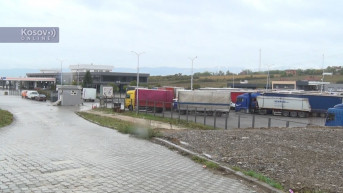
For a full year now, goods imported from Serbia to Kosovo have been allowed to enter only through the Merdare border crossing. The scanners whose installation is a prerequisite for opening other crossings will not be operational for another 12 months. Until then, both businesses and consumers will continue to bear losses due to congestion and delays at Merdare. Experts speaking to Kosovo Online believe that Kosovo Customs could organize inspections of goods at other crossings as well, but they express concern that the Kosovo Government’s measure is driven not by security reasons, but by politics.
Written by: Dusica Radeka Djordjevic
Kilometers-long lines of trucks at Merdare — the same scene as last October, when the Kosovo Government replaced its June 14, 2023, ban on Serbian imports with a new measure, allowing the passage of Serbian goods only at this crossing, subject to detailed customs and police inspections.
Truck drivers told Kosovo Online reporters that the inspection process for goods from Serbia can take up to two days at the terminal.
“We wait quite a long time, every week it’s the same. I don’t know how long this will last, but it’s very inconvenient. After we pass inspection, we stay at the terminal for one or even two days. It’s very cold here; it’s a mountainous area. I hope something will be resolved soon, but the way things are going, it doesn’t look good,” said truck driver Ivan Bradic.
If scanners are the only solution, the problem won’t be resolved until next autumn.
At the end of September this year, the German development organization GIZ launched a tender for the purchase of two X-ray scanners for Kosovo. Their procurement, installation, and commissioning are expected to take 12 months.
Although a mobile scanner was also planned, that purchase has been canceled. According to the Dukagjini portal, at the end of August, despite receiving five bids, Kosovo Customs canceled the €2.1 million procurement procedure for a mobile X-ray scanner “for budgetary reasons,” stating that none of the bids were suitable.
Is there an alternative while waiting for scanners?
Agim Shahini, president of the Kosovo Business Alliance, believes that Kosovo has the capacity to perform enhanced inspections of goods entering from Serbia at other crossings, not just Merdare.
He warns that introducing scanners only after a year will affect all businesses.
“Whether they are Kosovo businesses, Serbian, or international — everyone waits there. It drives up costs because transportation becomes more expensive due to the waiting time. I call on the Kosovo Government to reopen the border crossings at Jarinje and Bela Zemlja near Gnjilane, and to carry out inspections at all crossings with Serbia, as they do at Merdare. We have enough customs and police officers for that. It would reduce congestion and daily costs, including fuel expenses, which are ultimately paid by all citizens and consumers in Kosovo and Serbia,” Shahini told Kosovo Online.
He added that opening other border crossings for Serbian goods would ease congestion and lower costs caused by long waiting times at Merdare.
“Although there was talk that scanners would arrive soon, our Business Alliance pointed out that it can’t happen quickly, because scanners have to be manufactured according to Kosovo’s specific requirements. We have always supported the need for inspections regardless of where the goods come from or where they’re going, but never selectively. Having only one entry point at Merdare causes great losses due to waiting times. Goods sit for days, costs grow. We want those scanners introduced as soon as possible. Albania has had them for years — any suspicious goods go through the scanner, a fee is paid, and the shipment continues. Here, customs officers still conduct manual inspections,” said Shahini.
He noted that drivers — whether Albanian or Serbian — importing goods from Serbia to Kosovo sometimes wait up to three days, especially in summer, which increases costs ultimately borne by consumers.
Economic consequences
Nenad Djurdjevic, advisor to the president of the Serbian Chamber of Commerce, points out that the rise in transport costs is a direct consequence of the fact that, for a year now, Serbian goods have been allowed to enter Kosovo only through one crossing.
“This complicates operations for all companies and drivers, creating long queues at the entry point. As a direct result, transport costs rise — drivers refuse to drive for the same rates because they spend more time waiting, can make fewer trips, and the conditions at the crossing are inadequate for long waits,” Djurdjevic told Kosovo Online.
He added that the stated justification for the measure was to acquire scanners to improve border controls as a supposed anti-terror or security measure.
“However, until now, our customs authorities and companies have had smooth communication with Kosovo Customs at all crossings. I think this measure is more political — aimed at limiting the flow of goods from Serbia to Kosovo — rather than genuinely about counter-terrorism. Kosovo Customs was established under international supervision and is among the best-equipped and most professional institutions in the region. So, procedurally, there’s really no reason for such a restriction,” he assessed.
Last year, explaining why Serbian goods could enter only through Merdare until scanners arrive at other crossings, Kosovo Prime Minister Albin Kurti cited the “unchanged security situation” since the 2023 import ban, referencing the presence of the Serbian army near Kosovo, the Banjska incident, and several large seizures of weapons and ammunition.
Breach of CEFTA and regional agreements
According to Djurdjevic, allowing imports only through one crossing violates both the CEFTA agreement and the spirit of the Berlin Process, which aims to improve connectivity, integration, and create a common regional market in the Western Balkans.
“There’s an action plan adopted by the governments — including Kosovo’s and Serbia’s — with many measures to facilitate customs procedures and border crossings. This one measure takes us many steps backward, and it also undermines trust between the two communities. The business community wants cooperation, but this measure complicates trade, raises prices, and even affects Kosovo companies that import raw materials and grain from Serbia, which they later process and sell. In the end, everyone in the economic chain — including consumers — suffers higher costs and a more difficult life,” Djurdjevic stressed.
He concluded by urging governments to fulfill their commitments under the Berlin Process.
“The business communities didn’t sign the action plan — governments did, on behalf of their economies and citizens. We’ll see whether our appeals, and the broader international framework, will help change the situation and open all crossings,” Djurdjevic concluded.



0 comments