
Visits of Serbian Artists to Kosovo - Obstacles on the road, but at the destination, pure joy
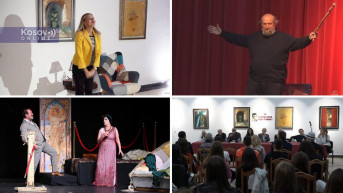
Someone of ours has come to visit us." This sentence, as actor Petar Bozovic described it earlier this spring for Kosovo Online, captures how the Serbian people in Kosovo feel when someone from central Serbia visits them. Direct contact with actors, writers, painters, and other artists brings an immense amount of love and understanding, something much needed during these times, according to the impressions of audiences in Serbian communities. Is it feasible for Serbian artists to visit Kosovo more frequently?
Written by: Dusica Radeka Djordjevic
Far from it being the case that they don't visit places like Velika Hoca, Pec, Gracanica, Leposavic, or North Mitrovica. However, everyone in Serbian communities would wish for these visits to be "regular."
Actor Svetozar Cvetkovic, who last visited Kosovo in Gracanica for the promotion of the book "Sa Cvejom," dedicated to actor Branko Cvejic, shared his thoughts: visiting Kosovo "is never often enough."
It’s also true, as noted by those interviewed by Kosovo Online, that the process isn’t the same when a theater troupe travels to Vranje versus Gracanica, and that writers often struggle to bring even ten books with them when heading to a book promotion in Kosovo. Despite the detailed preparations for performances like The Book of Milutin in northern Kosovo, the authorities in Pristina ultimately barred the Belgrade-based Zvezdara Theater troupe from entering Kosovo in May.
Predrag Radonjic, the director of the National Theater of Pristina based in Gracanica, told Kosovo Online that direct communication with artists means a lot to the people in Kosovo, who are under constant security, existential, cultural, and identity pressures.
"Every visit from Belgrade, every gesture of attention, especially when a well-known figure comes, gives them a sense that they are not forgotten and that someone is thinking of them. It is our duty, both from the cultural sector and from the state of Serbia, to support and nurture such cultural cooperation," says Radonjic.
He points out that there is a cultural life in Kosovo—writers, painters, and actors from central Serbian cities do visit—but these visits are often accompanied by administrative hurdles.
"It’s not the same going to Vranje as going to Gracanica. There is a kind of administrative pressure that Serbs live under all the time, where any minor issue in the paperwork or procedure can be used as a pretext to deny entry, with the excuse that it’s for procedural reasons rather than anything else. However, we and our colleagues who organize cultural events from other parts of Serbia manage to navigate through this," Radonjic explains.
Radonjic adds that a certain level of awareness and caution is necessary when organizing these events, but cultural visits are possible, as evidenced by numerous examples of cultural events in Kosovo.
"It’s not easy; there are complicating factors, but it is possible. When a performance takes place, the energy in the hall is truly special, and all the colleagues who have visited us have felt it and commented on it. In small communities, people literally feel as if someone has come to visit them for a celebration, as if they’ve come into their home, and they treat those people with happiness, full respect, and very positive energy. Truly, no one who has been to Kosovo and Metohija recently, whether they were there for a performance, an exhibition, a book event, or any other occasion, leaves the same as when they arrived," says Radonjic.
He gives special recognition to the Cultural Center in Gracanica, which, as he says, is a sort of hub, a central institution that in most cases handles organizing visits from central Serbia and the region.
"Certainly, this could be more pronounced. Most of the time, these are performances and events realized with the support of the Office for Kosovo and Metohija or through some projects of the Ministry of Culture, but there are also self-initiated events. The National Theater in Pristina strives to maintain developed cooperation, which is reflected in mutual visits with other theaters. We have hosted theaters from Nis, Krusevac, and other parts of Serbia. Last year, we were visited by colleagues from Niksic and Herceg Novi, where we have also performed,” says the director of the National Theater in Pristina, based in Gracanica.
Milos Jankovic, the president of the Serbian Writers' Association, says that writers from central Serbia visit Kosovo, but they should do so more often.
"It is necessary to plan, systematize, and institutionalize a way to increase this presence, in order to meet the cultural needs of the people living there. However, I think that on the other side, there is no dialogue partner willing to respect those needs. They do not want to respect even the ones related to food, healthcare, or social protection... It’s a terrible situation," Jankovic told Kosovo Online.
Whenever any writer visits Kosovo, the hall is always full, and a special kind of emotion is created, he emphasizes.
"This is not an ordinary audience, especially given the circumstances, which dictate that it won’t be an ordinary literary evening, an ordinary presentation, an ordinary panel, or an ordinary conversation... Nothing down there is ordinary anymore, and it's not our fault," says Jankovic with frustration.
In light of everything happening in Kosovo, he adds, the challenges faced by cultural life are no exception. Just as the daily life of the Serbian people in Kosovo has been complicated by measures that, he says, are unprecedented in modern history, imposed by the institutions in Pristina, the same happens with culture.
When writers travel to Kosovo, he notes, there are sometimes administrative problems of various kinds, and sometimes there are none.
"These issues mostly arise if you bring books with you. It’s logical to bring books for the audience and for presentation if you’re hosting a literary evening or participating in literary programs, but at the administrative crossings, these books often cause problems. That's one issue. Another issue is that all printed materials, like our Knjizevne novine (Literary Newspaper), don’t reach our subscribers because they’re printed in Cyrillic, or the packages are returned with excuses like ‘unknown address,’ ‘address cannot be verified,’ or similar reasons. This also happens when we send books as donations to libraries; they are returned or not accepted, especially if written in Cyrillic. We've raised this issue multiple times in written form to the international community and cultural institutions across Europe. The most basic human rights are consistently being denied, as the right to speak your language or read in your own script is fundamental," says the president of the Serbian Writers' Association.
At the end of September, during ceremonies dedicated to Lazar Vuckovic, a delegation of Serbian writers, including the vice president of the Serbian Writers' Association (UKS), Vidak Maslovaric, visited Pec, the Patriarchate of Pec, and Prizren, Jankovic points out.
"The Writers' Association of Kosovo and Metohija is a collective member of the Serbian Writers' Association as a guild organization for Serbian writers in Kosovo and Metohija, who are, of course, also individual members. We are in constant contact with our people, and we are individually present at various events organized in Kosovo and Metohija. Naturally, these events have now been reduced due to the current circumstances, which is understandable. This cultural activity remains largely intact, but I assume that the institutions in Pristina, with their, we can freely say, terrorist approach to reality that the Serbs live through every day, will likely turn their attention to cultural institutions and artistic programs happening there," Jankovic states.
He reveals that there was an idea to hold a session of the UKS board in Kosovo, since there is always a member from the Writers' Association of Kosovo and Metohija on the board. However, this also led to certain administrative and technical issues.
"Why everyone? Why 20 people? And why there? Not wanting to create additional problems for our people there or give any reason for them to be subjected to any form of harassment, we have so far abandoned that idea," Jankovic explains.
According to Zivojin Rakocevic, a writer and the director of the Cultural Center "Gracanica," the cultural life of Serbs in Kosovo is restricted by the harsh rules of the ghetto.
"In ghettos, you cannot talk about the normal development of culture. We have lost cities, galleries, libraries, our theater stages, and the smell of the city. In such a situation, the atmosphere in which our culture now lives is extremely restrictive," Rakocevic told Kosovo Online.
What offers hope, he adds, is that cities have somehow been revived within micro-communities.
"And most importantly, some of our cultural centers have developed to the extent that we now have choices. The fundamental thing in culture, life, and relationships is having choices. As for culture in Kosovo and Metohija, it is our only true freedom, and within it, we have choices," Rakocevic concludes.
The restrictions, Rakocevic explains, were set back in 1999 and have only multiplied and become more complex with additional obstacles.
"Whether it's the lack of infrastructure, the atmosphere that is being created, or the constant message that culture is a danger, that spirituality is a danger, and that anything different is a danger. The obstacles vary and exist at different levels. When a writer from Skopje brings ten of his books and at the General Jankovic crossing they take nine, and he arrives at a promotion in Gracanica with just one book, and Milutin Stancic has to figure out how to leave the other nine somewhere along the way and then ask a friend, 'You come and try to pass General Jankovic with my nine books so I can have some to give to friends at the promotion,' that's one of the images of the reality we live in," Rakocevic recounts.
Another image, he says, is the lack of free movement, where books must be smuggled.
"You're apprehensive that if you have five publications, someone will confiscate them. I can't even remember the last time a writer sent us a book by mail and it actually arrived. That’s another issue. Some books in Latin script make it through, but there's some invisible force, some ethnic censor, that stops books in Cyrillic. So, it's a million small things, and double or triple layers of administration you have to navigate. But in the end, none of that really matters. The most important thing is that you enter the hall behind us, that in the darkness of that hall, you experience something beautiful, experience catharsis, feel like you're in a city, and that not everything is lost," concludes Rakocevic.


comments