
Wesley Clark in The Hague – Will the testimony of the former U.S. General be decisive for Thaçi?
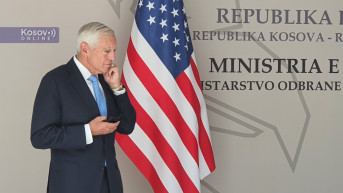
Wesley Clark, the American general who led NATO forces during the 1999 bombing of Serbia, will appear as the final defense witness in the trial of former KLA leaders. However, experts interviewed by Kosovo Online question how much Clark’s testimony could actually influence the outcome of the proceedings.
Thaçi, Veseli, Krasniqi, and Selimi have been held in detention in The Hague since November 2020 and are being tried before the Kosovo Specialist Chambers for, among other charges, war crimes and crimes against humanity.
Regardless of the verdict—whether guilty or acquittal—it will undoubtedly make headlines not only across the Balkans but also in international media, with political repercussions particularly in Pristina.
Attorney Tom Gashi believes that Wesley Clark’s testimony will contribute to establishing the truth.
“We all know that Wesley Clark was the general who bombed Serbia in 1999 because of war crimes committed in Kosovo. I believe he is one of the most important defense witnesses for Hashim Thaçi and the others on trial before the Special Court. I think he will help the court establish the truth regarding the charges brought more than five years ago,” Gashi said.
He emphasized that Clark was the NATO Supreme Allied Commander during the bombing of Serbia and therefore represents a highly credible witness.
“That is why he has been proposed as one of the witnesses before this Special Court by the defense,” Gashi added.
Editor of the RTS website Rade Marojevic stated that Wesley Clark, as the final defense witness before the Specialist Chambers, will likely continue the defense’s central argument—that the former KLA leaders on trial could not have been directly responsible for the crimes alleged against them.
According to Marojevic, the key defense witnesses have been Jack Covey and James Rubin, while Clark was brought in as a figure of broader symbolic significance, even though he did not have direct contact with Thaçi or KLA leaders during the war.
“We can expect that Clark will simply reinforce the defense’s argument that the KLA leadership on trial could not have been directly responsible for the crimes for which they have been charged. Essentially, the defense seeks to demonstrate that those responsible were individuals within the KLA ranks or regional commanders, rather than the top leadership. Luka Misetic is a highly skilled lawyer—as we have seen before—and he is trying to prove precisely that,” Marojevic explained.
Wesley Clark was at the helm of NATO forces during the period when the largest number of Serbs were kidnapped or killed by KLA members.
“Only part of the indictment relates to that period. The core of the indictment primarily concerns the period before NATO’s arrival, and partly the period after. However, the prosecution did not address NATO’s responsibility in any way—it did not attempt to attribute blame to NATO but focused directly on the KLA leadership. The justification has often been that NATO was not a police force and was not in a position to act as such in those initial months. That task was supposed to fall to UNMIK police, which never reached its planned strength of 6,000 officers,” Marojevic added.
In Pristina, expectations surrounding Wesley Clark’s testimony are high.
“He was the most prominent figure during the war and is regarded as a hero among Kosovo Albanians. Still, the two key witnesses remain Jack Covey and James Rubin—the man who created Thaçi and the man who defended him when the UN administration was being established in Kosovo. Covey was a key player from June 1999 onward on KLA-related matters, while before that, Thaçi’s public image was shaped by James Rubin and Paul Williams, who was an adviser to the Albanian delegation in Rambouillet and also a witness in The Hague,” Marojevic said.
When asked whether Clark’s testimony will be subject to restrictions, Marojevic replied:
“I believe he will face the same limitations as James Rubin and Jack Covey, since both required clearance from the U.S. State Department before testifying. Their participation was approved only after official briefings, and it was decided exactly what they could testify about. You need authorization from the State Department to participate in such proceedings, and the Pentagon likely did the same in Clark’s case. If there are any restrictions, we will probably never know their nature.”
Regarding whether Clark’s testimony could mark the closing phase of the trial, Marojevic said:
“As I understand it, the verdicts are expected in the spring. Whether that is realistic remains to be seen. This is a complex and rather secretive process—unlike previous Hague trials—without reports of witnesses being harmed or facing extreme pressure. The prosecution has done a good job in that sense, with sufficient time and resources to build its case. The defense, for its part, has also had time and resources, bringing in prominent figures from U.S. foreign policy. We will now see, in this clash of two worlds and sets of arguments, which side prevails.”
Marojevic concluded:
“I don’t think Wesley Clark’s testimony can fundamentally change the course of the case. The on-the-ground evidence is the key. The prosecution built its case on concrete events rather than political narratives. So it remains uncertain whether the defense’s argument—pushed by Rubin and Covey—can outweigh the factual evidence of crimes that occurred. The defense is countering specific crimes with political storytelling, which makes it difficult to predict how the prosecution will respond. Frankly, I’m afraid we simply cannot know.”
The President of the KLA War Veterans Organization, Hisni Gucati, believes that the testimony of former U.S. General Wesley Clark will be “shocking” for the representatives of the Kosovo Specialist Chambers and that the defense achieved a major success by obtaining permission for Clark to testify.
“Clark’s testimony will be shocking for them—shocking because it’s a great success that they managed to convince him. In the United States, you need official approval to testify. We thank the American government for allowing him to testify and look forward to hearing Clark’s testimony on November 19,” Gucati said.


0 comments