
The Western Balkans between the United States and the EU: A clash of national interests and international law
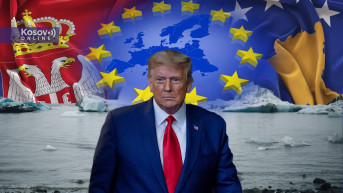
The dispute between the United States and the European Union over Greenland has placed the countries of the Western Balkans in an unenviable position, given their declared goal of EU accession on the one hand, and their economic and military reliance on Washington on the other. Avoiding an explicit public stance, sources interviewed by Kosovo Online say, may be the best possible solution, while noting that positions across the region will nevertheless differ, in line with national and foreign-policy interests.
Written by: Jelena Novakov
Even before the official start of his second term, U.S. President Donald Trump repeatedly voiced claims, among other things, regarding Panama, Canada, and Denmark’s autonomous territory of Greenland.
Following the intervention in Venezuela and the arrest of President Nicolás Maduro, Trump ruled out the use of military force as a means of acquiring Greenland during the Davos forum, but stressed that U.S. objectives with regard to the island remain unchanged.
Kosovo, Albania, and North Macedonia—along with the governments of Italy and Israel—are among the few U.S. allies that supported the intervention in Venezuela. However, Kosovo Online’s interlocutors note that the situation regarding Greenland is more complex and requires a cautious approach in order to avoid misunderstandings with Brussels.
By contrast, Montenegro and Serbia have taken clearer positions on the matter. Montenegrin President Jakov Milatovic stated that Montenegro supports the right to self-determination of Greenland’s population and their decision to remain part of Denmark, while emphasizing the importance of dialogue among NATO allies.
Serbia’s reaction was somewhat more cautious, with an emphasis on the country’s aspiration for a strategic partnership with the United States, while remaining on its European path and advocating respect for sovereignty and territorial integrity. Similar calls for respect for international law came from Denmark and Brussels.
In a move aimed at easing tensions, Trump also abandoned plans to impose tariffs on countries opposing his Greenland plan, while the EU announced a six-month suspension of a €93-billion package of trade measures against the United States. Experts warn, however, that the threat has not disappeared and that Western Balkan countries may soon face pressure to make concrete choices between America and Europe.
Silence as the Best Option
Analyst Nexhmedin Spahiu says that the U.S.–EU rift over Greenland has put Kosovo to a serious test, but that Pristina has no capacity to influence the situation. In his view, it is best for Kosovo not to take a position, noting that the U.S. and the EU are Kosovo’s main strategic allies.
“It is good that Kosovo has not taken a stance so far. It cannot help in any way, and any position Kosovo might take would be insignificant—especially given that Turkey, also a strategic ally of Kosovo, has not taken a position either. If Turkey cannot help or arbitrate between the European community and the United States, why should Kosovo, a small and insignificant country, do so?” Spahiu said.
He warns that a clear stance could only harm Kosovo.
“In situations like this, silence is the best option for Kosovo. Supporting America verbally would run counter to Kosovo’s interests. Opposing America would also be extremely risky—after all, it was the United States that created Kosovo as a state. There is therefore no reason for Kosovo to get involved in this issue. It cannot influence anything and can only suffer damage,” Spahiu concluded.
North Macedonia Will Follow the EU
Analyst Risto Nikovski believes that, in the case of Greenland, North Macedonia will follow the reactions of the European Union, avoiding a direct role on the international stage and focusing on its own interests.
Nikovski also believes that a solution for Greenland will be found and that North Macedonia will not be forced to choose between the U.S. and the EU. However, he expressed concern about Donald Trump’s impact on international relations, as well as about violations of international law in the context of the intervention in Venezuela and the creation of what he described as artificial divisions.
He assessed that the current situation with Greenland is more complex and more dangerous than that of Venezuela, and that Macedonian authorities will this time be slower to react and less inclined to support the United States, unlike during the arrest of Nicolás Maduro in Venezuela.
“I think they will be much more cautious. They will closely observe how the European Union reacts and behaves. This is an issue of specific interest to America, and Trump is clearly determined to go all the way—even threatening the use of force. I do not believe that will happen. However, although Trump has changed his positions in the past, and it would not be surprising if he did so again, I think he will persist in seeking control over Greenland and that a solution will ultimately be found. As a result, Macedonia will not be placed in a position where it has to choose,” Nikovski told Kosovo Online.
Unconditional Support from Kosovo and Albania for Trump’s Plan
Political analyst Ben Andoni stated that Albania would support any U.S. decision regarding Greenland, including potential threats to Denmark’s territorial integrity, and that Tirana is proud of its participation in the Peace Committee initiative launched by President Donald Trump.
“I believe Albania’s position is almost entirely clear. Albania even voted unanimously—both the ruling majority and the opposition—for a document authorizing Mr. Rama to represent Albania on the Peace Committee. There is no doubt that Albania will support Mr. Trump in any idea he has regarding the future of Greenland. The problem is that, at this moment, there is no defined document on Greenland’s future. Nevertheless, from debates in the Albanian parliament, from Mr. Rama’s speeches, and from clashes with the opposition, it is clear that Albania is not only proud to be part of this Peace Committee, but also considers everything coming from Washington to be valuable,” Andoni told Kosovo Online.
Speaking about Kosovo, Andoni said it is obliged to support any move by Washington, as Kosovo’s existence is tied to U.S. security interests.
“Above all, Kosovo is obliged to maintain any position dictated by Washington. This was evident from the great enthusiasm shown by Ms. Osmani when she met Mr. Trump prior to the signing of the document establishing the Peace Committee. This is for one simple reason: Kosovo’s existence and its state-building process are fully linked to American security interests. The issue of security and existence comes first for Kosovo—before the very serious economic problems and before institutional issues, given that in just one year there were two parliamentary elections and one local election. The goal is for Kosovo to remain an area aligned with American interests, and the enthusiasm with which the U.S. invitation was received shows that Pristina will maintain any position dictated by the United States,” Andoni said.
Serbia Clear on Territorial Integrity
Andoni notes that no country in the region has yet fully defined its position, while Serbia’s stance is cautious but clear regarding territorial integrity.
“The only country that can be clear is Serbia, because of what it considers a violation of its sovereignty in the case of Kosovo. I believe Serbia will be very cautious in its approach to the Peace Committee. Bosnia and Herzegovina will be highly chaotic, while Kosovo, Albania, Montenegro, and Macedonia will, in my view, align with American interests,” Andoni concluded.
Selective Application of International Law
Associate of the New Third Way, Petar Donic, points out that the situations of Kosovo and Greenland are not comparable, given their different historical contexts, and notes that international law has repeatedly been applied selectively.
“This is a matter of historical context. Kosovo is not comparable to Greenland for several reasons: how Greenland became part of the Kingdom of Denmark, the current situation, and the relevance of the actors involved. On the other hand, we have Kosovo’s secession and the current context. We speak in terms of international law, but it has been shown many times that international law is applied selectively,” Donic explained to Kosovo Online.
Asked what position Serbia should take on Greenland and what the risks are of aligning with Washington or Brussels, Donic recalled that Serbia is on the European path, while Serbian-American relations have been steadily improving.
“Serbia has long been on the European path. At the same time, the European Union—certainly over the past several years, and especially over the past decade—has shown slowness and inertia. This is now becoming apparent, particularly in a situation that is almost wartime, cold-war-like, and in some places even openly conflictual. The shortcomings of the European project are visible. It is a great peacetime project—the most successful in history—but it has its flaws, one of which is the speed of decision-making,” Donic said.
He added that the current moment calls for rapid, even “explosive,” decision-making.
“Europe has a problem because it requires consensus among 27 states on the economic level. In defense, there is NATO, where consensus is also needed. Unfortunately, all of this is far too slow,” Donic concluded.

comments