
Elections in numbers: Lower turnout, weaker support for Albanian parties among voters
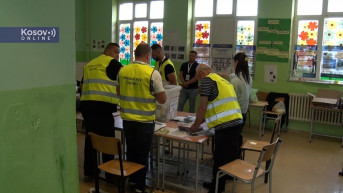
Although final results are still awaited, yesterday’s snap parliamentary elections in Kosovo, the third in the past 16 months, brought fewer votes for the largest Albanian parties than in the elections in December last year. The losses are even more significant when compared with the February 2025 elections. On the other hand, Serbian parties, especially the Serb List, recorded an increase in support.
Even during election day, it was clear that voters would not turn out in large numbers. The Central Election Commission published turnout updates, but in every public address the CEC president noted that the percentages were lower compared to the same period in December.
The data is still not complete, and verification of results by political entities based on forms filled out at polling stations is expected today, but votes from the diaspora and conditional votes are still missing. However, it is already clear that there cannot be major deviations.
According to preliminary results announced last night by CEC president Kreshnik Radoniqi, turnout in Kosovo was 36.33 percent. Turnout in December, which was final, was 47.68 percent, and it is not expected that the final figure will be able to bridge a gap of more than 10 percent.
Due to lower turnout, the four largest Albanian parties suffered losses, and fewer votes will also affect their parliamentary power, meaning the number of mandates.
Self-Determination Movement once again won the most votes, but suffered a significant drop in support. The party, which won around 370,000 votes in February and more than 480,000 in December, currently has less than 300,000 votes according to preliminary data. How much it will improve its result by the end of the counting, and with the support of the diaspora, which is considered its strongest base, will be seen soon, but the result from the December elections for Albin Kurti’s party will remain out of reach.
The Democratic Party of Kosovo still holds second place, but it also lost a significant number of votes. In the February elections it had the support of more than 195,000 voters, while in December that number was a few thousand lower, but based on yesterday’s data the drop in support is significant. With 99.44 percent of polling stations in Kosovo processed, the Democratic Party of Kosovo has just over 146,000 votes.
The Democratic League of Kosovo is in third place, and a downward trend in support is also present there. That party experienced its largest drop between February and December, from just over 170,000 to just over 126,000 votes. According to current data, the Democratic League of Kosovo has won just over 122,000 votes, which still leaves room for it to repeat its December result, something the party would certainly not be satisfied with.
Fourth place will again go to the Alliance for the Future of Kosovo, which has in the meantime changed its name to the Alliance. In the February 9 elections, when it ran in coalition with Nisma, it won just over 66,000 votes, but that result fell to around 52,000 in December when it ran independently. So far, the Alliance has just under 50,000 votes, meaning it may reach its result from six months ago once counting is completed.
When it comes to Serbian parties, the Serb List is recording a steady increase in support. In February it won just under 40,000 votes, in December the result was better at over 42,000 votes, and according to still incomplete data it won more than 43,000 votes in yesterday’s elections.
The Party for Freedom, Justice and Survival, which wins significantly fewer votes than the Serb List, also recorded growth, from just over 4,000 in February to over 5,000 votes at present.
It is still too early to convert votes into parliamentary mandates because the results are not final, but analysts note that some things can already be stated with relative certainty. Based on current projections, Self-Determination would receive 48 seats, the Democratic Party of Kosovo 24, the Democratic League of Kosovo 20, and the Alliance eight seats.
This means the same number of MPs for Self-Determination as in February and fewer than in December, when it had 57.
The same applies to the Democratic Party of Kosovo, the Democratic League of Kosovo, and the Alliance. The Democratic Party of Kosovo also won 24 mandates in February, the Democratic League of Kosovo had 20 MPs then as well, and the Alliance had eight seats, also in coalition with Nisma at the time.
The Serb List has in all three election cycles convincingly finished ahead of the Party for Freedom, Justice and Survival, but in two previous cycles it won nine of the ten mandates reserved for the Serbian community. The reason for this, as the Serb List has repeatedly pointed out, is the fact that the Party for Freedom, Justice and Survival manages to secure one mandate thanks to votes from Albanian-majority areas.


0 comments