
Greif: I do not think that the Serbs can renounce Kosovo
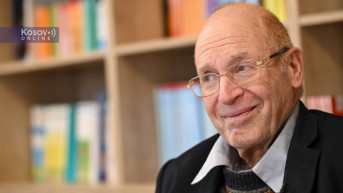
Israeli historian and expert on the Holocaust and war crimes, Gideon Greif, stated in an interview for Kosovo Online that he doubts Serbs could ever renounce Kosovo—and that they should not—because, for them, it holds the same significance as Jerusalem does for Jews: it is the core of the nation.
"If I compare it to the Jewish people, it is like our eternal city, Jerusalem. We say that without Jerusalem, our life is not truly life because it is the heart, the core of our nation. It is the beginning of the beginning, the heart of our tradition, our culture, our history. I do not think that Serbs can renounce Kosovo. I would not give up. I do not want to interfere in your affairs, but I would not give up because it is a part that is so important, so essential. You cannot give up. Never, never," Greif stated.
He expressed concern about the situation of the Serbian community in Kosovo, emphasizing that a solution must be found to put an end to the "terror and threats" they are facing.
"The situation is absolutely not good. Based on what I have heard with my own ears, Serbs there are suffering, and that is unjust. It is an injustice inflicted upon them. This situation cannot continue. I do not have a solution, but a solution must be found so that Serbian citizens can live in peace, without being subjected to terror or threats. This is certainly not a good situation—not at all—and I am truly concerned about it. It needs to change," Greif said.
As a Holocaust and war crimes expert, Greif has spent the past decade actively studying historical events related to the Balkans, both recent and distant.
He expressed sadness over the fact that the Serbian people have been "accused of absurd things" and emphasized that Serbs and Jews share a similar history of "suffering."
"I am proud to be a friend of the Serbs, who have suffered so much. You may know that our histories—the histories of Serbs and Jews—are very, very similar. They are histories of suffering, bloodshed, prejudice, false and fabricated accusations… We deserve a much better image in the world. And I feel sad for the Serbian people, who have been accused of truly absurd things, and I wish them all the best. When I came to Belgrade 12 years ago, I remember that from the very first minute, I fell in love with Serbia and the Serbian people. I am being very honest with you—I am telling you, I fell in love with Serbia," Greif concluded.
He is convinced that it is possible for the "ghosts of the past" to stop haunting the nations of the region and for them to turn toward the future. However, this would require overcoming many hostilities, prejudices, and feelings of hatred.
"This requires motivation. Without it, nothing will happen. That is why you must develop a kind of motivation that will take time—people will have to start talking to each other. But in the end, everything depends on the people. Without goodwill, nothing will be possible," Greif stated.
When asked whether reconciliation is possible between Serbs and Albanians, Greif expressed confidence that it would depend entirely on the goodwill of both nations.
"If you have goodwill, I believe you can overcome most problems—maybe not all of them. But in life, nothing is perfect. There is no perfect situation, but even achieving 80 percent or 90 percent is a good result. And I believe you can accomplish that. What is needed is goodwill, a good heart, and strong motivation. That is enough," the historian noted.
Greif participated in a scientific conference in Belgrade marking 80 years since the end of World War II.
When asked how much the world has "learned its lesson," he expressed concern that history continues to repeat the same mistakes that lead to bloodshed and wars.
"You see, we, especially in our private lives, tend to repeat the same mistakes over and over again. And there must be a strong reason for us to stop, reflect, come up with new ideas, and change our bad habits. The same applies to nations. They repeat old mistakes that lead only to bloodshed, conflicts, and wars, and they find it very difficult to change bad patterns," Greif said.
Nevertheless, he remains optimistic that change is possible.
"You need motivation to change. If you do not have motivation, you will never change. You will keep repeating conflicts, hatreds, prejudices, and harmful actions. There must be motivation and a desire to make this world a little better," Greif emphasized.
He believes this could be achieved with Donald Trump and Vladimir Putin as the leaders of the two most powerful nations, the United States and Russia.
"It is possible. I see that new opportunities are opening up now with these two great leaders—bold individuals with a strong vision. That is why I believe there is a chance. Of course, we are not prophets; we do not know what may happen. But a new opportunity has emerged, and perhaps this is a turning point for humanity—to start living in a better world. Personally, I believe that. As you can see, I draw comparisons between private life and the life of nations because I believe it is possible to make life better. The key is not to overcomplicate small things. Most problems are easy to solve, but people tend to complicate them unnecessarily. The same goes for nations. If the world is made more peaceful and simpler, everything will become more successful. That is my belief," Greif concluded.

0 comments