
Petritsch: Kurti lacks a culture of compromise, hence the crisis in Kosovo and stalemate in Dialogue
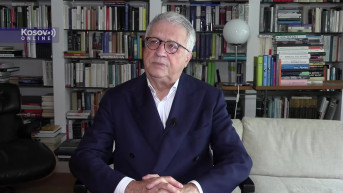
Albin Kurti, Kosovo’s acting Prime Minister and leader of the Self-Determination Movement (Vetëvendosje), lacks a culture of compromise, which is why Kosovo is facing an institutional crisis and why the dialogue with Serbia has stalled, stated Wolfgang Petritsch, former EU Special Envoy for Kosovo and former High Representative of the international community in Bosnia and Herzegovina.
In an interview with Kosovo Online, Petritsch emphasized that the prerequisite for successful normalization of relations and dialogue with Serbia is first the establishment of internal dialogue within Kosovo, ideally also with Kosovo Serbs.
Regarding the construction of two new bridges on the Ibar River, Petritsch said that if they are built unilaterally without, metaphorically speaking, a “pillar on the Serbian side,” they will not help much. He advised cooperative rather than unilateral action.
Speaking about the UN Charter, he noted that the 1999 NATO intervention had far more negative consequences than was initially thought. He also stated that the UN is in a fundamental crisis, because everything proposed and implemented by the U.S. and Europe since 1945 is now being called into question—by the U.S. itself.
On the political crisis in Kosovo and 49 failed parliamentary sessions:
“Kosovo is in a genuine political and governance crisis. It’s clear that the winner of the February elections is unwilling to compromise with opposition parties, insisting uncompromisingly on a single candidate for the Assembly President. This is a blatant lack of democratic understanding. Democracy also means, as in Kurti’s case—if you win over 40% of the vote, you still must make compromises. That culture of compromise is missing. I believe this is also the reason for the stagnation in the dialogue with Serbia. It reinforces the feeling that everything in Kosovo is at a standstill, while massive political and economic changes are happening all around the world.”
Does Kurti want new elections since he didn’t win an absolute majority in February?
“I recently participated in an international conference in Pristina, organized by a Geneva-based institute that has been working for years to mediate in Kosovo. People from the north also took part. The organizers arranged a meeting with Kurti, during which I asked him why he couldn’t try to find a compromise in the spirit of European democracy. I asked how he interacts with opposition leaders. He said—there is no dialogue. That’s unacceptable. The prerequisite for successful normalization and dialogue with Serbia is first to establish internal dialogue in Kosovo, ideally with Kosovo Serbs as well.”
What does the current crisis mean for Kosovo’s Euro-Atlantic integration?
“I see no progress. There’s the uncertainty of Washington and Trump’s administration, which was highly engaged in its first term. There are anti-American tendencies within Vetëvendosje. Trump hasn’t been active in his second term. I don’t think that’s necessarily bad. I believe the EU should push forward normalization with Serbia and urge Pristina to launch a genuine internal political process. Kosovo continues to suffer from emigration and a lack of investment—meaning the country is regressing, not progressing. That’s bad for Kosovo, Serbia, and the entire region. The EU has appointed Peter Sørensen as the new envoy for dialogue—he’s a seasoned diplomat. I’ve heard little about what’s being done. I hope he’s preparing seriously. In the past, especially due to Kurti’s intransigence, there’s been no progress—unlike during Hashim Thaçi’s time, when there was pragmatic understanding between him and Aleksandar Vucic. That’s missing now, and I find that concerning.”
Despite talks, dialogue hasn't restarted. What's the biggest obstacle?
“I assume Sørensen is considering restructuring the dialogue process, given the lack of progress in recent years. That would be necessary. Much was achieved over the past 10 years. Now, everything hinges on the Association of Serb-majority Municipalities, which Pristina refuses to implement. More cooperation is essential; otherwise, this could become a conflict vulnerable to negative external influence—by Russia, China, some Arab states, or Turkey. That would be bad for Serbia, Kosovo, and Europe. Ultimately, we want the Western Balkans to integrate into the EU. I see progress in Montenegro, but not elsewhere.”
Kurti opposes the Association and announced two new bridges in Mitrovica. What’s the meaning of this decision?
“Generally, building bridges is symbolically positive. But if it’s unilateral, without a symbolic pillar on the Serbian side, the bridge won’t achieve much. That worries me. I don’t know the details, but it’s essential to act cooperatively—not unilaterally.”
Is this more of a campaign move by Kurti, and could it escalate tensions in the north?
“Upcoming elections certainly play a role. That’s common in politics—leaders trying to show voters they are doing something. That’s not necessarily bad, but it must not be done against the will of part of the population. What I truly miss—and I told Kurti this—is that he doesn’t speak to those not yet convinced. Only then will normalization succeed. The government, representing the majority, must reach out to minorities—especially in the north. That’s key to regional peace. The two major unresolved conflicts from the Yugoslav era—Kosovo and Bosnia—need more serious attention. Serbia is central to resolving both.”
Trump recently claimed he prevented a Kosovo-Serbia war. What’s your view?
“Trump often makes grand statements, which are unreliable. Today’s statement may not hold tomorrow. Just like his promise to end the Ukraine war in a day—it’s unrealistic. The conflict between Kosovo Albanians and Serbs is too complex and historically deep to be resolved overnight. Long-term commitment is needed. It won’t succeed without Belgrade, without Pristina, and most importantly—without the people in the north of Kosovo. That’s the key prerequisite. Once accepted, progress will follow, as it did in the first 10 years of dialogue. Now we need a reset—review what worked, identify what didn’t. The top priority must be implementing the Association of Serb-majority Municipalities. Then negotiations must become more consistent, not sporadic. Meetings shouldn’t only be in Brussels—but also in Pristina, Mitrovica, or Belgrade, to find a real, citizen-focused solution on the ground.”
In his first term, Trump brokered the Washington Agreement, focused on economic ties. Can economic cooperation foster normalization?
“I believe the economic approach is valid, but must be paired with a political process to address unresolved status issues and normalization. For years, I’ve advocated for a cross-border economic zone—a free trade area—to intensify the strong economic ties between Serbs and Albanians in shared regions. Economic progress could bring political solutions closer.”
In today’s geopolitics, can the U.S. still focus on Serbia and Kosovo?
“Everything involving Trump is a mystery—it’s unpredictable. I believe this is primarily a European issue and should be resolved by Europe. You can see the U.S., via NATO, distancing itself from Europe. In security matters, Europe can no longer count on the American umbrella. The Western Balkans must integrate into the EU more rapidly—especially Serbia, as the region’s largest country. A few years ago, I wrote a book titled Serbia is Relevant. Serbia is indeed crucial—not only to resolving problems, but also to achieving political and economic progress. In an expanded EU, Serbia would play a decisive regional role. We must focus on positive opportunities, not conflict-ridden history. What unites us is far more than what divides us.”
UN Charter’s 80th anniversary—does it still hold relevance amid today’s global changes?
“The UN is in a fundamental crisis. Everything implemented after 1945—mainly by the U.S. and Europe—is now being challenged by the very same U.S. That’s a key challenge. The EU is built on values of cooperation, equality, transparency, rule of law—but these are now being questioned by the Trump administration. Europe is in an existential crisis. Global system changes are affecting Europe the hardest. We must reflect on this—especially in the Western Balkans. The region should not be part of the problem for Europe, but part of the solution.”
Serbia has always claimed the 1999 NATO intervention violated the UN Charter and led to today’s crises. How do you see that now?
“It’s undoubtedly a problem. The 1999 NATO intervention had more negative consequences than initially assumed. Back then, the U.S. was at its global power peak and believed it could do anything. That proved wrong and problematic. While we can’t change the past, we must acknowledge other UN Charter violations—Vietnam, Soviet invasions of Czechoslovakia and Hungary. Great powers have always tried to impose their rules. Europe must now, in its own interest, stick to the rules we set and not yield. All breaches of international law—Ukraine, Gaza—must be addressed. Otherwise, we weaken the European model of living.”
How do you view Serbia’s foreign policy that insists on respecting the UN Charter and international law?
“I believe that’s the right stance. Belgrade is aligned with the EU here. It shows that Serbia is a European country and understands that rules must be followed. Especially now, when progress on EU accession is minimal, Serbia needs renewed momentum.”
Can such a policy survive under the pressure from great powers pushing smaller states to align?
“I believe that Belgrade, with its policy of non-alignment and the historical legacy of Yugoslavia, must be particularly careful with priorities. The long-term priority must remain EU membership. It’s reasonable to maintain ties with other powers—Russia, China—but the goal must be clear, as President Vucic often emphasizes: membership in the European Union.”
How do you assess the defense cooperation agreement between Albania, Croatia, and Kosovo?
“I wouldn’t overestimate its relevance. It’s a political initiative—I don’t know its origin. But if the goal is more security for the Western Balkans, which is definitely needed, then everyone must be involved. Especially Serbia—as the most important country in the region—must be part of it.”
0 comments