
Disregard for international law is an introduction to a new world war

Writing for Kosovo Online: Zeljko Sain, Politika's special correspondent from Skopje
Kosovo and Metohija, Ukraine, and Gaza are three central military areas that clearly reflect the lines of global conflicts and military and political aspirations. We cannot assert that the world is roaring with a general global war, but we can agree with the statement of Pope Francis, as reminded by Cardinal Pietro Parolin, the Secretary of State of the Vatican, who said to "Politika" back in 2019 that we are witnessing the third world war in fragments.
Indeed, if we compare today's situation with the Second World War when the Nazis were genocidally destroying the Slavs, Jews, and Roma people, wherever they were on the globe – unfortunately, the similarity is evident. These three territories have the same composition of the population that Hitler himself attacked. In Ukraine, Russians and Ukrainians are in conflict, in Israel Palestinians and Jews, in Kosovo and Metohija, Albanians and Serbs. Of course, in all three areas, we have the same division of the world: on one side, the United States and the NATO bloc support Ukraine, Kosovo (Albanians), and Israel (Jews), and against them are the Russian Federation, China, India, South Africa, and the Muslim world.
Turkey, as a member of the North Atlantic Alliance, is trying to establish peace through diplomatic activities, but by breaking out a new conflict in Israel, it completely opposed all those who sided with Israel and considered Hamas a terrorist organization. At one point, even Blinken, the US Secretary of State, in India, distanced himself from Netanyahu's attacks on the Palestinian civilian population.
The same US that recognized Kosovo as an independent state has slowed down its political pressures on Belgrade and insists on implementing the Brussels Agreement with the Ohrid Annex. European countries, except Germany, which aggressively insists on Kosovo's recognition by official Belgrade, have taken a similar stance. President of the Republic of Serbia, Aleksandar Vucic, emphasized multiple times that it was impossible while he was at the helm of Serbia. The pressures facing Serbia have a clear goal – to provoke unrest, as happened in Banjska, and their culmination to open the doors to German "AWACS" in NATO aviation society, as in 1999 when Yugoslavia was bombed, and to completely destroy Serbia.
However, the Paris Peace Forum, titled "Seeking a Common Ground in a World of Rivalry", which brought together representatives of international organizations and leaders of states, including President Aleksandar Vucic, is dedicated to the greatest challenges of today and finding effective responses to the most urgent global problems, such as the war in Ukraine and the conflict between Israel and Hamas in the Middle East. The French President emphasized at the opening of the forum that there was global division regarding numerous challenges and that the forum was designed with the idea of following four principles: preserving the planet, the right to the sovereignty of each state, economic development, and complementarity. Such a stance is unlikely to please Germany, especially concerning respect for state sovereignty and complementarity.
While Germany advocated territorial integrity until reunification, as evidenced by the latest UN Assembly, where German Foreign Minister Annalena Baerbock emphasized in her speech how Germany respected the UN Charter and the territorial integrity of each country, it seems that Hitler's policy of international treaties lasting only as long as it serves German interests has been revived. After reunification, this country began to act as if it had paid all the debts for the crimes committed by Nazi Germany worldwide against the Slavs, Jews, and Roma people, and that, through economic investments, they have the right to political pressure, even using the military.
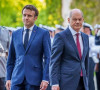
German Chancellor Scholz, recently excitedly commented that Germany's participation in the bombing of the Federal Republic of Yugoslavia and the war in Ukraine was the beginning of a new era for his country. Does this mean that the interests arising from international law are no longer valid for Germany and that a new era of disrespect for international law has indeed begun for the chancellor and his country?
Germany's participation in the aggression against the Federal Republic of Yugoslavia was contrary to the UN Charter and Germany's Basic Law, i.e., the Constitution of Germany. Such a decision by the allies of World War II, whether accidental or intentional, after the fall of the Berlin Wall and the end of the Cold War, opened the door wide to a third world war and bypassed the UN decision and the UN Charter.
Franco-German proposals for resolving issues between Belgrade and Pristina, Skopje and Sofia, fuel conflicts in the Western Balkans, perhaps on a larger scale than the Minsk Agreements, which were not implemented and served only as preparation for Ukraine's war with Russia, as confirmed by former German Chancellor Angela Merkel and former French President Hollande. With their actions, they significantly undermine the sovereignty of these countries. North Macedonia is conditioned to urgently change its Constitution again, or it will face international isolation, and Belgrade is required to recognize the independence of Kosovo.
If France wakes up and can see the consequences of the path Germany has led them on since the end of the Cold War, it is time for them to soberly define their role in Europe, and above all, to reason with Germany and not allow it to hypocritically violate international law and stir up a warlike conquest. Therefore, it is up to Macron to take action that will prevent the outbreak of a new world war, in which Serbia, with its neutral military policy and the appreciation it receives from China, Russia, Brazil, and India, as well as its significant historical contributions during World War II, can play a significant role. It was Yugoslavia's strong military liberation movement that enabled the defeat of the Nazi trio: Germany, Italy, and Japan, leading to the victory of the Allied forces. However, France and those same Allied forces seem to have forgotten Serbia's role and that this country was never the homeland of a genocidal nation. On the other hand, it is very clear which nation has a warlike conquest in its genes and a manner of disrespect for international law.
Therefore, although a small country, Serbia can help France return to the right path in relations with the United States, the Russian Federation, China, India, and Turkey through its diplomatic activities.
0 comments