
FEUILLETON 25 years of NATO bombing of Serbia (18): Clinton's unfulfilled promises, Handke in Belgrade, and the Easter bombing
Written for Kosovo Online by Dragan Bisenic
Strobe Talbott, in his book "The Russian Hand," presented an account of these events from his perspective, viewed through a Russian lens.
By the time he was already in Belgrade, on March 22nd, Russian Prime Minister Yevgeny Primakov took off from a Moscow airport heading to Washington. This meeting with Al Gore was long anticipated, within the framework of a joint commission. The Russians, who had given up on blocking the bombings, demanded a delay of the military action until Primakov concluded his visit to Washington.
"I was in constant contact with Dick in Belgrade. We spoke over an open phone line, so, in addition to updating me on the progress of his negotiations, we could send messages to the Serbs and Russians who were undoubtedly eavesdropping.
- Strobe, I assume you agree - Dick said loudly in a special kind of English - that we won’t let Primakov’s visit deflect us from our path or delay what we’ve intended.
- Absolutely, Dick - I responded, exaggerating my pronunciation equally - that’s the consensus here.
- Good. But, if Milosevic accepts all terms of the Rambouillet Agreement, we’ll still blast him with bombings unless he ‘pulls the handbrake,’ stops, and withdraws from Kosovo. The crimes he continues to commit there are enough for us to start bombing.
Milosevic remained defiant, and Dick headed to the airport. As his plane took off, I called our charge d'affaires in Belgrade, Richard Miles, and officially instructed him to burn confidential documents at the embassy, pack up, and disappear. I first met Miles in Belgrade nearly thirty years ago, when he was a junior embassy official; Brooke and I lived a few blocks away.
We briefly discussed how all of this was sad, but necessary. I asked him to thank and wish luck to the Yugoslav employees of the embassy, many of whom had faithfully worked there for decades.
Primakov was also en route to us. Gore caught him on the plane and informed him by phone that – since Dick is returning empty-handed from Belgrade – there was no reason to delay military action. NATO had no choice but to bomb.
- Blood drips from Milosevic's hands - Gore said - every goddamn day he used to kill innocent people, women, and children.
Primakov responded that NATO would be the one with blood on its hands, and all of this would have a devastating impact on US-Russian relations. Therefore, he ordered his plane to turn around and return to Moscow.
On March 24th, Clinton called Yeltsin; he tried to divert the Russian president's anger from the United States to Milosevic, calling him a pygmy who stood between two giants.
- He is also the last communist dictator - Clinton said - a type whom, regardless of reputation, Yeltsin, as is well known, despised.
It didn’t work.
Throughout the conversation, Clinton was never addressed as Bill or "my friend." Before hanging up, Yeltsin even referred to him in the third person.
- Well - he said - obviously, I haven’t managed to convince the President of the United States. Goodbye!
After Yeltsin hung up, Clinton held the receiver for a moment longer. He seemed deeply affected. He had witnessed Yeltsin's fury before but let it blow over, knowing it would soon pass. This time, he felt, "something fundamentally broke and it will take a lot to repair."
Within hours, American cruise missiles launched from warships in the Adriatic hit Serbian air defense radars and missile bases - marking the beginning of NATO's first military operation since its inception half a century ago, Talbot describes.
Despite everything, even during those first days of bombing, it was evident that the Russian government didn’t want to demolish what had been achieved with NATO over the previous years or sever all ties with the West.
"We must, somehow, somehow, maintain diplomatic relations," Ivanov told Secretary of State Madeleine Albright.
On March 24th, Clinton addressed the American people. In his memoirs, he wrote that he reiterated "Milosevic had stripped the Kosovars of their autonomy, denying them constitutionally guaranteed rights to speak their language, run their schools, and govern themselves." "I described the Serbian crimes: killing civilians, burning villages, and driving people from their homes, sixty thousand in the last five weeks, a total of a quarter million. Finally, I put the current events in the context of the wars Milosevic had already waged against Bosnia and Croatia and the destructive impact of his murder on the future of Europe," Clinton noted.
Clinton stated that the bombing operation had three objectives: "to show Milosevic we were serious about stopping another round of ethnic cleansing, to deter an even bloodier offensive against innocent civilians in Kosovo, and, if Milosevic does not throw in the towel soon, to seriously degrade the Serbian military capabilities."
"That night, NATO air strikes began. They would last eleven weeks, while Milosevic continued to kill Kosovo Albanians and drive nearly a million people from their homes. The bombs would cause significant damage to Serbia's military and economic infrastructure. Alas, on several occasions, they missed their intended targets and took the lives of people we were trying to protect," Clinton summarized.
In his address the following day, as if he hadn’t said everything in his first speech, Clinton specifically addressed "the Serbian people." Explaining the reasons for the bombing to "the Serbian people," Clinton said that the U.S. and European allies were not "in conflict with the Serbian people." "Our history is honored by the contributions of Serbian families who came to America to start a new life. But our shared future is endangered by a war that threatens peace in Europe and the lives of thousands of innocent people in Kosovo," Clinton said.
He then called for attention to be shifted "from history" to events in "the last 10 years." He blamed Slobodan Milosevic for the troubles facing the Serbian people and, in his assessment of events in Kosovo, reversed the emphasis, saying it was not just a fight against armed Kosovo forces but also an operation of violence" against "unarmed civilians." Then, he said something that many in Serbia used to justify the bombing and even the effort to remove Milosevic from power. "NATO allies support the Serbian people's desire to keep Kosovo as part of your country. We insisted on this with our Russian partners in peace negotiations in France. The result was a fair and balanced agreement that would guarantee the rights of all people in Kosovo -- ethnic Serbs and Albanians alike, within Serbia," the American president said. Today, 25 years after his words, it turns out that one cannot trust even American presidents, not even Clinton himself, who seemed to sincerely mean what he said. Subsequent American presidents not only disregarded Clinton's words and promises but went so far as to reject even what the U.S. had accepted and guaranteed in treaties or UN Security Council Resolution 1244. In the case of Kosovo, that is UN Security Council Resolution 1244.
Later, President Clinton reiterated that the goal was to establish peace, "by preserving Kosovo within Serbia while guaranteeing the rights of its people under your law, Serbia will sooner join the rest of Europe and build a nation that gives all its citizens a voice and a chance for prosperity." Clinton emphasized: "Each of us has ties to Serbia. Each respects the dignity and courage of the Serbian people." "I call on all Serbs and all people of goodwill to join us in seeking an end to this unnecessary and avoidable conflict. Instead, let's work together to return Serbia to its rightful place as a great nation of Europe; included, not isolated, by the international community; respected by all peoples for having the strength to build peace."
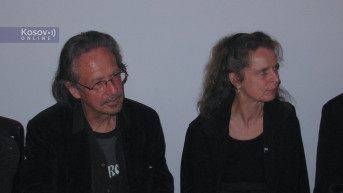
A few days after his return, just in time for Catholic Easter on April 4th, Peter Handke arrived in Belgrade. As announced, Handke appeared in Belgrade when the bombing began. "Everyone expected the bombing to start, but when it actually happened, it was like fiction, as if it wasn't real... But it became real! I remember everything. I was on the street, the wind was blowing, and there was some silence all around... Maybe it wasn't actually quiet, but in a strange way - there was a dreadful silence," Handke said. Before coming, he once again stirred up Germany and provoked strong reactions after a brief message in which he supported Yugoslavia and condemned the NATO aggression.
We were at lunch, and then we went to Republic Square, on a beautiful, sunny day, where people gathered for demonstrations. Handke had previously listened with a look of disgust to my story of staying in Berlin, with all the encounters there, from Blair, Schröder, to Monica Lewinsky.
"Now, for the first time, I would like to live to be 90 years old. To live and write down everything that happens to the Serbs. Serbs are the new Jews undergoing a new holocaust, and I would like them, like the Jews, and I with them, to write down every word, every declaration that the media of the new Nazism publish," Handke said as he left Belgrade after a short visit (from Wednesday to Friday last week). With a few friends, he toured Belgrade and the people demonstrating in the city center. "Like Hitler, NATO is in love with its own death," he adds.
As announced, Handke appeared in Belgrade with his friend Zlatko when the bombing began. Before arriving in Belgrade, Handke once again stirred up Germany and provoked strong reactions after a brief message in which he supported Yugoslavia and condemned the NATO aggression. "After the NATO attacks, the planet is now called Yugoslavia. Jerusalem, Jericho, London, Paris, and of course Berlin and Washington will be part of Yugoslavia... For all of us who have not become Martians, Yugoslavia is our homeland," Handke wrote.
"Our" to "ours"
Among the first to respond was Sarajevo publicist Dževad Karahasan, who disclosed that he had never been able to read Handke's works "which have been boring and pretentiously silly for years." Karahasan thus aligned himself with Susan Sontag, who on the same occasion stated that "many writers in New York who previously eagerly read Handke, promise never to pick up any of his books again." Milo Dor, now an Austrian writer, previously Milutin Doroslovac, concluded that Handke "mixed everything up because he doesn't understand politics at all." The most miserable behavior came from Slovenian "philosopher" Slavoj Žižek. To criticize Handke, Žižek took ideas from a book published a year before the bombing without once indicating whose ideas they were, that is, they belonged to Vesna Goldsworthy (previously Bjelogrlic) and had just been published in the book "Inventing Ruritania" (Yale University Press). The book analyzes the "imaginative imperialism" of British writers towards the Balkans. Žižek copied the introduction and published it as his own text.
On Handke's side stood his publisher, the owner of one of the largest publishing houses in Europe, Frankfurt's "Suhrkamp" - Siegfried Unseld. "As a publisher, I believe that in a free country, everyone is free to express their opinion, whether it's a novel or a drama," he says. The weekly magazine "Der Spiegel" sharply criticized Handke, with the allusion that he would not go to Serbia as he promised in his message. Although he knew that Handke would definitely head to Belgrade, Siegfried Unseld did not want to reveal this to journalists.
That he would come to Belgrade if it were bombed, Handke said back in October of the previous year, when he was in the Yugoslav capital while the bombing was only a threat, when the "activation order" was issued, and when the results of talks between President Milosevic and Richard Holbrooke were awaited. When NATO threatened to bomb Serbia in 1998, Handke headed to Belgrade.
- My place is in Serbia, if NATO criminal bombs fall - he said.
At a dinner hosted on October 11th by the then Austrian ambassador and EU envoy for Kosovo, Wolfgang Petritsch, listening to many criticisms of Serbian policy, Handke irritably shouted to the host: "Leave these people alone. Drink good beer and look at beautiful women. This is their country, not yours," to conclude: "International community? The very word sounds like a crime."
Petritsch later wrote that the next day, at a meeting with Milosevic, he said that Handke had been at his place the previous evening and that Handke had requested that everything end peacefully and without bombing.
Respect for the Writer
Setting off to Belgrade this time, Handke seriously said that the trip had a goal of "visiting two old women," the mother of his translator and the mother of his friend Zlatko with whom he traveled. He didn't want to give an interview to anyone because of this, except for a short statement to "Politika" and a brief comment during a chance encounter with Radovan Brankovic on the streets of Belgrade. I would sometimes like to be a Serbian Orthodox monk fighting for Kosovo - he said, as reported by The Guardian.
It would never be said that young people in Belgrade would approach a writer with so much respect, asking for his autograph, as if he were a soccer player, tennis player, or rock star. Holding in his hand a just-arrived NIN magazine, Handke patiently greeted passers-by, mostly young people, signing caps and papers with a drawn target, the symbol at the time meant to mark everyone wearing it as a target for NATO bombs. Handke himself bought several such gags from street vendors. He soon left Belgrade for Borodino, then to Bucharest, since a bridge in Novi Sad had already been destroyed and it was not possible to continue via Budapest.
Before arriving in Belgrade, Handke had left the Catholic Church, dissatisfied with its stance on the bombing of Yugoslavia, but he was in Belgrade for Catholic Easter.
Meanwhile, at NATO Command, General Clark and Javier Solana discussed Easter. Solana posed the question of whether the bombing would be over by Easter. Clark could not promise that everything would be finished so quickly.
The immediate question was the prospect of a bombing pause. Clark pleaded: "Please, don’t let that happen." Solana listened, then explained that the Pope would speak on Wednesday, before Easter, and would call for a halt to the strikes. The Secretary-General was very concerned. "I asked how the Pope could do such a thing while Serbian operations were ongoing. Can someone explain this to the Vatican?" Clark wondered.
"You don’t understand the impact it will have," Solana said. "When the Pope speaks, people and governments listen. They will see this as very difficult. Try to think like a Catholic from Southeast Europe."
"I am a Catholic," I protested, half-joking. He knew this very well, as we often talked about our religious views.
"Then you're probably not a good Catholic," Solana retorted, laughing a bit because of the absurd position we found ourselves in, fighting in an operation for moral and humanitarian goals and defending our freedom of action against Christian values," Clark recorded.
Easter Bombing
The Patriarch of the Serbian Orthodox Church, Pavle, on April 10th, in his Easter letter, condemned the NATO bombing of Yugoslavia. For Orthodox Easter on Sunday, April 11th, Patriarch Pavle stated that the brutal aggression of NATO was morally condemnable. "NATO has caused suffering and destruction with the endlessly cynical explanation that it wants to prevent a ‘humanitarian catastrophe.’ The logic of NATO's force means only tragedy for the Serbian people and all other ethnic communities in Kosovo and Metohija," said Patriarch Pavle. "All proposals from lawyers and the esteemed effort must be respected. They contribute to a free and peaceful life for either the Serbian people in Kosovo and Metohija or equally for Albanians and other groups.
The Serbian Orthodox Church announced that many old monasteries and churches in Kosovo and other regions of Yugoslavia were damaged after bombing nearby facilities.
The NATO bombing of Yugoslavia provoked similar words of condemnation from other religious leaders in Belgrade. Thus, Catholic Archbishop France Perko condemned NATO and proposed a suspension of operations during Easter. The Yugoslav Army declared a unilateral ceasefire in honor of Easter.
NATO's spokesperson's statement also prompted a reaction from the Muslim leader, Hamdija Jusufspahic. The Sheikh said that in the sound of American bombers, Albanians recognized the "sound of angels." "There are no songs, no angels. Such a thing could not have been said by a religious man, because he would not and could not celebrate the suffering of other people."
Jusufspahic said that "the West has pushed Albanians against Serbs who have lived together for centuries," but "this game is against the Albanians, not in their favor," emphasized the Muslim leader. "Albanians will be refugees around the world," Jusufspahic warned.
He explained that "Americans have never pursued a policy in favor of Muslim countries." "They are not just bombing the Serbian people, as they said. They are bombing all people, regardless of religion and nationality," said the Belgrade mufti Jusufspahic. "We should see what these Americans are doing in Palestine, how they target civilian parts of cities and shelters in Iraq, their behavior in Somalia, or attacks on the Libyan leader Gaddafi in his home. The breakup of the former Yugoslavia is part of such a Western policy because 6 million Muslims lived in the former Yugoslavia," he concluded.
Religious organizations sought to play an active role in seeking a political and diplomatic solution to the existing situation. A high delegation of the Community of Sant'Egidio, led by Monsignor Vincenzo Paglia, visited Belgrade on Thursday, April 8th. Sant'Egidio had played a key mediating role in previous years in signing agreements between President Milosevic and Ibrahim Rugova on normalizing the education process and other areas of life. This was the first document signed between both sides. Regarding the latest visit of the Community of Sant'Egidio to Belgrade, only protocol news was published. While the delegation worked on the education agreement, we were in very frequent contact.
Based on current activities, there are indications that Sant'Egidio may play a similar role in potential negotiations between the two sides. Kosovo Albanian leader Ibrahim Rugova intensified his political activities. On Friday, he met with two vice presidents of the Serbian and federal government, Ratko Markovic (head of the Serbian delegation at the meeting in Rambouillet) and Nikola Sainovic. A brief statement announced that there was talk of a "possible continuation of the peace process." This was Rugova's fourth public appearance since the start of NATO attacks on Yugoslavia.

0 comments