
FEUILLETON 25 years of NATO bombing of Serbia (6): Biden against the independence of Kosovo and "Greater Albania"
Writing for Kosovo Online: Dragan Bisenic
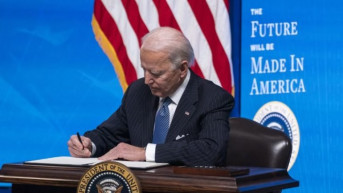
Biden recalled a letter he received from American Albanians, the contents of which directed his attention to a dimension of the Kosovo issue that he did not like. "There's one letter I received, and it states the following: a national issue that calls for the liberation of occupied Albanian lands, national identity, and self-determination. Now, that sounds to me like Greater Albania. If we start with this assertion, that these are occupied Albanian lands, I'm not sure where all of this leads. In fact, I'm pretty sure where all of this is going," Biden concluded, posing the question of the "administration's understanding" of this plan, namely for "Greater Albania"?
Gelbard reiterated that the administration "does not accept the idea of Greater Albania." "We respect the territorial integrity, as I said earlier, of Yugoslavia, just as we do with Albania and Macedonia," Gelbard said.
Responding to Senator Biden's inquiry about the status of the KLA, Gelbard stated that it was a "small group" that did not have "broad support," but its significance had increased "in Kosovo and worldwide because the Yugoslav Government resolved it in the worst possible way."
"Everything we know about counter-insurgency theory, doctrine, policy, goes 180 degrees in the opposite direction of how they are handling it, whether it's militarily, politically, economically, socially. The government is playing into the hands of the KLA, and I have to wonder, in my pessimistic mood, whether there is some kind of internal alliance between the two sides that wants to polarize the situation and weaken the moderate leadership of Dr. Rugova and others in Kosovo.
But as a result of what happened, especially since February, I believe the KLA has gained dramatically greater support both within and outside Kosovo. We've seen a huge increase in terms of the influx of people, weapons, and money, and now the problem is creating conditions in which we can have serious, legitimate negotiations between the two sides to try to urgently resolve this to achieve a serious political result," Gelbard stated.
Biden returned to the question of Kosovo's future status. "Woodrow Wilson is dead, but his idea is not at all," he said, referring to the issue of self-determination. He warned against drawing the "wrong message" from opposing Slobodan Milosevic's policy. "I think some people read the wrong message into that, that it means we believe there should be an independent Kosovo, or some changed statuses in terms of sovereignty within Yugoslavia, and it seems that - I just hope the message is not the one we want to convey. It would be a wrong interpretation of our aversion to Milosevic and his policy to conclude that I think there should be an independent Kosovo. I think autonomy — I think status, before the collapse of the great Yugoslavia, is important. We need to participate in providing a forum, or at least indirectly through the Contact Group, to change the behavior on the part of Belgrade. Again, I suggest that one thing that will probably diminish any consensus around that effort would be if that statement I read is seen as policy, a national issue calling for the liberation of occupied Albanian lands, national identity, and self-determination," Biden pointed out.
The NATO Council on May 24th and 25th, 1998, adopted a decision in Lisbon that it was essential to initiate an operation to "stabilize Kosovo and Metohija and the borders of the FR Yugoslavia towards neighboring countries." Member states of NATO were ordered to begin preparations for military intervention. The NATO Ministerial Council supported the military intervention, and the NATO Military Committee was tasked with preparing a plan. Forces were ordered to be deployed in Albania. In the further procedure, the imposition of an ultimatum on the Serbian leadership was envisaged. If not fulfilled, operations for a no-fly zone would be established. Imposing a "no-fly zone" is a textbook step preceding military intervention. After that, an expert team was formed with the aim of bringing in ground forces. They concluded that the objective could be achieved through an air operation, and a landing operation would be very risky. The United States was not prepared to participate with its ground forces, and Germany did not have the constitutional authority to deploy its soldiers. It was calculated that 170,000 soldiers would be needed for a ground operation.
The NATO command is also troubled by the legal framework. For NATO to carry out an attack, one country in the alliance needs to be threatened, and the others need to defend it. They need to enter the land and airspace of that country!? They considered various options. In June, the objectives were defined: radar systems, missile systems, 80 anti-aircraft defense positions, 240 aircraft, and destruction of hydro system factories...
By the end of June, NATO planners narrowed down military options in Kosovo to a shortlist of alternatives involving the use of air forces over Serbia, the Pentagon announced on June 26th. Pentagon spokesman Kenneth Bacon stated that it would take "at least another week for NATO plans to be completed as allies try to figure out a 'seamless link' between political and diplomatic goals and military options."
"I think the central element of current thinking is how to ensure that any military action is in line with political objectives," Bacon said. According to him, the NATO Military Committee presented the Alliance Council with a shortlist that week, retaining between two and four options from the original list of nine.
"This includes options over Serbia," Bacon said, later adding that "what is primarily sought is the use of air power." NATO planners also sought the deployment of their troops in Macedonia and Albania, Bacon added. He did not provide any details of the options at that time, but disruption of Serbian communications and large-scale air attacks on the Federal Republic of Yugoslavia were mentioned.
When asked if these options meet the Pentagon's requirement that any air campaign must include preventing Yugoslav air defenses, Bacon suggested an affirmative response. "Work on the details of these options is still ongoing," he said. "It is clear to us that we must be able to explore and respond to any threat that could endanger American or NATO aircraft flying over Kosovo," the Pentagon spokesman specified. Objectives were adopted in August. A plan for missile and air strikes was drawn up.
In mid-September, the NATO Council continues with more aggressive preparations for an attack. There is speculation about the date. To gain support from the international community for the necessity of intervention, a group of experts is sent to Kosovo to conduct a survey. Preparations are made to clear a part of the terrain. A meeting of NATO countries and members of the "Partnership for Peace" is convened. Diplomats are present there. They are presented with data indicating that the humanitarian catastrophe has reached unprecedented proportions and that 626 villages have been destroyed in Metohija, where 90 percent of the population lacks housing conditions. In terms of family estates, allegedly 224,000 houses have been destroyed. These facts, presented by NATO experts at the meeting, were sufficient to obtain an alibi for the attack and gather enough core support.
Robert Gelbard confirmed on July 6th in London that NATO military planners were "rapidly" preparing plans for a potential action. "We're keeping all options open. When we say that, we don't mean it lightly, but seriously, we've learned from Bosnia," Gelbard said. After the conference, Gelbard told journalists that the United States wanted a firm UN Security Council resolution approving the possible use of force to "stop Serbian aggression in Kosovo."
He also stated at the time that Washington, according to US laws, did not consider a new UN resolution necessary. "The planning process in NATO is not fiction. It continues very aggressively. Planning is real and has progressed significantly," Gelbard said.

0 comments