
FEUILLETON 25 Years Since NATO's Bombing of Serbia (20): Rugova in Belgrade and the Start of "Warden's Week"
Written for Kosovo Online by: Dragan Bisenic
Thursday, April 15
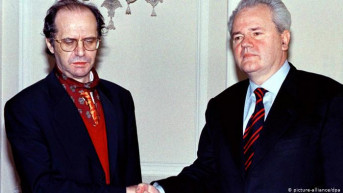
Today, the President of Serbia, Milan Milutinovic, and the President of the Democratic League of Kosovo, Ibrahim Rugova, met in Belgrade, announced from the Office of the President of Serbia. The joint statement emphasizes that "both parties accept a multiethnic and multicultural approach to a political solution for the Kosovo issue" and that "direct negotiations are the only way to find an appropriate political solution." Both sides have called for a halt to the bombing because a political agreement can only be achieved in peace. This meeting confirms the strength of mutual trust, the statement noted.
Ibrahim Rugova has already met with Serbian officials several times. The subject of the talks was a transitional government for Kosovo and Metohija, announced by the Government of Serbia. Other sources have reported that the provincial government is not just a topic and that talks are being conducted within the framework of a comprehensive solution for Kosovo.
The Yugoslav side believes that the Rambouillet Agreement can no longer be the basis for negotiations with the Albanians. Nebojsa Vujic, a spokesperson for the Yugoslav Ministry of Foreign Affairs, stated that the Yugoslav government now has two "main objectives". The first is defense against aggression, and the second is the continuation of the "political process of finding a political solution for Kosovo and Metohija that started on April 1 after the meeting with Presidents Milosevic and Rugova". During the war, Rugova first spoke out on March 31 on the steps of his house where, in front of a group of journalists, he called on NATO to stop the bombing, mentioned that we are now supposedly "all sobered up" and requested the finding of a peaceful solution.
"Rambouillet has never been and will never be the basis for a political solution. It is dead before its life. Rambouillet was misused to bomb our country and the political status of the third republic," Vujic said.
For the Serbian side, Rugova is the leader of a "political party, the political party of the Albanian minority that voluntarily remained in Kosovo, who feels the soul of the Albanian people and is there where he thinks it is necessary," Vujic said. He specified that the subject of discussion has three points: a transitional government, self-government for Kosovo, and the return of refugees. "This is an essential political process and will be much faster," Vujic explained.
Serbia carefully regards all peace initiatives, including Germany, but only after the cessation of bombing commented Vujic on Serbia's stance toward other peace initiatives. He praised the negative approach of UN Secretary-General Kofi Annan. "Several times before the aggression we asked the Secretary-General to prevent it, but he did not react. His position is similar to that of the aggressors," said the Yugoslav spokesperson.
This was added by the spokesperson of the ruling Socialist Party, Ivica Dacic, the refugee problem will be resolved after "negotiations with groups around Ibrahim Rugova" which shows that Rugova is not just a partner on the Albanian side.
Yugoslav President Slobodan Milosevic said two days ago that a multiethnic approach that respects all ethnic groups in Kosovo should be applied" and that the Serbian and Albanian sides need to negotiate directly, without foreign interference. Such an approach was confirmed at the last Milutinovic - Rugova meeting.
The Yugoslav government noted that the fourth week of NATO aggression on the FR Yugoslavia shows that NATO has not achieved any of its goals, and the defensive system of the FR Yugoslavia operates decisively and effectively, inflicting heavy losses on the aggressor.
The Russian State Duma supported with 293 votes for and 53 against, the decision of the Assembly of FR Yugoslavia to enter into the Union of Russia and Belarus.
Bombing various targets on the Danube (northern Serbia and Vojvodina) caused enormous damage, about 10 billion US dollars, stated the director of the river company Radisa DJorDjevic at a press conference. During the course of the Danube, seven bridges were destroyed, oil refining plants, oil warehouses, the chemical industry. The Danube River is the most important route connecting several European countries with the Middle East and Turkey. After the destruction of two bridges in Novi Sad, the river was closed for traffic to Romania and Bulgaria. More than 40 ships are awaiting transfer to both countries.
Two cities that were most attacked by NATO are Novi Sad and Pancevo, both on the Danube. Last night, both were attacked and an additional new bridge over the Danube that connected the cities of Smederevo and Pancevo was destroyed. The bridge is 1300 meters long.
Last night, as well as last week, oil facilities in Novi Sad and Pancevo were bombed. In the last attack early in the morning, plants for heating factories of the Chemical Industry Pancevo were destroyed. The civilian population in the vicinity has been evacuated. The factory management warned that hazardous material had entered the air.
Both oil refineries in Novi Sad and Pancevo were destroyed and attacked again in new attacks. In the attacks, several civilians were killed and wounded. Worker Dejan Bojkovic (28) was killed, and two other workers were seriously injured. They are in the local hospital.
These are just some of the consequences of the daily bombing of the Danube and near cities since the beginning of NATO's military operation. This was discussed yesterday at the meeting of the Danube Commission in Budapest. The Yugoslav representative in the Danube Commission, Ambassador Branislav Novakovic, informed the members of the commission from other Danube countries about current problems on the river yesterday.
The Commission decided to prepare a document on damage and consequences for the next session on April 22. This document, which will contain proposals for resolving this situation, will be sent to international organizations, the UN, the IMF, the World Bank, and the European Union.
At the session, it was warned that the entire role of the Danube in serving European integration and regional cooperation, peace, and stability was completely disrupted by recent events.
The Yugoslav ambassador said that attacks on targets without military functions may indicate an intention to attack other targets - the DJerdap I and DJerdap II hydroelectric plants on the Yugoslav-Romanian border.
About 60 million tons of goods are transported over this river annually, and just to Yugoslavia, which owns 587 kilometers of the river - 20 million. "The destruction of the first bridge has broken the Convention of all Danube countries from 1948, which allows free navigation and transport on this, the largest European transport route. Yugoslavia as a Danube country expects support from the Danube Commission meeting in the unconditional cessation of NATO aggression and help in building new bridges," said Radisa DJorDjevic.
The Danube has always been a strategic economic resource and therefore of great interest for any military operation. In World War II, Hitler planned to retain the Danube in Yugoslavia and at the so-called "Iron Gates" - (Iron Gate) build many facilities for the production of electric energy. He saw the Danube as the best route for connecting Germany and the Middle East and oil sources.
Today, three McDonald's fast-food restaurants in Belgrade have reopened. Three very popular restaurants in the city center were damaged in demonstrations immediately after NATO's aggression on Yugoslavia and the capital Belgrade. During the same demonstrations, cultural workers from the four most important countries in NATO attacks on Yugoslavia: the USA, France, Germany, and Great Britain were damaged or completely destroyed. These four institutions are located on the main city street, Knez Mihailova.
After they were damaged by police forces, their buildings are being watched. Professors and students of the Belgrade Faculty of Languages took books from the libraries of these cultural homes in an effort to protect them from further damage.
Saturday, April 17
Today many collective resistance manifestations against NATO are organized, like the traditional Belgrade Marathon and a joint wedding at the City Assembly.
McDonald's restaurants had been closed for more than three weeks. During that time, the restaurant windows were protected, and the restaurant management kept the following information on the doors. "Dear citizens, we are part of this city. If we must be destroyed, let NATO do it." Similar messages were sent to Belgradians at music concerts held every noon.
Upon reopening, the restaurant management decided to deliver 3000 sandwiches for free. McDonald's Yugoslavia publicly condemned NATO's aggression, and the restaurant management worldwide supported it. "We believe that a peaceful solution will be found very soon," announced the director of McDonald's World.
During the last two weeks, this company has delivered more than 6,000 kilograms of food, milk, and other products through the Red Cross and directly to children's hospitals. These steps should show the "local face" of the company, announced the PR service of the company.
Today, thousands of people in Belgrade ran in the traditional event - the marathon. Despite heavy rain, ordinary Belgrade residents participated in the so-called "Race of Pleasure" even with umbrellas. A message of peace was delivered by 77-year-old veteran and silver medalist from the 1956 Melbourne Olympics, Frano Mihalic.
Among the runners was also American athletic manager Zein Branson, who stayed in Belgrade after the start of the bombing. "My small contribution is my duty as an American and a responsible citizen of the planet to be against aggression," Branson said.
The President of the International Athletic Federation, Dr. Primo Nebiolo, stated that "the marathon can contribute to the celebration of peace and love among people."
Another traditional event was held at the City Assembly where 19 young men and women got married in a joint ceremony. After the ceremony, Belgradians saw them off at Republic Square.
Collective resistance manifestations are held daily in Belgrade and other cities. In the evenings in many cities, especially in Belgrade, citizens form a "living shield" to protect the most important bridges between the two sides of the cities across the Sava.
Monday, April 19
The Federal government has broken off diplomatic relations with Albania, officially announced from the Federal Ministry of Foreign Affairs. At the same time, the delegation of the Foreign Policy Committee of the Federal Parliament refused to go to SRJ Macedonia for the second session of the parliaments of the member countries of the Stability Process in Southeast Europe (Rojamont initiative). In this way, Yugoslavia responded to the increasingly strong military-political pressure coming from these countries.
The Yugoslav Minister of Foreign Affairs regrets that this decision is only "formal" because the two countries have not actually been connected for a long time.
Minister Živadin Jovanovic condemned the Albanian side for supporting terrorist activities and aggression against Yugoslavia. He negatively answered the question of whether Yugoslav forces had crossed into Albanian territory, as reported by agencies a few days ago.
The President of the Foreign Affairs Committee of the Federal Parliament, Ljubisa Ristic, refused to go to BJR Macedonia, to the session of the Rojamont initiative. In his letter, Ristic stated that under the current circumstances due to the "uncontrolled escalation aimed against the entire state whose consequences are catastrophic for my state, people, and region," he cannot participate in the session. This aggression is supported in various ways by countries of Southeast Europe. They participate in direct actions, provide territory or airspace for operations against Yugoslavia, as well as logistical support and propaganda in the media. In this way, the foundations of bilateral relations with Yugoslavia are endangered, Ristic wrote.
The reasons for finally breaking off relations with Albania could be linked to the latest statement by the commander of the Pristina Corps, General Vladimir Lazarevic. He said that NATO is entering the third phase of its operation against Yugoslavia.
"From attacking economic and military targets, NATO comes to the so-called isolation of the battlefield by destroying everything that moves. This means the beginning of air-land operations that are part of the third phase of aggression. On the front of 15-20 kilometers, Albania has started a land aggression in which NATO, with air support, has engaged several thousand terrorists collected from Western countries, Macedonia, as well as armed forces from Albania," Lazarevic said.
He informed that similar activities are expected from Macedonian territory. General Lazarevic confirmed that the Yugoslav Army controls the territory of Kosovo and is successfully defending Yugoslav territory.
The Pristina Corps reported this morning that three aircraft were shot down by NATO around Pristina. Serbian Television broadcasted an audio tape during the shelling with communication of one pilot with his control center. The pilot was catapulted. More details are not disclosed.
Almost all neighboring countries are taking measures to pressure Yugoslavia during the recent events. Hungary stopped a Russian humanitarian convoy for Yugoslavia, Romania refused to allow an air bridge from Russia to Yugoslavia, and in Macedonia and Albania, NATO troops are present.
Great publicity in Belgrade had the statement of the Jewish rabbi from Sarajevo, Eliser Papo, who said that the chance for the Balkans is neither war, nor conflict, nor foreign tutelage. "Great powers manage conflicts in the Balkans and set the peoples of the Balkans against each other. Bosnia is now a barracks," emphasized Papo.
The week from April 18 to 25 was the most aggressive week to date. Exclusively civilian targets in Belgrade were attacked and destroyed, including the residence of President Slobodan Milosevic himself. The building of the former "CK", a separate tower on the former Lenin Boulevard, where the business center "Usce" now stands, was destroyed. The peak of the escalation was the bombing of the RTS building. All this happened just before the NATO Summit in Washington, during which the first expansion of the North Atlantic Alliance was conducted, and it seemed that all this should be symbols of NATO's triumph in its new role, which should restore the shaken self-confidence of the organization and the undermined trust in its role and goals. This series of bombings also marked the first arrival of the Russian mediator Viktor Chernomyrdin and his long conversation with Slobodan Milosevic on April 22.
Ivo Dalder and Michael O'Hanlon wrote in their book about Kosovo "Winning Ugly" that NATO forces had only 350 aircraft ready when the bombing started, about one-third of the number they thought they needed and 1/10 of the aircraft used in the Gulf War. Neither in the Adriatic nor in the Mediterranean Sea were there any aircraft carriers when the war began. All in all, the authors note, it was a "textbook example of how not to conduct a war."
Michael Short, his comrades thought, would not find it easy as an air force commander in a task like Kosovo. Many people around him believed that he quickly began to hate Clark, because his frustrations were very large, and it simply was not in Short's nature to understand the more complex equation that Clark faced, nor in Clark's to have the human qualities that would build a bridge to Short. Short occasionally said that if he had been admitted to West Point as he had hoped, he would have been a year ahead of Clark. If he had been a junior at West Point when Wes Clark came as a freshman, Short liked to say, history might have been a little different.
For those who observed the relations between the two leading generals of the first NATO European war, some of the tensions between these two men were historical, like the tensions between Eisenhower and Patton or Powell and Schwarzkopf. In addition, Clark was an officer, at heart an infantry soldier, who, in Short's opinion, had little sense of what a modern air operation should look like when properly led. Even before the operation began, there was a fundamental disagreement about priorities. Clark asked Short: "Mike, what will you do when Milosevic starts killing Muslims in Kosovo?" "Boss, I'll attack the leadership in Belgrade." That was the wrong answer, at least at that time. Neither NATO nor Washington were yet ready for something so drastic. In Short's opinion, the obvious strategy was to bypass the Third Army in Kosovo and inflict damage on Milosevic and the people close to him.
The real center of gravity, Short insisted, was Belgrade, where all the crucial instruments for maintaining Milosevic in power were located. Short and Clark sometimes argued about what they considered to be the real target, the jewel in the crown. "Boss, you and I have known for months that we have different jewelers," Short told him once. "Yes, but my jeweler has a higher rank than yours," Clark replied.
This week, however, was entirely Short's and entirely in line with his application of the Warden's doctrine.
Wednesday, April 21, 1999.
Last night on Tuesday, April 20, the Business Center "Usce" known as "CK" (Central Committee) named as the headquarters of the former League of Communists of the Federal Republic of Yugoslavia was bombed. Now there were offices of the ruling Socialist Party of Serbia and several TV and radio stations, as well as many business offices. Here were TV and radio station "Kosava" at the head was Marija Milosevic, daughter of the Yugoslav president Slobodan Milosevic, and RTV "Pink" which is close to the power.
This shows that NATO has started a war against the media in Yugoslavia, officials commented on television in initial reactions. NATO has already announced that the media in Serbia will be targeted "because they broadcast content against NATO."
In a new story, Serbian Television took into account the story of mass graves from a NATO briefing. "They destroyed us with their lies. There are no mass graves here. There were no killings, no one was killed, nothing like that happened. These are just lies. Because CNN lies, it fucked us Albanians," said Nezir Balaj from the village of Izbica in the TV segment of Serbian Television.
Serbian Television aired a segment from the Kosovo village of Izbica, 30 kilometers from the town of Istok. Izbica was recorded and shown from a NATO satellite as a place where mass graves exist as has been stated several times at NATO press briefings.
In the story of Serbian Television, it shows that Izbica is a very small village, only with 12 families and 70 residents and it would be theoretically impossible to kill 150 people as NATO claims. In this story, several Albanians were recorded. Speaking Albanian, elder Bajram Salla denied the possibility of mass murders and the existence of mass graves. "Whoever said that, is lying. There were no killings," said Salla. In the satellite image, as reported by Serbian Television, his field was shown as the site of mass graves. Salla said he worked in the field a month ago.
The arrival of the Serbian Television crew is the first such visit in the history of the village. The reporter of Serbian Television said that it is clear, comparing the areas in the real village and the areas shown in the NATO satellite image, that the real village does not match the NATO image. "There is manipulation with computers," concluded the reporter.
Explaining why this village was taken by NATO for this story, reporters said that it was very difficult to find this village because residents of very close places did not know about the existence of such a village. "People at NATO thought it was impossible to prove this story with an almost unknown village," said the reporter.
This story is an illustration of NATO's propaganda war against Serbia, said the minister in the federal government, Goran Matic. He led a group of foreign journalists to visit the building of Serbian Television, "a building so feared by NATO and the Pentagon". Matic thanked the foreign journalists for "making the lies of Kenneth Bacon and Jamie Shea lies."
He emphasized that NATO and Pentagon manipulations have five principles. There are supposedly ethnic cleansing, refugee crises, mass graves, rapes, and concentration camps. Pictures from that do not exist because real events do not exist, and subsequently invented constructions cannot be a reason for war," said Matic.
Serbian Television in the late edition broadcasted a comment about the threat of renewal that Serbian Television might be bombed. Namely, foreign correspondents who have offices in the building of Serbian Television were told they must leave for security reasons. The truth is NATO's biggest enemy, concluded Serbian Television.



0 comments