
FEUILLETON Henry Kissinger, America, and Kosovo (14): Differences between Kissinger and Madeleine Albright
Writing for Kosovo Online: Dragan Bisenic
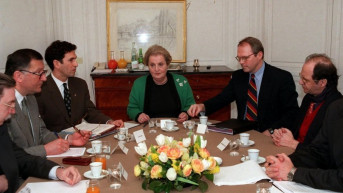
The generation gap has exacerbated the crisis. The formative experience of key personnel in the Clinton administration was in the trenches of the protest movement in Vietnam, or in presidential campaigns - or both. Skeptical about the role of power in foreign policy, they use it inefficiently and without conviction.
They emphasize the so-called "soft" issues, such as the environment, and pay little attention to the concepts of international balance or traditional US interests, which they disdain as outdated. Obsessively driven by public opinion polls, they are always tempted to treat foreign policy as an extension of domestic policy. Their diplomacy is quite adept at dealing with short-term tactical issues but dull when it comes to strategy; skilled in shaping public opinion but oblivious to the valuable lessons of generations past about the limitations of air power and the futility of the concept of "gradual escalation".
What if Serbia doesn't yield?
The refusal of a long-term strategy explains how it was possible to enter into the conflict in Kosovo without adequate consideration of all its implications, especially the reaction of almost all nations of the world against NATO's new doctrine of humanitarian intervention.
Before the start of the bombing, it was common in Washington to believe that Serbia's historical connection to Kosovo was exaggerated and that Slobodan Milosevic sought an excuse to solve the problem he advocated – for which it was assumed that a few days of bombing would be sufficient. However, it was not so.
"But what if Serbia, a country that fought against the Turkish and Austrian empires and defied Hitler and Stalin at the height of its power, does not yield? How far were we willing to go? A ground war, announced at the very beginning, tempted Milosevic to test his endurance against continuous bombing. No provisions were made for a war of attrition or the flood of refugees it had to cause—not to mention the ethnic cleansing the war accelerated and intensified", Kissinger asked.
He pointed out that from the very beginning, there was a huge gap between rhetoric and the means by which it was supported. Allied statements ritualistically compared Milosevic to Hitler. However, transparent reluctance to accept casualties signaled that if the outcome were some kind of compromise, Milosevic would inevitably be legitimized and emerge as a valid interlocutor. Justifying war in terms that require complete victory with the implementation of a strategy that encourages compromise, NATO fell into a trap", Kissinger stated.
The editor-in-chief of "Time" at the time and simultaneously one of Kissinger's earliest biographers, Walter Isaacson, in the article "Albright at War", published on May 10, 1999, confirmed these observations by Kissinger.
He concluded that Kosovo had illustrated how Albright's views and style had been rooted in her personal history. Her father, Josef Korbel, a war-era Czechoslovak diplomat, was witty and sociable, with a talent for survival. Madeleine, who spent two lonely years in Belgrade as a child while he was the ambassador there, as noted by Ann Blackman in her biography of Madeleine Albright, "Madam Secretary", has a deep reservoir of intelligence and wit. Still, at times, it seems she wears blinds to protect herself from things that clash with her self-image.
For example, for years, she almost deliberately hid from herself, as her father hid from her, evidence that her family is Jewish and that many perished in the Holocaust.
The absence of a strategic framework
People generally come out of such experiences in one of two ways, Isaacson noted. "Some, like Albright, develop aggressive moralism and idealism, promising never again to allow the world to close its eyes to crimes. Others—Henry Kissinger, another Nazi refugee, is a different example—become hardened realists with a sense of the nuances of power, a vision of conflict of interests on the world stage, and contempt for what they consider sentimental impulses and ideological fervor".
"Albright lacks Kissinger's ability (or desire) to conceptualize comprehensive strategic frameworks and analyze how action in one corner can ripple worldwide like through a spider's web. She does not excel in careful contingency planning that marked, and sometimes paralyzed, many corporate lawyers—Cyrus Vance, James Baker, Warren Christopher—who once did her job. Consequently, she entered the intervention in Kosovo without worrying too much about geostrategic consequences (how it would affect Russia, China, Macedonia, Greece, etc.) or planning for all unforeseen situations (how to deal with the terrible tide of refugees and the readiness to use ground troops if Milosevic were defiant and persistent)", Isaacson concluded.
Analyzing Kosovo and other "humanitarian", or "morally inspired interventions", Isaacson discussed with Madeleine Albright whether they represent a new view of American interests after the Cold War.
Why Kosovo and not Rwanda?
"I think threats to our national interest come from various problems, including the creation of chaos and instability that arise as a result of ethnic cleansing", Albright said.
How do we choose such battles? Why Kosovo and not Rwanda, Isaacson asked.
"I think you can't make a very simple matrix. You have to look at the scale of what is happening. I believe, and I argued that we should have done more in Rwanda at the time. We get involved where the crime is enormous, where it is in a region that affects our stability – and the stability of Europe is something that has been crucial for the US in the last 200 years – and where there is an organization capable of dealing with it. Just because you can't act everywhere doesn't mean you don't act anywhere. We are developing these rules. There is still no doctrine that really outlines this in an organized way", Albright responded.
These assessments of hers will be the subject of strong opposition from Kissinger.
Isaacson also noted that for someone "who is so proud to be tough, she looks touchingly eager for approval, worried about how the article about her and the pictures will turn out. Nevertheless, in her mind and heart, she shows no doubt about her views“.
After Isaacson's article, it became colloquial to call the attack on Serbia over Kosovo "Madeleine Albright's private war" or "Madeleine's war", as Isaacson precisely posed that question to her: Is this your war? Albright responded that she didn't think it was just her war. "But I feel that we did the right thing, and I am proud of the role I played in it", Albright said.
Continuation tomorrow: Kosovo has become a symbol of Russian post-Cold War frustrations


0 comments