
FEUILLETON Henry Kissinger, America, and Kosovo (15): Kosovo has become a symbol of Russian frustrations
Writing for Kosovo Online: Dragan Bisenic
Kissinger noted that several fateful decisions had been made in those seemingly distant days of February when other options had still appeared open. 'The first was the demand for 30,000 NATO troops to enter Yugoslavia, a country not at war with NATO, and to govern a province that held emotional significance as the birthplace of Serbia's independence. The second was to use the predictable Serbian refusal as a justification for the commencement of the bombing', Kissinger concluded.
“Rambouillet was not a negotiation – as is often claimed – but an ultimatum', Kissinger assessed, adding that it had marked a 'startling shift for an administration that took office proclaiming its commitment to the UN Charter and multilateral procedures“.
Simultaneously, the transformation of the Alliance from a defensive military group into an institution ready to impose its values by force occurred in the same months when three former Soviet satellites joined NATO.
“This undermined repeated American and allied assurances that Russia had nothing to fear from NATO expansion, as the Alliance's own Charter declared it a purely defensive institution“, Kissinger reiterated.
Kosovo thus became a symbol of Russian post-Cold War frustrations.
The troubles of Yugoslavia, a traditional friend of Moscow (setting aside the break during Tito's years), emphasized Russia's decline and stirred hostility towards America and the West, which could generate a nationalist and socialist Russia. This would be a sad end to the policy of an administration that supported Russian reforms and urged Russia to approach the West.
Meetings of Albright with Ivanov and Chernomyrdin
Kissinger considered expectations regarding Russian intervention in Kosovo to be exaggerated. Russian leaders would hardly be broken if the outcome in Kosovo weakened NATO.
"Russian intervention faces a double dilemma: if it is seen as supporting NATO goals, it will lose status at home; if it leads us to reduce our demands, it will become a scapegoat in the American internal debate on compromising our war aims. The most constructive role for Russia, in my opinion, would be a full participant in the conference for political arrangements in the Balkans after the ceasefire", Kissinger suggested.
He commended the administration for recognizing the importance of involving Russia in the international community.
"But this effort was primarily identified with democratic reforms and a market economy within Russia. All this emphasizes the Russian sense that Russia has come under some kind of colonial tutelage. In turn, Russia adhered to many aspects of its traditional diplomacy: seeking to reduce our influence, especially in the Middle East. Russia's image of itself as a historical player on the world stage must be taken seriously. This requires less lecturing and more dialogue; less sentimentality and more acknowledgment that Russia's national interests are not always in line with ours; less sociology and more foreign policy", Kissinger concluded.
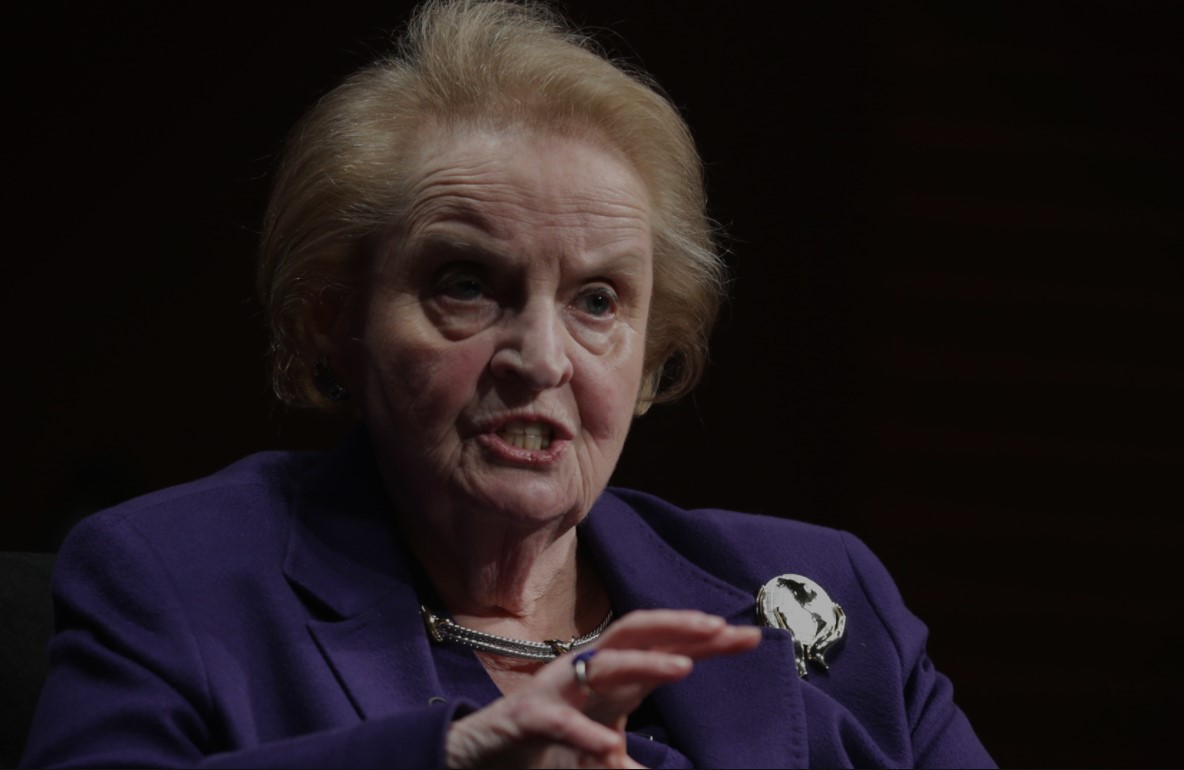
In his text, Isaacson described how the United States convinced Russia to accept the deployment of NATO forces in Kosovo. It began with the arrival in Washington of Viktor Chernomyrdin, the former Russian Prime Minister whom Boris Yeltsin invited to help mediate in Kosovo.
"We are following a strategy of a double magnet", Albright explained. "We attract Moscow to our position on how Kosovo must be resolved and then encourage them to pull Belgrade in that direction. There were many issues on the table, but one serves as a good example of diplomatic maneuvering: the effort to induce Russia to publicly support the deployment of international military forces in Kosovo and then try to convince Serbian leader Slobodan Milosevic of it as a part of a peace agreement".
Albright worked almost daily with Russian Foreign Minister Igor Ivanov on this issue from January when she flew to Moscow to tell him—during a break in La Traviata at the Bolshoi Theatre—that NATO was threatening to bomb. Immediately after the start of the bombing, they met in an empty, beige room at the airport in Oslo, where Ivanov plucked a silk flower from the table to give to her. From his chest pocket, he pulled out a paper with 10 "principles" for a solution. Albright noticed that some matched NATO's. She suggested they take out pens and mark the ones they could agree on. After three hours, Ivanov still hadn't accepted Washington's essential demand for NATO-led peacekeeping forces. But there were enough points of agreement for Albright and Ivanov to come out with a joint statement.
Since then, Vice President Al Gore and Deputy Secretary of State Strobe Talbott worked on Chernomyrdin, Clinton spoke with Yeltsin three times, and Albright spoke almost daily with Ivanov. When Chernomyrdin arrived in Washington, he made it clear that Russia was willing to accept, even if privately, the idea of international security forces, although not necessarily those led by NATO. The talks continued throughout the evening at Gore's official residence (while Albright attended a state dinner) and resumed there the next day.
During breakfast, Chernomyrdin chatted with Albright in Russian for a few minutes, one of the six languages she understands, about the days she spent in Belgrade as a child when her father was the Czechoslovak Ambassador. She described the meeting with Tito and the giving of flowers. Chernomyrdin claimed that the Russians would not publicly support anything the Serbs opposed. This was absurd, she told him openly. Russia's role should be to push the Serbs, not just convey their views. The insistence of the US on NATO-led forces was not a matter of theology but practicality: everyone agreed that the Kosovars should return home, but they wouldn't do so without a strong force to guarantee their security. When the meeting concluded, Albright invited Ivanov to Moscow to ensure that both Russians received the same message, Isaacson described.
Significant Role of China
Analyzing the Chinese stance, Kissinger stated that before the NATO attack and the destruction of the embassy in Belgrade, China's reaction to the air war had been more subdued than Russia's but equally negative.
Every nation views international events through the lens of its history. For China, NATO's new doctrine of humanitarian intervention evokes the unilaterally proclaimed civilizational mission of Europe in the 19th century, which led to the fragmentation of China and a series of Western interventions. In the 20th century, these humiliations were followed by the so-called Brezhnev Doctrine, which proclaimed the Kremlin's right to use military force to punish communist regimes that deviated from its ideological line.
Kissinger knew this, and that's why he reiterated that China began to rebuild its relationship with the United States in 1971 to resist this Brezhnev doctrine.
Kissinger assessed that the policy of close ties between the United States and China was now in question in both capitals. "President Clinton's policy is based on the conviction of all his predecessors since Richard Nixon that both China and the United States have much to gain from cooperation and risk exhaustion through confrontation. For China, a breakdown in relations would deal a severe blow to its economic program and modernization. For America, it would ensure turmoil throughout Asia, leaving China's neighbors torn between the need to choose between the most populous country in the world, with its 5,000 years of history giving it a special place in Asia, and America, the sole global superpower", Kissinger presented.
This policy of cooperation is losing momentum on the American side mostly due to the deadlock between the administration and opponents who see China as the main American strategic threat. The impasse arises from the administration's tendency to present its engagement policy with China less in terms of shared goals and more as a better method for achieving the objectives of its critics. It has been declared a "strategic partnership", but real strategic discussions at the highest level have been rare amid disputes over issues ranging from Taiwan to human rights. The administration felt obliged to balance its China policy with periodic gestures toward its critics.
Continuation tomorrow: Reexamining the concept of humanitarian intervention

0 comments