
No independence for Kosovo

Writing for Kosovo Online: Dragan Bisenic
Prominent French jurist Robert Badinter passed away yesterday at the age of 95, but he will remain in historical memory in our region as the President of the Badinter-Herzog Commission, which formulated recommendations on how the SFRY would dissolve and the controversies that those conclusions provoked. According to those conclusions, Slovenia and Croatia, under certain conditions, had the right to international recognition, Bosnia and Herzegovina received a specific treatment while changing the territorial status of Kosovo and Metohija was not considered an option at all. Because of this, not only the Serbian side, based on Badinter's opinion, considered Kosovo an internal issue of Serbia. British lawyer Marc Weller, a long-time international legal advisor to Kosovo delegations, assessed that the Badinter Commission's attitude towards Kosovo had been "very restrictive and discretionary". and that the commission's recommendations had been "disastrous for Kosovo".
Badinter was not unknown in Yugoslavia. He was a frequent visitor to the coast where he engaged in underwater fishing. When he wasn't on vacation, he was a respected lawyer for the Yugoslav film industry and the famous director of Avala Film, Ratko Drazevic.
Generally considered the basis of post-Cold War territorial organization, the Arbitration Commission of the Conference on Yugoslavia (named the Badinter Commission after its President Robert Badinter) separated territoriality from ethnic affiliation and made the internal borders of Yugoslavia the borders of successor states: a principle initially accepted by the former Soviet Union and its successor states. But Bosnia could not fit within the framework of the principles, and Kosovo was a direct contradiction to them, not to mention Abkhazia, South Ossetia, and Crimea.
Efforts to remain within Badinter's principles revealed inherent difficulties in completely rejecting the ethnic principle as a territorial concept, not only by the constitutional judges who made up the Arbitration Commission. They supported cultural nationalism, encouraged a significant degree of political self-determination, and legitimized identity nationalism as the true aspiration of the people. For example, Cornelia Navari argues that Crimea, with its borders, separatist movement, denial of the right to identity, and recognized right to autonomy, is as much Badinter's child as the secession from it.
The Badinter Commission was established by the foreign ministers of the European Community in 1991 to arbitrate among the "relevant Yugoslav authorities" in the impending breakup of Yugoslavia. Its opinions, issued between November 1991 and January 1992, effectively served as a peace agreement that ended the Cold War in Europe. At its heart was the separation of territoriality and self-determination from the ethnic principle.
The territorial principle is expressed in Opinion 3, in response to the question: "Can the internal borders between Croatia and Serbia and between Bosnia and Herzegovina and Serbia be considered borders in the sense of international public law?" The Commission found that "unless otherwise agreed, the previous borders become boundaries protected by international law", basing its decision on two principles: respect for the territorial status quo and "especially. . . the principle uti possidetis, which supported colonial borders. However territorial agreements after World War I involving the dissolution of three empires (and the closest approximation to a precedent for the situation in Europe after 1990) showed very little regard for internal borders. Badinter's feeling of insecurity in applying the principle is also evidenced by the fact that the judges immediately resorted to providing constitutional justification, invoking the second and fourth paragraphs of Article 5 of the Yugoslav Constitution (in which each republic respected the borders of others). It also supported the "hard" version of uti possidetis – without changing territory.
The working method was such that until December 23, 1991, applications were accepted from those republics that wanted independence. After the requests for recognition were received, they would be subjected to assessment by the EoC Arbitration Commission at the Peace Conference, headed by Badinter. Kosovo also submitted a request for recognition in a letter to Lord Peter Carrington, Chairman of the Peace Conference on Yugoslavia, one day before the deadline. Unlike the requests of the four republics seeking statehood, the Badinter Commission did not even consider Pristina's letter.
When Croatia announced its intention to secede from Yugoslavia, it did so invoking the right to self-determination, which was reiterated by Chancellor Helmut Kohl when he recognized Croatia. The right to self-determination appears in the United Nations Charter, whose Article 1.2 extends the right to self-determination to all peoples. (Other sources, such as the Declaration on the Granting of Independence to Colonial Countries and Peoples, only apply to colonized peoples.) However, the Charter does not define what is meant by the term "peoples" or how their rights are to be realized. The Badinter Commission took the stance that "in its current state of development, international law does not explain all the consequences arising from this principle".
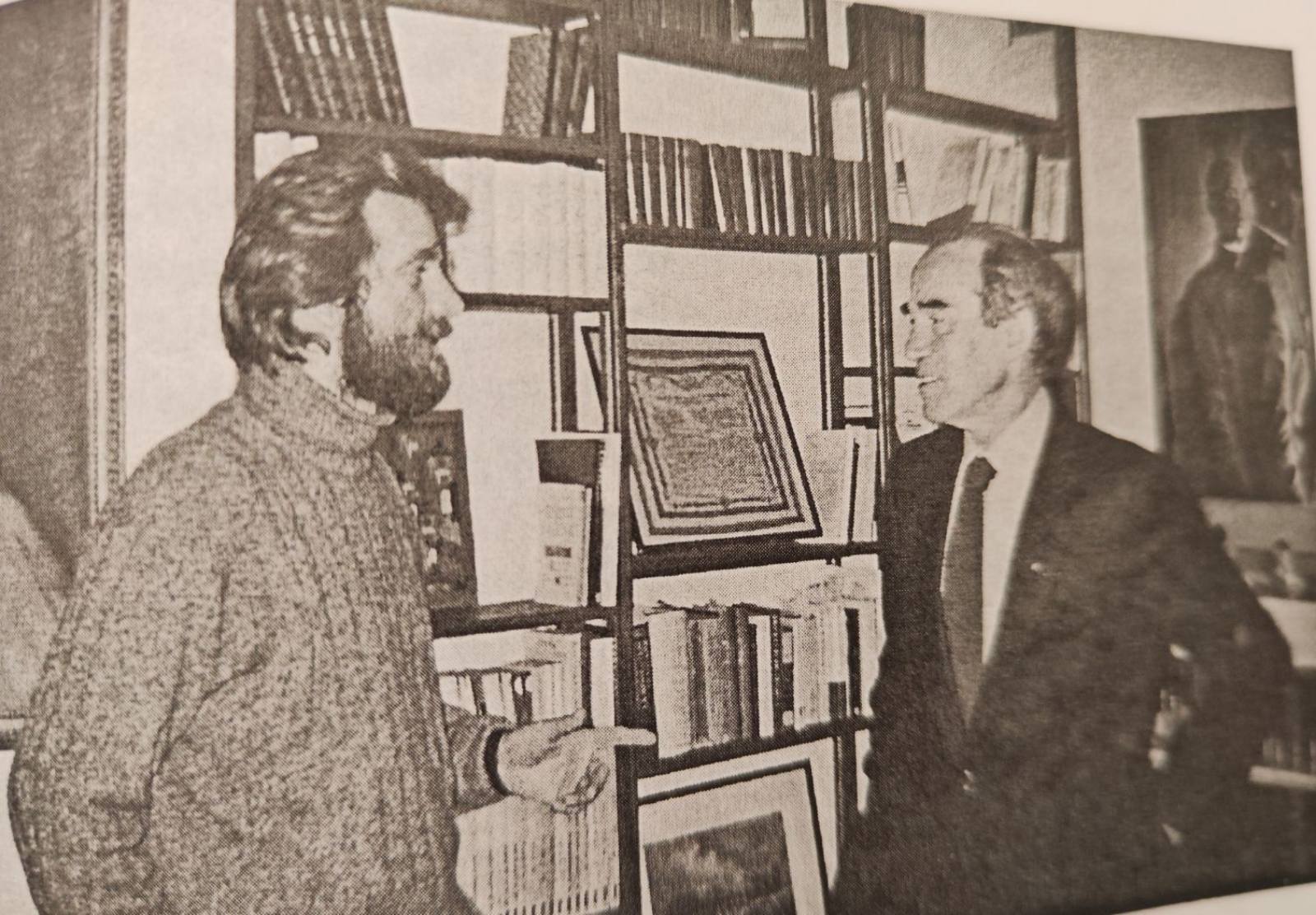
When we spoke in his Paris apartment while he was still President of the Constitutional Council of France, Badinter relativized his findings. He said they were just "opinions that the international community and international law can approve or criticize, they can respect or reject them".
Describing the atmosphere that prevailed at the beginning of the conflict, Badinter recalled that "in those days, nothing seemed lost yet". "The fate was teetering between war and peace. Personally, I sought every possible way to avoid war, to use all, absolutely all means of reconciliation, primarily negotiations within the framework of the EU and UN that could take the form of mediation or international arbitration, to open pathways to all financial sources if resorting to war could be avoided," Badinter recounted.
He considered the recognition of Bosnia and Herzegovina to be a "big mistake". A significant statement was Opinion 2, issued in response to the question: "Does the Serbian population in Croatia and Bosnia and Herzegovina, as one of the constituent peoples of Yugoslavia, have the right to self-determination?" The Commission replaced the term "communities" with "peoples" and granted them rights within existing states, acknowledging "that within one state, there may be different ethnic, religious, or linguistic communities" and stating that all such communities have the right to have their corresponding identity recognized and to benefit from "all human rights and fundamental freedoms recognized in international law, including, where appropriate, the right to choose their national identity".
"Bosnia is a special case. In the Commission, we considered this with the utmost care and wanted to say that it is not clear what the will of the people in Bosnia is, therefore international recognition should not be rushed. The recognition of Bosnia was a mistake and this was immediately understood. It should have been waited for, and a slow approach towards a balanced solution should have been taken, and its recognition should not have been rushed. Bosnia and Herzegovina was recognized by the UN so suddenly, and the basis of that haste is not known. What a huge mistake that was!" Badinter concluded.
Some believed that the conclusions of the Badinter Commission should be put on the banners of national struggle. The Commission, namely, stated in its response that "states arise factually". The factual way implies force, so, for example, Bosnian Serbs should find their first ally in the recommendations of this commission.
At the London Conference held a year later, the delegation of Kosovo Albanians received an invitation that had strange content and could not be considered an invitation to participate in the conference. Kosovo did attend the meeting from what became known as its "echo chamber", where the course of the conference was broadcast live. Occasionally, Lord Carrington and other dignitaries would visit the room and listen quite attentively to the demands of Ibrahim Rugova and his delegation. However, there was no substantive engagement on the issue of Kosovo.
For the future of the peoples of the former Yugoslavia, he recommended the same as the Germans and French did just three years after the end of World War II, "while the smoke was still coming out of the crematoria of concentration camps". At that time, "the great Europeans, Schuman, Adenauer, De Gasperi, Spaak, and Monnet, gathered at the conference in The Hague - they met to forever close the page of the past". Badinter described that there had been a gap between the French and Germans similar to the one that existed "between Serbs and Croats". At the moment when Europe was to be rebuilt, everything that happened between Germans and French over a century was buried, "I believe forever", Badinter added. He proposed that this was the "only direction and way of thinking that can be constructive for the peoples of the former Yugoslavia".
We engaged in a debate regarding this analogy. Badinter, in response to my assertion that Germany had no choice after the war but to leave the past behind, replied that France had a choice, that "even Germany had a choice". "You can choose hatred internally. You can be defeated and continue to fuel hatred. The case of Germany is not so simple," Badinter said. To my remark that Germany was occupied, he responded almost angrily, "Yes, so what? You are occupied too. Do you want to continue nurturing hope for revenge and hatred towards your enemies, or will you change your mind and say, 'We will rebuild the country and be friends with our neighbors, because hatred only brings war again, and war is a horror for all generations, regardless of who the winner is'? It is essential to understand that," Badinter almost shouted.
But the law was by no means the final arbiter of post-Cold War settlements, at least not in the realm of guaranteeing the rights of "communities". On the territorial side, Western powers were forced to change their commitment to the 'first layer down' in drawing new borders and granting full authority to Republika Srpska, in Bosnia, in 1995, and to completely depart from it in their recognition of Kosovo in 2008, provoking Russia to recognize Abkhazia and South Ossetia two months later.
A year after the bombing of Serbia, I met Badinter at a reception in Paris, and I told him anecdotes from my encounter with Monica Lewinsky at the beginning of the bombing. I asked him what he, as a lawyer, but also a proven charmer, thought about Clinton's behavior during the "Lewinsky case"? "Terrible. He is not a gentleman at all. A gentleman should not sweat and blush for two hours denying what the lady confesses," Badinter replied.
On that very day when we met, he was proud that the man he had defended as a young lawyer and on whom he had gained fame had been released from prison. The case was lost because it involved the murder of a child. Already a staunch opponent of the death penalty, Badinter managed to save his client from the punishment that the public had already assigned to him. In the meantime, he completed high school and college in prison and eventually earned a Ph.D. in history. He became the most exemplary prisoner in France. "If a man is free in his mind, he is free everywhere," Badinter said.
Similar words were echoed a few years later by another famous prisoner, Slobodan Milosevic.
"Even though I am in prison, I am free. Freer than you, as my very name says," Milosevic said in court.
I don't know if he would have ever uttered them if he knew he shared the same thought with Badinter.


0 comments