
Colonel Pietrucha: Civilian targets were deliberately targeted to teach the Serbs a lesson; two Orthodox churches were destroyed by cluster bombs
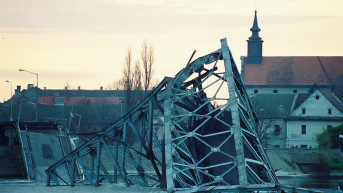
The pilot of the F-15E multi-purpose combat aircraft, who during the NATO aggression against Yugoslavia had dozens of combat flights, Colonel Michael Pietrucha, in his testimony about the combat use of the US Air Force and other NATO countries over Yugoslavia in 1999, said that the targeting of civilian targets and the train in Grdelica Gorge was an error, reports Tango six.
Pietrucha emphasized several times during his testimony that "Allied Force" was not a well-run campaign. From the already mentioned "problem" that after a month they did not have valid targets for shooting, to the fact that the ROE (Rules Of Engagement) was not adequately defined. From his story, one gets the impression that squadrons and pilots had to protect themselves from controversial orders, which, as he claims, he once did.
The story about ethics in combat operations and the clear selection of unnecessary civilian targets begins with the mission that was supposed to be carried out on May 5.
According to him, they got a task to attack with using CBU-87 cluster bombs in a village in Serbia. He says that at first he was suspicious that the target was a village (which he failed to identify even after the war) but that the entire mission planning process was substandard.
The map only drew a rectangle within which they were supposed to drop cluster bombs without a specific military target. Pietrucha rebelled and through the chain of command called the AOC (Air Operations Center) to ask them if they were sure it was a valid target. He got an answer that General Michael Short (commanding all NATO air forces for strikes on Yugoslavia) personally signed the order for this specific action. Pietrucha then told the other crews from his squadron that they should not perform this task if they were not convinced that they were military targets when targeting with video sensors. The procedure they agreed upon among themselves for that oocasion was to drop the bombs within the given rectangle but in the forest outside the civilian settlement.
And so it was. While approaching the target, they saw that the target points were two Orthodox churches. The crews agree to drop the cluster bombs at an agreed uninhabited location in the forest. However, another package with other crews from his squadron was tasked again for the same objective on a second night. Pietrucha, having found out about it, left a written message as a warning that it was about churches to the pilot from the crew who was responsible for planning the next mission. The mentioned pilot nevertheless carried out the mission after protesting through the chain of command that did not produce results and, as Pietrucha claims, that package destroyed churches with cluster bombs.
According to Pietrucha's testimony, the mentioned pilot had mental problems after the war and was killed in the accident of a small civilian plane that he was flying alone. Pietrucha met General Short after the war and confronted him with the choice of this particular target, to which Short replied that he did not remember the details.
Continuing with the story of the destruction of civilian targets, Pietrucha mentions that he knew "Wild Weasel", a fellow pilot who served in Stuttgart during the "Allied Force" campaign and who personally confirmed to him that there were orders from NATO superiors to deliberately target civilian targets in space of Yugoslavia and that, as his friend heard, this was done in order to "teach the Serbs a lesson".
At the end of this story, Pietrucha states that he thinks this was the best mission in his combat career - because he didn't complete it.
Pietrucha describes the action on the bridge in the Grdelica Gorge and the passenger train that was crossing the bridge at that moment, during which at least 13 civilians were killed, as a mistake. He personally did not participate in this mission, but he reconstructs and analyzes it in detail, showing a non-accelerated video of the action itself.
He states that the train was not a target because, as he claims, even if there was someone on the train who needed to be targeted, it would not have been done in this way and with these weapons. The primary mission was the destruction of the bridge with two AGM-130 guided missiles (it is actually a GBU-15 rocket engine bomb). Broadcast footage of the action explains the WSO's attention schedule, which lists this practically radio-controlled bomb by looking focused through a narrow field on the cockpit display.
Pietrucha claims that the WSO could not see the approaching train or deflect the bomb at all and that he saw the train in time since in that phase of proximity to the impact the trajectory of the bomb would have remained the same even if the greatest possible command to change its angle of attack had been made. He is convinced that the planning of the mission was wrong, that it was only necessary to look at the train schedule and that it was precisely for this reason that the attack on the bridge in Novi Sad was carried out at 3 in the morning due to minimal traffic.


0 comments