
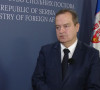
Djukic: "Friends of the Western Balkans" are not a mentor for everything, the focus is on foreign and security policy

The group of seven European Union members, "Friends of the Western Balkans," which has proclaimed its goal to integrate the region into the EU family, will not be a "mentor" for all integration areas, according to diplomat Srecko Djukic; instead, it is focused on two themes – foreign and security policy, where the greatest lag is noticeable. As he adds, they are actually working on the final realization of the 20-year-old promise of Balkan integration into the EU.
In the non-paper, with which ministers of EU member states are acquainted, the group called for the improvement of cooperation with Western Balkans partners in the areas of common foreign and security policy, as well as the acceleration of the accession process with those countries. Djukic says for Kosovo Online that the EU has realized how much it has erred, "which, of course, it does not admit," because the previous European Commission "wasted" its mandate, and the current European Commission, nearing the end of its term, has realized that the Western Balkans must be admitted rapidly.
"It must also be understood that these efforts and investments in admitting Western Balkan countries cost much less than having it remain El Dorado - a place where anyone from the world does as they please, and Europe, i.e., the EU, pays the bill in the end. I think this is an important strategic step for the EU, and they take it seriously. Personally, I expected the previous European Commission to do this because it is very significant, not only for the Western Balkan countries – it is most important for them, but also for the EU because it is Europe's soft underbelly. Now it is fantastically clear that the EU made a good move when it admitted Bulgaria and Romania to membership and closed off the possible direct influence from the east on the entire Balkans, and thus the Western Balkans," Djukic says.
Austria initiated the group, and our interlocutor believes that it was not created "by a key" to reflect friendships but rather to reflect the EU's structure.
"There is also Italy, one of the largest countries and a founder of the EU, then countries that were admitted in a joint package – the Czech Republic, Slovakia, and Slovenia, then the youngest EU member, Croatia, and Greece, admitted before all of them. So, it is a structure that absolutely corresponds to the Western Balkan countries, perhaps more to some, less to others," he notes.
As he adds, Croatia's relationship with Serbia may be problematic, but other countries absolutely suit everyone in the Western Balkans.
Djukic says that the group of friends of this region was not established without consultations with other, most important EU members because it is a community in which agreements are made and moves are coordinated.


0 comments