
Djuric: Kurti is responsible for the destruction of society in Kosovo and Metohija
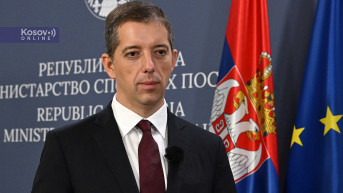
Serbian Foreign Minister Marko Djuric emphasized that Kosovo’s Prime Minister Albin Kurti bears historical responsibility for the destruction of the multiethnic and democratic character of society in Kosovo. He stated that Kurti is not a modern European leader but rather an ethnonationalist who seeks, by all means, to eliminate the influence of the Serbian community and prevent the survival of Serbs in Kosovo.
In an interview with NIN, Djuric pointed out that Kurti is among those who have plunged interethnic relations into darkness through a series of unilateral and uncoordinated moves aimed at diminishing collective, political, economic, and general rights—primarily of the Serbian people but also of other national communities that, as he added, refuse to conform to Kurti’s national-romantic and pan-Albanian ideas.
“He must be acknowledged for consistently implementing his party’s 2012 program, which is based on an ethnonationalist agenda aimed at unifying Albanian ethnic territories under Albanian rule, completely eliminating any Serbian influence in Kosovo and Metohija, and eradicating Serbian institutions that have existed for hundreds of years. Some of these institutions—primarily educational and religious—have been functioning uninterruptedly since the late 18th or early 19th century. During Ottoman rule, Serbian schools existed, yet now Kurti is attempting to shut them down. Imagine a situation in 21st-century Europe where the leader of a major religious community, such as the Serbian Orthodox Church (SPC), is prevented from reaching the seat of his religious organization, which has been in Pec for centuries,” Djuric stated.
He emphasized that the provision allowing the political party with the most votes from the Serbian community to appoint a representative in the Kosovo government and other institutions has been ignored in recent times.
“Kurti is not a modern European democratic politician but a skillfully disguised, retrograde ethnonationalist who does not hesitate to use crude or sophisticated methods to eliminate every form of collective political influence of the Serbian community, as well as its physical survival and presence in the region. I would like to remind you that the so-called Kosovo Constitution stipulates that representatives of the political party winning the most votes among the Serbian community should appoint a representative in the government and other institutions. This provision has been completely ignored in recent times,” Djuric added.
He stated that Serbia’s foreign policy is firmly anchored in the principles of international public law, based on the UN Charter and a sincere desire to foster and develop equal relations with other countries.
“I like to define it as a nationally responsible policy of an outstretched hand, whose foundations include the aspiration for EU membership but also the creation of an environment that allows us to protect some of our vital national interests. This particularly applies to defending our interests in Kosovo and Metohija, as well as the broader struggle for the collective, political, economic, and identity rights of the Serbian people in the post-Yugoslav space. Additionally, a key task of Serbian diplomacy is to preserve traditional friendships with Non-Aligned Movement countries and to seek new markets for Serbia’s growing high-tech industry and economy in general,” the Serbian Foreign Minister stated.
He added that with Donald Trump’s rise to power in the U.S., a new history is being written, and Serbia must respond to all global changes calmly while closely monitoring developments.
“We are at the beginning of a new era. There are tectonic changes occurring, and this is not just a phrase. A new history is being written—not just between the U.S. and Russia, but in the shifting centers of gravity in international relations. What we are witnessing now, dealing with the acute crisis in Eastern Europe, reflects a desire to resolve continental issues so that real energy can be directed toward Southeast Asia and the Pacific, where new drivers of global economic growth are striving to claim their place—not just in the geopolitical power balance, but also in the international division of labor and the struggle for new markets. Serbia must respond to all this calmly, carefully monitoring developments, and striving to be more present than before in some of these new markets, particularly in Southeast Asia—both economically and politically. We are fortunate to have maintained an independent capacity for decision-making,” Djuric stated.
Djuric highlighted that Serbia has made great efforts to build political infrastructure with the United States and emphasized the progress in U.S.-Serbia relations.
“Serbia and Serbian national interests have always suffered when we left a vacuum in Washington, when we were not engaged or proactive. In recent years, we have invested significant effort, work, and resources into building political and diplomatic infrastructure in the U.S., and I would say that our relations are improving regardless of which administration is in power. A key advantage is the good relationship that Serbian leadership enjoys with Mr. Trump personally, as well as with some of the people in his inner circle. This presents an opportunity not only for bilateral cooperation between Serbia and the U.S. but also for resolving regional issues,” he said.
Although it is unrealistic to expect that the Balkans will be a priority for the U.S. administration, Djuric stressed that for Serbia, having access to the top levels of American leadership remains a strategic advantage.
“Serbia, both now and in the future, seeks a strategic partnership and a renewal of its historic alliance with the United States. Not only was our president among the first leaders to speak with Trump after he took office, but behind the scenes, we helped facilitate the first contact between the new U.S. administration and several of our friendly countries,” Djuric revealed.
Regarding cooperation with U.S. Special Envoy for Special Missions Richard Grenell, Djuric acknowledged that negotiations with him are not easy but noted that Grenell respects Serbs as well as other peoples in the region. He described Grenell as a key figure in future American policy.
“Richard Grenell is a man who enjoys the trust of the U.S. president and maintains close communication with him. He is one of the few individuals capable of breaking the cycle of non-engagement by the highest levels of American leadership in the Balkans. His concepts and ideas go beyond the outdated frameworks we have seen in previous years, which failed to untangle the knots left from the 1990s. Grenell is a figure of the future in American politics and holds significant potential for the region. That does not mean we will always agree with him. Negotiating with him is not easy—these discussions can be very difficult and challenging. However, he certainly has respect for both Serbs and other peoples in the region, which is of great importance to us,” Djuric added.
On the situation in Bosnia and Herzegovina, Djuric reaffirmed Serbia’s commitment to the Dayton Agreement and stated that the Republic of Srpska President Milorad Dodik is not responsible for the current political tensions.
“We do not believe that Milorad Dodik is the cause of the current political tensions in Bosnia and Herzegovina. We firmly advocate for the full implementation of the Dayton Agreement, including the territorial integrity of Bosnia and Herzegovina, which Serbia has never questioned. There are frequent accusations against Dodik and the Republic of Srpska regarding alleged separatism, while at the same time, it goes unnoticed that a significant portion of parties from the Federation are attempting to reduce the powers of the entities as outlined in Dayton and to establish full control over the system for the benefit of only one ethnic community. This is skillfully disguised in rhetoric about a ‘civic society,’ exploiting the fact that, for the first time in history, one ethnic group became the majority in the latest census,” he said.
He emphasized the importance of preserving the Republic of Srpska’s competencies.
“Behind the so-called demands for a ‘civic state’ lies the intent to impose majority rule over two of the three constituent peoples in Bosnia and Herzegovina. For us, it is extremely important that the Republic of Srpska's powers remain intact. At the same time, in the coming years, we must build a different, vastly improved relationship with the political leadership representing the Bosniak community, because if tensions persist, the only likely outcome will be an even greater depopulation of the region,” Djuric stated.
Djuric also called for the immediate release of Alon Ohel, who has roots in Novi Sad and is currently imprisoned by Hamas under horrific and inhumane conditions.
“We are also family. No human being deserves the hell that he and his family are going through,” Djuric said.

comments