
Djuric: Serbia has no closer or better friend than Hungary; Szijjarto: You can always rely on Budapest
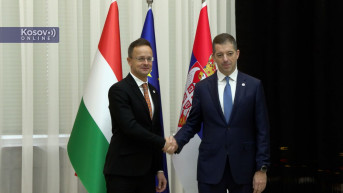
Serbian Foreign Minister Marko Djuric stated, after meeting with his Hungarian counterpart Peter Szijjarto, that Serbia has no closer or better friend than Hungary, which shows great understanding for Serbia’s European integration and for the issues and position of Serbs outside Serbia’s borders in the region, in line with the Brussels and Dayton agreements. Szijjarto said that, when it comes to energy supplies, Serbia can always rely on Hungary, as well as that Budapest firmly believes it is in the EU’s interest for Serbia to become a member, unlike Ukraine.
“The public in Serbia and the international public should know that there is no closer and better friend, in both hard and good times, than our Hungarian friends, and that our cooperation has become the best possible example of European cooperation. A great credit for the upward trajectory of our relations goes to our leaders, Prime Minister Viktor Orban and President Aleksandar Vucic, as well as Minister Szijjarto, who has worked intensely over the years to improve these relations. I believe this friendship is something that will remain a lasting legacy for the Serbian and Hungarian peoples,” Djuric emphasized at a joint press conference with Hungarian Minister of Foreign Affairs and Trade Peter Szijjarto.
He noted that there were two reasons for this meeting today.
“One is multilateral, the meeting of the Central European Initiative, an organization of which both Hungary and Serbia are members, where for 30 years now our two countries have been encouraging cooperation through this multilateral forum. The second reason is even more important, and that is our bilateral cooperation in a challenging time when there is a clear need to strengthen and expand communication and ties between the two countries, both in the energy sphere and in the area of circulation between the two countries, as well as the unstoppable strengthening of cooperation between our diplomatic networks,” Djuric explained.
He said that Serbia and Hungary have strategic relations and that political alignment is at the highest level.
Djuric conveyed that he discussed with Szijjarto the acceleration of construction of new gas pipelines and oil pipelines, because in these times it is important to ensure supply security, since it is clear that we cannot depend on only one supply direction if we want to create good economic conditions.
He added that they also discussed increasing the circulation of people and transport across borders, adding that services of both countries will work on increasing cargo traffic through border crossings.
“It is extremely important that our Hungarian friends show great understanding for Serbia’s European integration and for the issues and position of Serbs outside Serbia’s borders in the region, in line with the Brussels and Dayton agreements. We are grateful for that,” Djuric stressed.
He thanked them for the excellent relations that exist between the two national communities as well.
“It is a fantastic example of how the Hungarian state treats the Serbian community in Hungary, and we are also trying, honoring the memory of Istvan Pasztor, to work on further improving the position of the Hungarian community in Serbia. Today we even have fraternal relations between the national communities,” Djuric said.
Before the conference, Serbia’s Foreign Minister Marko Djuric and Hungary’s Foreign Minister and Trade Minister Peter Szijjarto signed a Protocol on the joint use of premises for the needs of the diplomatic–consular mission in Thessaloniki.
Szijjarto: It is in the EU’s interest for Serbia to become a member; you can always rely on Hungary
Hungarian Foreign Minister Peter Szijjarto stated that, regarding energy supply, Serbia can always rely on Hungary, adding that a political agreement had been reached on this topic between the two countries’ foreign ministers and that the technical details remain to be specified.
“The most important thing is that, just as Hungary could always count on Serbia for energy supply, Serbia can always count on Hungary. We will never leave you alone, we will help you to have secure energy supply,” Szijjarto emphasized.
He reiterated Hungary’s position that it is in the EU’s interest for Serbia to become a member, because the Union would benefit greatly from that.
He pointed out that the EU’s enlargement policy is completely devalued by the fact that Serbia’s accession, which is beyond any discussion considering the country’s economic progress, is being blocked by some EU members, while they advocate for the accession of a country that is at war and clearly not ready for EU membership, whose highest state levels are driven by a machinery of corruption and whose accession would damage the EU’s economic system.
“They do not want Serbia, which brings new opportunities, in Brussels, but they want Ukraine, which would be dangerous for us. We will say that there can be nothing of that,” Szijjarto stressed.
He added that Ukraine has “a machinery deeply mired in corruption,” and asked what message that sends to candidate countries – whether they should have war and corruption in order to be admitted to the EU.
Szijjarto also said that he and his Serbian counterpart agreed that the border crossing at Backi Breg would be modernized so that freight traffic could also pass through, and he mentioned the Protocol on the joint use of premises for the diplomatic–consular mission in Thessaloniki.
“That is a sign of strategic cooperation, a principle that we have joint representations in the world,” Szijjarto said, adding that the Hungarian section of the high-speed railway from Belgrade to Budapest will be put into operation next year.


0 comments