
Does the conflict within Self-Determination Movement lead Kosovo to elections - the West chooses between Abdixhiku and Krasniqi
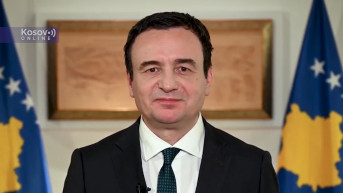
Kosovo Prime Minister and leader of the Self-Determination Movement, Albin Kurti, has started dealing with cadres within the party who he thinks could threaten his power, according to Kosovo Online's interlocutors, and as they add, the first target was the influential MP Haki Abazi, until recently the head of Self-Determination Movement for foreign policy and diaspora.
According to them, the collapse of the Self-Determination Movement will undoubtedly lead Kosovo to extraordinary elections and bearing in mind the recent statement of the US Special Envoy Gabriel Escobar that "the CSM will be formed with or without Kurti", as well as the position of the German Embassy that "there are no conditions regarding the CSM" it seems that Washington and Berlin have started looking for Kurti's successor as Kosovo's prime minister.
Predrag Rajic from the Center for Social Stability states for Kosovo Online that Kurti will try his best to postpone his fall from power with various "politician tricks" and at the same time avoid the formation of the CSM.
"Kurti is a chauvinist and a fanatic. He is an opponent of any kind of agreement. For him, the CSM is a complete Albanian capitulation, and if he were the one to form it, it would be a political disaster for him, since for years he represented any Serbian self-government on Kosovo and Metohija, as a betrayal of Albanian national interests. Nevertheless, his rating, although in decline, is still not low. He could only be defeated in the case of the formation of a broad coalition of parties that emerged from the KLA and the late Rugova's party. Although the collapse of the Self-Determination Movement should not be ruled out as a realistic scenario either," Rajic says.
According to research from September last year conducted by "UBO Consulting", the rating of the Self-determination Movement fell to 37.3 percent, although after the crisis and the barricades in the north, there was a slight increase.
Unlike the Self-Determination Movement, Lumir Abdixhiku's Democratic Alliance of Kosovo has grown to 22.3 percent, while Memli Krasniqi's PDK is listed at around 20 percent. The Alliance for the Future of Kosovo of Ramush Haradinaj had percentage fluctuations during the past months and in September it was listed at 7.7 percent.
If Self-Determination Movement falls apart, primarily due to "disagreements" with the US, it becomes clear that the leaders of the Democratic League of Kosovo or PDK could succeed Kurti, who together in coalition with Haradinaj's party could topple Kurti.
It remains to be seen how the current president Vjosa Osmani's List "Guxo" will fare and whether she could retain her position.
In the current convocation of the Assembly of Kosovo, the ruling majority (Self-Determination and Guxo) with minorities (except the Serb List) have 68 seats (out of 120).
We should not forget the results of the last local elections when the Self-Determination Movement lost Pristina and Prizren, and they were defeated in all major cities except Gjilan. The Democratic League of Kosovo and PDK returned to the scene and won in 14 municipalities.
Analyst Ognjen Gogic says for Kosovo Online that after the situation at the barricades in the north of Kosovo, Kurti's rating improved, but that this is natural when there are crises.
"Now, it is evident that Kurti has softened his rhetoric towards the agreement in recent weeks, and that slightly softer stance will cost him some voters, but the question is who could replace him. Kurti and Self-Determination Movement benefited in 2021 by attracting a large number of Democratic League of Kosovo voters, but according to the results of the local elections, those voters began to return to the party led by Abdixhiku, and the PDK was beheaded by sending its former and then current leaders to The Hague. However, I do not expect elections in Kosovo, because at the moment there is a stable majority, except in the event that Self-Determination Movement is not divided or Kurti's mandate is not restored. I also think that the foreigners understand that they cannot do without Kurti and that he would be a much bigger obstacle to an agreement in the opposition than now in power. The CSM is a stumbling block, but I think that foreigners care more about the European proposal than the CSM, and by replacing Kurti they would risk losing both.



0 comments