
Mazreku: The risk of escalation will persist until Kosovo and Serbia reach an agreement
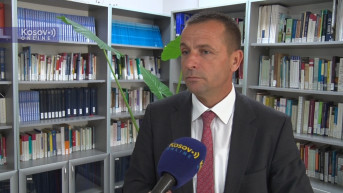
Professor of European law Avni Mazreku believes that the risk of escalation in the situation in Kosovo, as well as in the Western Balkans, will remain until a final agreement is reached between Belgrade and Pristina.
"As long as there is no final agreement between Serbia and Kosovo to normalize relations, and as long as these two political actors do not act constructively, there is a possibility of escalating the security situation in the Balkans. While the two countries have not yet reached a point of definitive normalization in their relations, other actors interested in destabilizing the Balkans are present in the region," Mazreku said.
According to him, until an agreement between Kosovo and Serbia is reached, there is a danger of foreign influence, which, he adds, could lead to an escalation of the situation.
"This is why it is urgent for relations between Kosovo and Serbia to find the right path and reach a political point where citizens of both countries, especially those living in northern Kosovo, are guaranteed a normal life. This can be achieved with a shared political stance. Both countries' interests lie in EU membership and accessing the development funds the EU has allocated. These will directly improve the lives of citizens in both countries and their NATO membership, despite strong public opposition to it in Serbia. I believe transatlantic integration is inevitable for countries geographically located in this part of Europe. Countries like Croatia, Albania, and Serbia, as part of the Western Balkans, have no other interest than their Euro-Atlantic integration," Mazreku added.
Mazreku believes that elections in Kosovo and those recently held in the EU will significantly advance the Kosovo-Serbia dialogue process.
"When we talk about politicians, their ambitions are everywhere – Kosovo included – and every politician has their own political interests. For the current government, the dialogue with Serbia has been a peripheral priority, but the truth is that dialogue was never a peripheral issue on the political agenda. I think that the elections in late February, as well as those in the EU, fundamentally affect the intensity of talks and the search for common ground to find specific solutions. In this case, both the EU and Kosovo elections will advance the dialogue process," he noted.
As he emphasized, the CSM remains a hot topic, but there is no doubt it will be established. However, according to Mazreku, the current government will resist forming the CSM until February 9, when elections will be held in Kosovo.
"After this date, we will see concrete steps toward forming the CSM," Mazreku concluded.



0 comments