
Mijacic: It is difficult to set deadlines for an agreement; the current proposal is the only one offered - there are no other offers
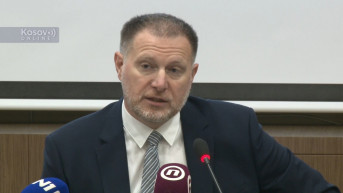
The Coordinator of the Working Group of the National Convention on the EU for Chapter 35, Dragisa Mijacic, said today that it was difficult to set deadlines for reaching an agreement between Belgrade and Pristina because it seemed to him that there would be obstructions from both sides so that the issue would not be resolved now, but only in 2025, after the elections in the US and the EU, but that this opened the key question - how to preserve peace in the meantime.
Mijacic also said that there would be no other proposal from the international community, after this Franco-German one, and that this was on the table and what had to be discussed.
"It is difficult to set any timelines for an agreement between Belgrade and Pristina. Neither in Belgrade nor in Pristina, neither the public nor the political elites are yet prepared for any agreement. There will be great pressure to resolve this issue this year, but I am not sure that the public and political elites will work on it. I am inclined to think that there will be obstructions, causing conflicts, calling elections and various techniques in order to skip the next year, and the issue will be resolved in 2025," Mijacic said at last year's conference of the NCEU Working Group, “Towards an agreement”.
That is why the key question for him is how to preserve peace in that entire area. He added that last year had been on the verge of incidents, so keeping the peace would be a challenge for international factors in Kosovo.
"It is difficult to preserve peace and hence the pressure to reach an agreement this year, in order to normalize relations as much as possible. This agreement is not the end, it should guarantee peace in the era of Kurti and Vucic. The previous peace was guaranteed by the Brussels Agreement in the era of Thaci and Vucic. Now Kurti has entered the political scene and peace with Kurti is needed," Mijacic said.
He pointed out that the agreement on license plates had been in effect for a year and a half, but Pristina did not accept it and did not apply it, while the Serbs in the north of Kosovo have used up the capacity of the barricades in the way they did, so now, according to Mijacic, it was impossible to erect new barricades to solve the issue of plates, which remains as a capsule that can cause incidents, to which the international community would then react.
He added that the recent session of the parliament had turned into something that had been the least related to Kosovo, with big words and platitudes, even incidents, and no serious debate.
Mijacic also stated that the Franco-German proposal had not been a final proposal for an agreement, but a proposal for discussion, with six points which, although the proposal is not public "are implemented as a constant".
"One item, implies that Serbia recognizes some kind of legal subjectivity of Kosovo, the second, unpopular and unfavorable for Belgrade, is that Serbia does not oppose Kosovo's membership in international institutions and organizations, and the third, which Serbia wants to hear - that there is no formal recognition of Kosovo, at least not until Serbia's accession to the EU, for which some date, as we hear, is 2030," Mijacic said.
He also stated that one point referred to the issue of the protection of the Serbs in Kosovo, and one to the status of the Serbian Orthodox Church in Kosovo, since in practice there were many problems in this regard.
The last, sixth item, he says, "as a carrot" refers to investments and regional integrations, with the assessment that, interestingly, European integrations are not mentioned because everyone is aware that nobody can guarantee them to Serbia at the moment. That is why regional integrations are mentioned, adds Mijacic, who predicts that the two initiatives, the Berlin Process and the Open Balkans, will all be integrated at one point.
"These are the six principles of the agreement, and the details of how to formulate the vocabulary of the agreement that will emerge are currently being negotiated. However, there are certain conditions for negotiations to take place, namely security in the north of Kosovo and the absence of unilateral acts. It is not easy to do so, considering what has been happening in the north of Kosovo in the last year and a half, especially recently with the construction of a special police base that is causing unrest among the local population," Mijacic said.
According to him, the return of the Serbs to the institutions should be followed by the establishment of the CSM, as a matter of all issues without which there was no progress in the negotiations.
"A challenging year awaits us, there are many steps to follow. It is interesting that next year is the year of elections in the US and the EU, and next year no one will enter into those processes. That is why the solution will be sought this year, or only in two or three years," Mijacic is confident.
According to him, the Franco-German proposal was nothing new, and it could be called "Brussels Agreement 2", that is, a part of the agreement that had not been negotiated.
"It is clear to everyone that Serbia cannot recognize Kosovo at this moment, but they are looking for ways for Serbia and Kosovo to progress in the integrative processes, without Kosovo not being recognized. There is no alternative to this agreement, there is a possibility that, in some elements, language could be reformulated to be more acceptable," Mijacic believes.
He also notes that the whole process, if the Community of Serb-majority Municipalities is not formed, will not be credible.
"I think it is good that at this moment recognition is not sought from Serbia, not only because the act of recognition is difficult for our society, but it is a mechanism for the Kosovo side to agree to sincerely approach the implementation of all provisions of the agreement. The Kosovo side has never worked on the implementation of the decisions taken, ever since Ahtisaari's plan. They only worked at the beginning, and then there was a derogation," Mijacic said.
He also stated that there would be no other proposal from the international community and that this was what was on the table, which was why an in-depth debate in society was needed, pointing out that the alternative was a frozen conflict, which, he noted, was not the same for the people sitting in Belgrade, or anywhere in Kosovo.
"This means that we have given up on the citizens there", Mijacic believes and adds that this is why a dose of responsibility towards the given moment and solving the problem is needed.
Answering the questions, Mijacic also said that for him the biggest unknown was what Serbia wanted from this process.
"Serbia's platform for negotiations is unknown. In 2018, President Aleksandar Vucic organized an internal dialogue and said that he would come out with a platform in the end, but he did not do so with the explanation that we could not come out with a platform because it would diminish Serbia's position in the negotiations. In September, when there was an extraordinary session on Kosovo, Vucic said that Serbia had had a platform for the division of Kosovo. I think it would not be a bad platform and that he should have come out with it in 2018. Serbia should say - what must come out of the process,” Mijacic said.
As he says, it is not known what the better outcome for Serbia is - if it is fighting for territorial integrity, then it is going in one direction, and if it is fighting for the Serbs in Kosovo, it is going in another direction.
"I have the impression that our politicians are only fighting not to recognize Kosovo. And that is legitimate, but the product of that is a campaign against Serbian products... I am not saying what the state should do, but as a citizen, I have the right to know what Serbia wants. If Serbia perceives the future in the preservation of territorial integrity, I think that Serbia's position will get worse and worse," Mijacic said.
For him, the question of whether Serbia will preserve the Serbs in Kosovo is also important as a political factor.
"There are 120,000 Serbs, and if 40,000 leave, you are no longer a political factor," he said.
He added that it was not the first time that there was a campaign against Serbian products, but that trade had returned to the level before the introduction of taxes, which was good because the strengthening of economic relations contributed to the stabilization of political conditions.
He also stated that it had been known since 2009 that the condition for Serbia's entry into the EU is to recognize Kosovo, which the Germans had said back then, and they had not changed their position.
"These are key negotiations with Kosovo. After these negotiations, only Serbia remains to recognize Kosovo or to implement the agreements reached. These are negotiations where all issues will be resolved, recognition and implementation remain," Mijacic said.
NCEU coordinator Bojana Selakovic, speaking about the decline in citizens' support for the European integration of Serbia, said that it was nothing strange, given the trends of the last 10 years.
This, she said, was a consequence of internal dynamics in society, but also of the inconsistent attitude of the EU, not only towards Serbia but also towards the region.
She explains that since February of last year, since the Russian aggression against Ukraine, there has been a change in the EU's narrative, aware that this region has remained out of focus, but in addition, she says, there is also a fundamentally inconsistent and insincere attitude of the authorities towards the process of European integration and constant confusion of the public, sometimes also by the holders of the highest public offices.
"Regardless of these data, the fact that still the largest number of Serbian citizens, daily, immigrate precisely to EU countries, speaks of their attitude towards the EU," Selakovic said.
She added that EU accession no longer depended on Serbia, which, she said, had not proven to be the most zealous candidate for membership, but also that Serbia now had a chance to join that train.
"Everyone who advocates abandoning the European path should explain to the citizens what the consequences are and what is the alternative for our society in the future," Selakovic is clear.

0 comments