
Pantic Pilja at PACE: Pristina manipulated and redrew the electoral will of Serbs in Kosovo
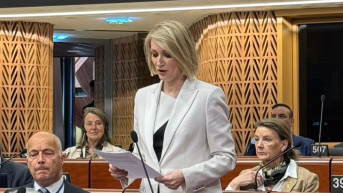
The head of Serbia’s parliamentary delegation to the Parliamentary Assembly of the Council of Europe (PACE), Biljana Pantic Pilja, pointed out yesterday during discussions on elections in Kosovo that Pristina’s manipulations in the electoral process led to the redrawing of the electoral will of Serbs. She emphasized that even the EU’s Preliminary Report indicates drastic irregularities and the misuse of institutions to carry out ethnically motivated pressure and discrimination against Serbs.
"Although the Serb List achieved an electoral result that entitled it to all 10 guaranteed mandates for Serb representatives, the Central Election Commission allocated a mandate to the party of Nenad Rasic, who represents Albanian interests and received votes exclusively from Albanian-majority areas. Nenad Rasic’s party was registered as a party competing for the guaranteed mandates for the Serb community, yet it received votes only in Albanian areas, clearly indicating Kurti’s electoral engineering and a brutal redrawing of the electoral will, as well as a violation of Serbs' electoral rights," Pantic Pilja wrote on Instagram.
She noted that the EU’s Preliminary Report also proves that the electoral process in Kosovo was compromised, highlighting drastic irregularities and the misuse of institutions to exert ethnically motivated pressure and discrimination against Serbs.
She pointed out that nowhere else in Europe is postal voting banned — as happened in Kosovo — where internally displaced Serbs from central Serbia were prohibited from voting by mail.
"Pristina’s institutions tried to ban the organized arrival of Serbs to vote, but after pressure from the international community, Pristina had to abandon this attempt," Pantic Pilja said.
She also emphasized that it is rarely mentioned how Serbs in Kosovo face daily repression by Albin Kurti’s regime.
She warned that Kurti’s regime is daily cracking down on the Serbian population in Kosovo, leading to mass emigration, with Pristina’s clear goal being an ethnically pure Kosovo.
"As for the Brussels Agreement, it is hardly worth mentioning, since even after more than 10 years, the Community of Serb Municipalities has not been established — and Kurti, whom you support, has openly stated he will not form it. It is clear, unfortunately, that human rights are being grossly violated in Kosovo and Metohija, and that the electoral process itself has led to the redrawing of the electoral will, with no sign of the rule of law in Kosovo and Metohija," Pantic Pilja said at PACE.
A member of Serbia’s delegation to the Parliamentary Assembly of the Council of Europe, Aleksandar Mirkovic, also drew attention to the fact that electoral manipulations by the Pristina authorities during the election process culminated in an open violation of the electoral will of the Serbs.
"The party of Nenad Rasic, which represents Albanian interests, has no legitimacy within the Serbian community. It appears that the votes he received from areas with a majority Albanian population were enabled by the party of his political ally and the leader of the regime that represses Serbs, Albin Kurti. Considering that without votes from Albanian-majority areas Rasic’s party would not have secured the necessary support for even a single mandate designated for Serbs, it is evident that the Pristina authorities are brutally violating democratic rights and imposing a new form of electoral coercion on the Serbs. We emphasize that this manipulation is merely a continuation of the systematic pattern of violation and suppression of human and democratic rights of Serbs in Kosovo and Metohija," Mirkovic said.
He explained that this "policy of suppression" by the Pristina regime first manifested through attempts to block the Serb List, and then through efforts to completely ban its participation in the elections.
Since they did not succeed in that, Kurti openly admitted his intention, saying they "had a historic opportunity to prevent the candidacy of the Serb List in the elections," Mirkovic reminded.
Therefore, according to him, the Pristina authorities unlawfully and drastically reduced the number of Serb List representatives in election boards and centers in majority-Serb areas of Kosovo.
In this regard, he pointed out that by reducing their number below the legal minimum, legitimate Serbian representatives were directly prevented from overseeing the electoral process, while Nenad Rasic’s party received a disproportionately large presence in those same election bodies.
"Even all of that was not enough, so Albin Kurti secured 421 votes for Nenad Rasic. A clear case of electoral manipulation in Gnjilane, Pristina, and Srbica. Rasic’s party received 167 votes from Albanians. The most drastic case: Rasic received 157 votes in Prizren, in Albanian-majority areas. As you can see, everything about them is fake, just like the so-called independence of Kosovo. Because Kosovo is not a state. Kosovo and Metohija are Serbia," Mirkovic declared.



0 comments