
Stano: EU members, not Kosovo politicians, decide on the abolition of punitive measures
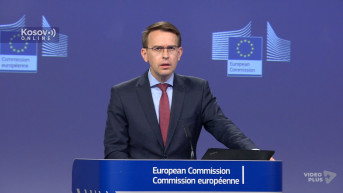
European Union members, not Kosovo politicians, decide on the lifting of punitive measures against Kosovo, EU spokesman Peter Stano said today, regarding the statement of Kosovo Prime Minister Albin Kurti that Pristina has fulfilled all requirements for the lifting of the measures.
"The European Union has introduced punitive measures due to constant crisis situations, unilateral measures and escalation in relations with Serbia. The EU has clearly said that the measures are reversible. They will be abolished when the EU members decide, not Kosovo politicians. I repeat, when the members of the EU decide that there is no longer any reason for the measures to remain in force. That has not happened so far, and the member countries are continuing the discussions and these are internal processes," explained Stano at the press conference today.
He emphasized that the measures are still in force, adding that the elections in four municipalities in the north of Kosovo were seen as one of the elements that led to the introduction of the measures.
"We saw the elections in four municipalities as one of the elements that led to the introduction of measures, but that remains up to the member states, as stated in the Conclusions of the Council for General Affairs from December last year. It remains up to the member states to reassess the situation and then with to the European institutions to decide whether the measures should be lifted or not. I can only confirm that the discussions are still continuing and to remind that the measures have not been lifted," added Stano.
He stated that punitive measures were not introduced only because of one thing, but because of a series of decisions and measures, and what Kosovo did on just one issue is not decisive for their abolition either.
"We want to see the whole situation resolved. Both sides should fulfill their obligations, and Kosovo has heard what our expectations are. The elections in the north are only one issue. We can look at how the elections were organized and what led the Serbs to boycott them. The measures are introduced against Kosovo for certain reasons. When they are no longer there, they will be abolished, and they are not related to just one thing," Stano was clear.
Asked if there is any progress regarding the missing, he said that there is no news.
"We expect that we will be able to see that the two sides make progress on this issue. But this applies to the dialogue in general, as well as to this issue. The agreements reached must be followed by concrete actions and it is not up to the EU to undertake them, but on both sides. We would like to see that the situation is such that we can abolish the measures. When there is a consensus on the punitive measures, then we will announce it. These are internal processes, within the EU and EU members," added Stano.
When asked what the EU's position is regarding the proposed ministers in the new Government of Serbia, Stano said that Serbia is a candidate country for EU membership, which has set itself the European path as a strategic goal.
"We are trying to work with the Serbian government to fulfill its obligations on that path. Serbia knows our expectations well. As a candidate, it should do everything to fulfill its obligations, and as far as foreign policy is concerned, this means full harmonization," Stano said.
He said that Alexander Vulin's statements and actions were contrary to that goal.
"I remind you that EU membership is Serbia's strategic choice, and we expect the Government of Serbia, whatever it looks like, to demonstrate commitment to that goal for the benefit of its citizens and its credibility. The choice to make it a strategic goal was made by the Serbian authorities," he added.

0 comments