
Vucic: CSM is nowhere in sight, Serbs in Kosovo exposed to legal and physical violence
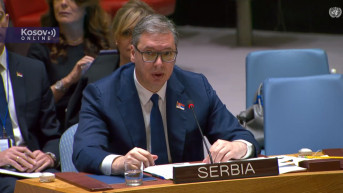
President of Serbia Aleksandar Vucic stated at the UN Security Council session that Serbs in Kosovo are subjected to legal and physical violence and that authorities in Pristina are creating unbearable living conditions for Serbs and other non-Albanians.
He reminded that three days ago, on April 19, marked 11 years since the most important agreement between Belgrade and Pristina was adopted in Brussels on the path to normalizing relations, one of the signatories being the European Union.
"Even 11 years later, although Serbia has fulfilled all its obligations - the Community of Serb-majority Municipalities (CSM) is nowhere to be seen. For all Serbs in Kosovo and Metohija, these 11 years have been 11 years of lies, unfulfilled obligations, accidental or intentional irresponsibility of the EU to move things from a deadlock,” Vucic emphasized.
All of this, he warned, has resulted in continuous legal and physical violence against Serbs in Kosovo.
He added that the brutal repression of Serbs and other non-Albanians intensified after the emergency session of the UN Security Council in February, which was held at the request of Serbia, where all Security Council members expressed concern for the position of Serbs, with an emphasis placed on the abolition of transactions in dinars.
Vucic stated that authorities in Pristina are creating unbearable conditions for the lives of Serbs and other non-Albanians, noting that since the last Security Council session on February 8, the continuous legal and physical harassment of the Serbian population in Kosovo has continued.
He said that the UNMIK report does not reflect the seriousness of the situation on the ground, merely factually documenting almost all significant events, but without linking these events.
“The UNMIK work report that we are discussing today is something that has been discussed a month and a half since this esteemed body held a special session on the situation in Kosovo and Metohija on February 8. Allow me to remind you that this emergency session was held at the request of Serbia because the temporary self-government institutions in Kosovo and Metohija, led by Albin Kurti, threatened international peace and stability,” Vucic said.
He stressed that Serbia then provided a detailed explanation of the actions based on which the temporary institutions continue to deliberately create unbearable conditions for the lives of Serbs and non-Albanians.
Serbia, he added, presented to the Security Council all the steps these institutions have implemented well-planned, widespread, and systematic attacks and treatments against Serbian civilians including continuous legal violence, physical violence, and selective targeting.
He reminded that the February session was held thanks to the fact that all Security Council members assessed that Serbia's arguments and complaints were fact-based and, based on that, Serbia's request was approved.
“I particularly emphasize that the majority that accepted our argumentation consisted of countries that do not respect the sovereignty and territorial integrity of Serbia in the manner prescribed by the legally binding Security Council Resolution 1244,” he stated.
Vucic said that the majority that accepted Serbia's argumentation is composed of countries that do not respect the territorial integrity and sovereignty of Serbia and reminded that almost all Security Council members expressed deep concern for the situation of non-Albanians and called for dialogue.
He pointed out that the session was also held because transactions in dinars were prevented in Kosovo, which, he explained, dramatically and additionally made the daily life of Serbs and other non-Albanians difficult, given that they mostly receive their incomes in dinars.
“Abolishing the use of dinars represents the culmination of an ethnically motivated, prolonged campaign against Serbs by Pristina institutions. Albin Kurti told everyone here that he gave Serbs a three-month transition period, during which no rights of Serbs would be abused to accept and receive dinar. From the moment the session ended, no one in Pristina, nor in the international community, even mentioned the three-month transition period. And all measures against Serbs regarding the dinar began to be applied immediately,” he emphasized.
Serbs and other non-Albanians in Kosovo, therefore, are still unable to receive their pensions, salaries, social benefits, child allowances, and all other payments, which is why the operation of schools, kindergartens, medical, social, and other institutions is practically disabled.
“Employees in these institutions who still work face daily fear of baseless arrests that Kurti's regime massively carries out under false accusations. This situation greatly affects children in kindergartens, retirees, single mothers, and seriously ill people in rural areas, but of course, everyone else,” he warned, accusing the government of Albin Kurti of implementing a chauvinistic agenda.
Vucic emphasized that since February 8, five rounds of talks in Brussels have taken place, and the only tangible outcome was the exposure of Pristina's main motives.
"Bislimi, Kurti's partner in the persecution of Serbs, confirmed that unilateral escalatory decisions to abolish the dinar have affected people, unlike Kurti who claimed at the Security Council that the accusations of the measure affecting citizens are false. Bislimi emphasized that the measure aims to eradicate the Serbian presence in Kosovo and Metohija. He remains committed to the idea of Greater Albania and hegemonic aspirations. His leadership of the dialogue is carried out through sabotages during attendance," he explained.
Vucic pointed out that instead of Pristina being sanctioned, it is constantly rewarded and the brutal repression of Serbs has intensified further.
He reminded that since the Security Council session, there have been 16 new ethnically motivated attacks - armed attacks on Serbs in Gracanica, shootings and intimidation of Serbs in the west, continuous unjustified detentions, and the violent removal of signs with names in the Serbian language in predominantly Serbian settlements.
"The continuous attacks have deepened with the incursion of paramilitary forces into pharmacies, and the seizure of a large amount of medical supplies. While the UNMIK report is full of factual precision, it lacks the connection of events. These limitations in reporting are superficial. It is my duty to offer the members further insight into the events from the report," he stated.
Vucic said that in the report, mentioned under item 22, the emergency session of the Security Council was misrepresented as a discussion on the consequences of the currency ordinance.
"Wrong because Serbia's request was based on a complaint supported by arguments for endangering peace, and the illegal abolition of the dinar was just a part of the complaint. Systematic widespread attacks against Serbs, creating unbearable conditions for Serbs, and the persecution of Serbs were the main topics. In the report from the SB session, the persecution of Serbs was only prosaically presented, through a sentence that Vucic and Kurti participated and presented opposing narratives. Our address was merely a listing of facts of Pristina's attacks against the Serbian population," he pointed out.
Vucic also reminded of the illegal expropriation of over a million acres of Serbian land for the construction of illegal police bases in northern Kosovo.
He also pointed to the arbitrary arrest of dozens of prominent Serbs without charges, as well as the constant presence of armored vehicles in peaceful areas, the introduction of a nine-month embargo on Serbian goods, and the violent seizure of Serbian Orthodox Church property, which violated special zones around religious sites, and the destruction of Serbian cemeteries.
Vucic underlined that Pristina's measures have prevented the payment of 60,946 salaries and 9,430 scholarships, there were 470 unsanctioned ethnically motivated attacks on Serbs, 75 attacks on religious sites, 25 attacks on Serbian children, including an attempted murder of an 11-year-old Serbian boy by representatives of the illegal military forces of Kosovo.
Instead of Kurti's regime being sanctioned, he repeated, it is being rewarded.
He criticized how many times the tragic event in Banjska has been mentioned in the media and at the Security Council, and almost never mentioned that a soldier of the so-called Kosovo army used an official rifle and shot Stefena and Miloša Stojanovic on the eve of Christmas.
"Sometimes we wonder whether he was charged with a minor offense because the victims are 'only' ethnic Serbs," he said.
Vucic reminded that the U.S. Special Envoy for the Balkans, Gabriel Escobar, in Pristina said that the dinar issue is an urgent humanitarian issue that must be resolved and that he was moved by the words of ordinary Serbs affected by this measure.
Escobar, he added, conveyed that Kurti had rejected his plan to resolve this issue.
Vucic stated that Serbs are Kurti's target for well-planned, systematic harassment aimed at persecution, which should have been emphasized in the UNMIK report.
"We do not expect UNMIK to make a report that suits both sides, but the factual situation. Credible reporting does not include neutrality and ambiguity of events that directly endangered the security of the population," he added.
Vucic stated that the report consists of individual events, but lacks the context of civilian persecution, which is the reality on the ground. He emphasized that the tragic events in Banjska were not the cause but the consequence of persecution, and reminded that Serbia has clearly condemned the events in Banjska and will not allow this tragedy to be used as an alibi for the persecution of Serbs.
"More than a year after this tragic event, Serbia has been warning that the Serbs are subjected to systematic attacks. But no one wanted to listen to our warnings," he added.
He emphasized that Pristina then organized elections in Serbian-majority areas in Kosovo, where only 0.029 percent of Serbs participated, followed by the establishment of illegal authorities and their brutal terror over Serbs.
Vucic said that despite declarative calls, the occupation in the north continues.
He also mentioned that after false promises to revoke illegally elected officials, Pristina requested a petition from Serbs, and a referendum.
"For the referendum to be successful, turnout must exceed 50 percent. But Serbs collected six times more signatures for the recall than the Albanian officials received. To prevent the recall, Pristina increased the number of registered voters. It showed that the number of voters was 46,249, which is 5.1 percent more than in 2021, accounting for 2,498 new voters. The number of Albanian voters increased by 12.4 percent. If you add the campaign of intimidation and blackmail, Pristina intends to finalize the persecution of Serbs with the support of illegal municipal authorities. The decision to boycott the referendum was the only possible one, as Serbs were unable to meet the threshold," he explained.
Regarding the arbitrary arrests of Serbs, he reminded of the false guarantees from the international community, mentioning the recent arrest of Srecko Sofronijevic on April 14th on charges of violating the constitutional order of Kosovo.
He reminded that Sofronijevic barely survived being shot during a protest, for which no one has been held accountable.
He pointed out that Serbia has received reports of his physical mistreatment since his arrest.
Vucic said that at the same time, Minister Liburn Aliu in December stated that the independent state of Kosovo is a temporary project, and a Kosovar nation cannot be created, and questioned how Sofronijevic was arrested for violating the constitutional order, while Aliu remains free and in a high position.
Serbia, he stressed, demands the immediate release of all political prisoners, as there can be no reconciliation until they are freed. He also reminded that Serbia has adopted an amnesty law several times, freeing terrorists, including Kurti among them.
He assessed that the Security Council is one of the rare institutions where it is possible to openly discuss the situation in Kosovo, as representatives of temporary institutions, with the support of their sponsors, make small steps, imposing what is unacceptable, and the UN is the last bastion and support of international law that should not allow this.
Serbia, Vucic stressed, demands a clear condemnation and cessation of persecution.
He said that Serbia is clearly for dialogue, and the agreements reached have contributed to normalization so that people can live normally.
"As a credible and responsible partner, Serbia has long fulfilled its obligations. It makes painful concessions so that Serbs in Kosovo can live in peace and respect fundamental rights. Belgrade's insistence on the Community of Serbian Municipalities is without any questioning of Kosovo's status. It is about an institutional solution that would prevent the persecution of Serbs. If the CSM had been established, we would have the right conditions for historic dialogue and normalization of relations. Driven by primitive ethnic hatred towards Serbs, Kurti uses tensions to cleanse Serbs. He opposes the CSM, hoping that by gradually eliminating rights, the unbearable living conditions will force the remaining Serbs to leave Kosovo. Obviously, this is not apparent in the report," he concluded.
Vucic said it is high time to realize that the population in Kosovo cannot rely on the UN as an arbiter and someone who will prevent Pristina's ethnic engineering.
"For months we have been accused in the international media of initiating aggression as if it were possible to do so by someone acting on their own territory, against Kosovo or others, and no one has said apologize for these terrible lies. I assure you once again that Serbia is dedicated and committed to peace, international public order, UN resolutions, and the EU-mediated dialogue process and we will do our best to maintain peace and stability in the region; you can always count on Serbia's seriousness," he stated.
Vucic warned that if Kosovo is admitted to the Council of Europe, an institution whose purpose and goal is to promote the rule of law and freedoms, it will reward the regime of the Prime Minister of the temporary Pristina institutions, Kurti, for carrying out persecution of the Serbian people in Kosovo and creating an apartheid system in the heart of Europe.
"Although today's session is dedicated to the specific semi-annual report on the work of UNMIK, I must warn you not only about the danger arising from the revitalization of the politics of hatred carried out by Pristina, but also about the danger to the international legal order posed by the recommendation of so-called Kosovo for membership in the Council of Europe," he pointed out.
He reminded that the vote on Kosovo's membership in the CE, which he called "the finale of the mockery of international law," is planned for mid-May.
"Therefore, we can easily find ourselves in a situation where the chauvinistic regime that persecutes an entire people is rewarded for its actions precisely by the organization whose purpose and proclaimed goal is to promote and protect the rule of law and human rights and freedoms," he said.
0 comments