
Celic: Serbian Government's strategy signals commitment to the return of displaced Serbs to Kosovo
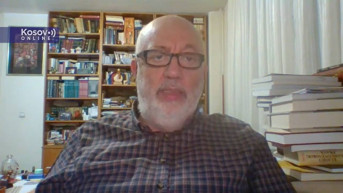
By adopting the Strategy for Resolving the Issues of Refugees and Internally Displaced Persons for the Period 2024–2030, the Serbian Government has sent a political message that it remains committed to the return of displaced persons, stated Dusko Celic, assistant professor at the Faculty of Law, University of North Mitrovica, in an interview for Kosovo Online. He emphasized that this issue cannot be resolved without significant intervention from the international community.
“If we analyze this document, we can first and foremost say that Serbia is not giving up on the return of Serbs to Kosovo and Metohija. This sends a political message that the issue remains open, unresolved, and that everything will be done to ensure that a significant number of Serbs return to the territory of Kosovo and Metohija in an organized manner,” Celic said.
Celic, who was among the experts involved in drafting a similar strategy adopted by the former Federal Republic of Yugoslavia in the early 2000s, pointed out that, according to UNHCR data, around 240,000 people were displaced from Kosovo in 1999, and the number of returnees over the past 25 years is statistically negligible—an unprecedented situation even in a global context.
“A quarter of a century later, the number of returnees remains at the level of a statistical error. The situation is largely unchanged, and it seems unprecedented globally for a community—two-thirds of the Serb population of Kosovo and Metohija—not to have been able to return even 25 years after their forced displacement,” Celic noted.
He recalled that the 2001 strategy for the return of displaced persons to Kosovo achieved consensus at both expert and political levels to ensure the return was organized and massive.
“The basic principle should be that the return is organized and massive, not sporadic or disorganized. I hope that this time, one of the fundamental principles of the government’s strategy is precisely that,” Celic said.
He warned that a significant issue during the initial sporadic returns of Serbs in 2001 and 2002, even though UNMIK held executive power at the time, was the strong resistance from the Albanian population.
“Now, after Kosovo’s unilateral declaration of so-called independence in 2008, the situation on the ground has worsened. It seems that, without significant intervention from the international community, return is not feasible,” Celic emphasized.
When asked whether the return of displaced persons necessitates active participation from the international community, Celic had no doubts.
“Absolutely. Even in 2001, this couldn’t be done without UNMIK. Due to strong resistance, returns were limited to the ‘go-and-see’ project, where displaced Serbs, under armed escort by UNMIK, could visit their properties to assess their condition. Even that project faced strong resistance, let alone efforts for permanent and sustainable return,” Celic explained.
He highlighted that the current situation is even more unfavorable.
“The situation on the ground is now worse, due to systematic violence perpetrated by the regime in Pristina and the evident lack of political will to facilitate the return of Serbs. This lack of will is present not only in Pristina’s authorities but also, to some extent, in international organizations. None of them are currently addressing the return of Serbs to Kosovo and Metohija, even though they all pledge allegiance to a multiethnic Kosovo and are aware that the mass expulsion was nearly genocidal in scale,” Celic specified.
He believes the original intent of the international community—to return displaced persons to their places of origin—is now completely unrealistic, and the only viable solution is to facilitate the return of displaced Serbs to areas in Kosovo where Serbs form a majority.
“More than 350 settlements have been ethnically cleansed of Serbs since 1999. Initially, the international community insisted on returns to the so-called places of origin, the last place of residence of the displaced. This was objectively impossible even then, and now it is even less feasible. It is more realistic to expect returns to areas where Serbs have managed to survive,” Celic explained.
He primarily referred to northern Kosovo, followed by central Kosovo, Kosovo Pomoravlje, and to a lesser extent, the Osojane Valley.
“In these areas, displaced persons could rely on the local Serbian population, as it is evident they cannot rely on local authorities in Pristina. There is a systematically fueled atmosphere of hostility among the local Albanian population toward Serbs,” Celic concluded.



0 comments