
Stojkovski: The systematic rewriting of history in Kosovo has been ongoing for a long time
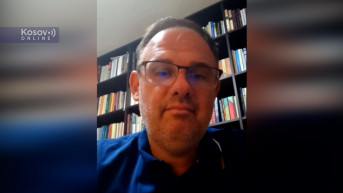
Stories about Ulpiana as part of Kosovo's cultural heritage represent a blatant fabrication and rewriting of history," says historian Dr. Boris Stojkovski in an interview with Kosovo Online, adding that this early Christian Roman city has no connection to the Albanians.
Speaking about the visit of the U.S. Ambassador to Kosovo to Ulpiana, during which he referred to it as part of 'Kosovo's cultural heritage,' Stojkovski notes that the systematic rewriting of the history of this area has been ongoing for a long time.
"I am referring to the entire Balkan Peninsula, Central and Southeastern Europe, and thus the area of Kosovo and Metohija as well. When we talk about Ulpiana, it has absolutely no connection with the Albanians—truly none at all. It also doesn't fundamentally relate to the Serbs. Ulpiana is primarily an early Christian Roman city, and it cannot be considered part of any imaginary Kosovar heritage, not only because the so-called Kosovo essentially does not exist as a state for many reasons, but also due to the fact that something related to the heritage of the majority population of today's Kosovo and Metohija—namely the Albanians—cannot be from the Roman period," Stojkovski explains.
He adds that there are many contradictions in this narrative and emphasizes that such a stance has no scientific basis.
"A great deal has been written about Ulpiana, its history, and the Roman Empire in this region by many esteemed historians, archaeologists, and classical philologists, dating back to the old Yugoslavia and even earlier. Theologians have also studied it due to the two holy martyrs, Florus and Laurus, who were stonecutters from Ulpiana. Therefore, what we are witnessing and what the so-called ambassador stated is a flagrant fabrication and rewriting of history," Stojkovski underscores.
He warns that there are already dozens of monographs that discuss a so-called history of Kosovo with a subversive element, often produced with the support of the United States, which is "one of the most significant patrons of the so-called independence of Kosovo and Metohija."
"Let's be clear, this is a policy that official Washington has been pursuing for the past 25 years, or more precisely, in the last 16 years since the unilateral declaration of independence in Kosovo and Metohija. This is the policy being carried out, and it is nothing new. Let's remember the Roman Catholic Mass held in Novo Brdo, even though there are remnants of a Roman Catholic church there, the Mass was conducted on the remains of an Orthodox temple. This rewriting of history, unfortunately, is something we are witnessing in Serbia as well. It is all a consequence of ideas and narratives like 'the Serbs, the oldest people,' from which many profit, including those who do not wish well for the cultural heritage of the Serbs, the state of Serbia, and indeed, the entire world. Ulpiana, as a very important Roman site, is the cultural heritage of the entire world and the entire Mediterranean where the Roman Empire once extended," Stojkovski concludes.
In the fight against such narratives, both policy and expertise are crucial, according to Stojkovski.
"Experts are there to present indisputable facts, whether it's about Ulpiana, which we're discussing, or Visoki Decani, Novo Brdo, Vucitrn, Zvecan, or Trepca, which has existed as a mine since the Middle Ages until today—this is what experts have spoken about and continue to speak about, not only Serbian or former Yugoslav experts. There are also serious international researchers involved in these topics, meaning not everyone is necessarily tied to a specific policy or ideology. However, if this knowledge does not have broad support, it remains confined to narrow academic circles. For such issues, it is essential and necessary to have the widest and most extensive support possible. In this context, I believe that all the efforts being made at the national level are crucial, and certainly, more should be done, as much as possible, to bring such matters to light at the highest levels, including international platforms. This includes the university and academic communities, but also a much broader audience. I believe there is significant room for maneuver here," Stojkovski concludes.

comments