
A study of one of the greatest crimes in contemporary history is necessary
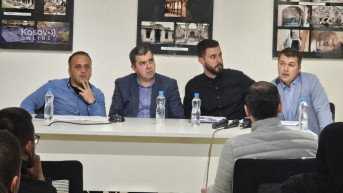
On the occasion of the twentieth anniversary of the Pogrom in Kosovo, a panel discussion and photo exhibition titled "Pogrom on March 17, 2004 - Rewarded Crime" was held at the gallery of the Cultural Center in Gračanica.
The participants of the panel, from an academic perspective, attempted to address the key questions regarding the causes, extent, and consequences of the March Pogrom, emphasizing the need to study one of the greatest crimes in our contemporary history.
The photo exhibition, featuring some images that have circulated worldwide, depicts the phenomenon of evil and the vulnerable points of suffering.
Vladan Virijevic, a professor at the Faculty of Philosophy of the University of Priština with temporary headquarters in Kosovska Mitrovica, stated that the March Pogrom was an event associated with a culture of pain.
"What happened on March 17, 2004, and what preceded it, creating fertile ground for this horrific pogrom, can historically be compared and measured with the St. Bartholomew's Day massacre of 1572, the Night of the Long Knives in Nazi Germany in 1938, or even the far more tragic Kristallnacht in terms of the extent of destruction and suffering," Virijevic said.
According to Professor Virijevic, the March Pogrom is a moment that is the result of the germination of one seed and the realization of a process that is not an ad hoc moment or instant.
"This is the result of a long process that began, we can freely say, since the establishment of the first Prizren League in 1878 and had its phases in various political, ideological, and socio-economic circumstances throughout the late 19th century, throughout the 20th century, and we saw its epilogue at the beginning of the 21st century," Professor Virijevic said.
Stefan Radojkovic, a research associate at the Institute for Political Studies in Belgrade and a historian, spoke about the pogrom from the perspective of international relations and emphasized that from that moment, the issue of independence had been brought to the forefront.
"From 1999 until 2003, the issue of independence and negotiations on status are mentioned, but it is still somewhat on the sidelines. It's there somewhere in the ether, happening, not absent, but simply not at the forefront of all these discussions. That's what changes with the March Pogrom. At that moment, something happened that two UNMIK representatives, who were here and were extremely critical of UNMIK, I intentionally used them, they are Iain King and Whit Mason, they say there is something called the 'Albanian veto' in diplomatic circles, which was a metaphor for violence. What you can't achieve through diplomatic, institutional work, you will push through with extreme violence," Radojkovic said.
According to Radojkovic, at that moment, Albanians realized that violence would prompt the international community to take action.
"It took the international community about a year, if this happened somewhere in March 2004, until around spring 2005 to realize what had happened to them. It was a trauma for them; they had experienced terrorist attacks before, and it wasn't unfamiliar to them, but such a wave of violence that directly hit their vehicles, their offices, and their representatives, including UN police, KFOR members, until the US KFOR troops arrived, until they took off from Naples, Caglavica could have fallen because the others couldn't hold it as needed," Radojkovic said.
Marko Markovic, Director of the Archive of Kosovo and Metohija, historian, says that the topic is too painful and sensitive for all Serbs, especially for those who experienced the March Pogrom brutally.
"Besides being extremely painful and sensitive, this topic is extremely important and significant, and it must be constantly talked about. We, as a nation, tend to forget these important events often and easily overlook them," Markovic said, adding that younger generations know little about March 17, noting that 20 years after the event, there was a historical distance that allowed for a clear understanding of some processes and events after they have been sorted out.
"If we start from the northern part of central Kosovo, starting from Pristina, we can see that in that March Pogrom in Pristina, even the remaining traces of Serbian life in that city disappeared. The Church of St. Nicholas was destroyed, and the building of the YU program building, where Serbs lived, was also destroyed. Besides Pristina, neighboring Kosovo Polje suffered greatly, where, in addition to Serbian homes, a Serbian school, church, and hospital were burned down. In such a situation, when someone burns down your church, hospital, or school, what message are they sending you? We must not forget the suffering of Lipljan and its people when it comes to central Kosovo. We cannot forget the suffering of the people in Bresje and especially in Caglavica, which was the epicenter of those unfortunate events," Markovic said.


0 comments