
The Neziraj project
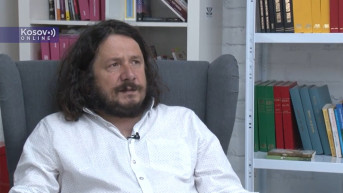
Writing for Kosovo Online: Muharem Bazdulj, writer and journalist
Bearing in mind that he is a writer of a small language, Jeton Neziraj is a very successful man globally. He is certainly among the three or four most famous playwrights in the world among those born in socialist Yugoslavia. His plays have been translated into nearly twenty languages, and have been staged all over the world: from New York to Milan and from Berlin to Lausanne.
At the same time, Neziraj's position is originally more ungrateful than that of Biljana Srbljanovic or Miljenko Jergović, for example. Not all variants of Serbo-Croatian in total are among the big languages, but they are part of the big Slavic family. I mean, everywhere in the world there are more literary translators from Serbian than from Albanian.
From Orhan Pamuk to Amos Oz, world-famous writers often undermine the dominant national narrative of their environment. Jeton Neziraj does not fit into that model. In fact, in his own way, he constantly perpetuates the dominant narrative among Kosovo Albanians.
Basically, a few days ago Neziraj upset the few Serbian theater workers in Kosovo by writing in one text, I'm paraphrasing, that the National Theater of Pristina based in Gracanica is not an artistic but a parapolitical institution. There were many reactions from Belgrade to Neziraj's speech, but the most important of all is the "defense" that comes from the very institution that Neziraj attacked, i.e. these words of Predrag Radonjic, the current director of the National Theater of Pristina:
"Expelled from its hometown, expelled from its theater house and from its home stage, the National Theater in Pristina found its new home and stage in the House of Culture in Gracanica. In addition to playing in Gracanica, on the territory of the municipality which, according to the Serbian administrative system, still belongs to the city of Pristina, so in a somewhat more liberal interpretation it can be said that we have returned home, our theater also plays in all parts of Kosovo and Metohija where the Serbian population lives: in cultural centers in Zvecan, Strpac, Zubin Potok, Silovo, Pasjan, in classrooms of primary schools, the churches yards and monasteries, the courtyards of returnees' houses, just as we are occasionally present with our performances in other parts of Serbia, the region, abroad... Access to our house, in the most ethnically pure 'capital' in Europe is denied and made meaningless, where there are almost none of our viewers left. That's why we are here with our shows where there are still our viewers, where there is a desire and need to be seen".
Perhaps the most interesting part of Neziraj's text is the criticism of the several-year-old play "Lift: The Free Show" by Jelena Bogavac and Nenad Todorovic. In Neziraj's opinion, "this play does not deal with Milosevic's crimes in the right way". Although unequivocally critical of Milosevic's political legacy, Neziraj thinks that the play does not go far enough in this regard.
A few years after this play by Bogavac and Todorovic, Neziraj staged the play "Handke Project", which is a genre-like form of the "author's post-dramatic concept". However, although Handke is undoubtedly a more complex phenomenon than Slobodan Milosevic, there is nothing complex in Neziraj's image of this writer. Everything is completely black and white. For Neziraj, Handke is a villain and a disciple of Joseph Goebbels.
In this sense, and retroactively, Neziraj's play "Lift: The Free Show" is shown as the antithesis of what he does, both ethically and aesthetically. Within his native culture, Neziraj enjoys a comfortable position to confirm its dominant political narrative with his artworks. Banally speaking, it is easy to mock Handke in Pristina and Sarajevo, much easier than mocking Milosevic in Gracanica.
When Belgrade theaters and Belgrade festivals invite Albanian artists from Kosovo to perform, they are representatives of the local scene. When someone from Serbia rarely appears in Pristina, it's only people who perform from the extreme margins. This policy creates a double benefit for them: first, it does not wake them up from their dogmatic slumber, and then it lulls them into their prejudice that the Serbian mainstream is "abnormal".
If it did not represent giving too much attention to a realistically not overly important artistic contemporary, the National Theater of Pristina in Gracanica could in the near future put on a play entitled "The Neziraj project". It would be a somewhat paradigmatic and almost pseudo-Faustian representation of an artist who was formed as a person in the years when his community was a minority, threatened, and majorized, but despite everything, when things turn one hundred and eighty degrees, he is unable to empathically recognize that in that same society, another party now suffers in a minority position and that it is his community that oppresses them.

comments