
Half a century of Greek-Turkish dispute: Could a solution for Cyprus be a model for Kosovo?
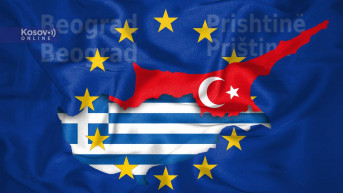
Half a century ago, on July 20, 1974, Cyprus was divided into two parts. While the newly reappointed head of the European Commission, Ursula von der Leyen, claims that the time has come for the reunification of this island, experts speaking to Kosovo Online believe that in the current geopolitical situation, anything is possible, however, for now, this scenario remains only in the realm of the European Union's "wishful thinking." Similarly, the dialogue between Belgrade and Pristina is also in this "folder" of unresolved issues. Could the European Union, through a solution for Cyprus, find a model for Kosovo?
Written by: Arsenije Vuckovic
One emerged during the Cold War, and the other at the end of the last century.
Though largely incompatible, the cases of Cyprus and Kosovo share an irresistible similarity: two frozen conflicts in Europe that remain unresolved.
Simultaneously, Europe's stance on both issues is almost identical.
Had the citizens of Cyprus been omitted from her speech, both Belgrade and Pristina would have recognized themselves in the words of European Commission President Ursula von der Leyen.
"We support territorial integrity and sovereignty. Cypriots deserve to live in a united country in conditions of peace, coexistence, stability, and prosperity," the President of the Commission said.
She also added that "the Cyprus issue is also a European issue."
"We will continue to firmly support Cyprus in efforts for the reunification of the last divided EU member state, in accordance with relevant UN Security Council resolutions," von der Leyen emphasized on the occasion of the 50th anniversary of the division of Cyprus.
In such a scenario, neither Belgrade nor Pristina would appreciate hearing the prompt response of Turkish President Recep Tayyip Erdogan to von der Leyen's idea.
"We believe that a solution with a unified federation is not possible in Cyprus," Erdogan said briefly.
Cyprus gained independence and ceased to be a British colony in 1960, but the joint administration of Greek and Turkish Cypriots soon collapsed.
Then, on July 20, 1974, Turkey sent strong naval and air forces to protect, as it stated, its brothers in Cyprus.
After occupying the northern part, the island was divided by the "green line" into the Republic of Cyprus in the south, which has been an equal member of the European Union since 2004, and the self-proclaimed "Turkish Republic of Northern Cyprus," currently recognized only by Ankara.
The international community has not found a solution for the divided country even after almost half a century.
The Kosovo issue, at least in its most recent factual details, began in 1999 with the adoption of UN Security Council Resolution 1244, which ended NATO's intervention in the then Federal Republic of Yugoslavia. Yugoslav security forces had to withdraw from that part of the then Autonomous Province of Kosovo and Metohija.
The authorities in Pristina declared independence in 2008, which has been recognized by most Western countries, however, within the European Union, five member states still firmly oppose this.
Evidence and Precedents
Former ambassador to the OSCE, Branka Latinovic, believes that the statement by European Commission President Ursula von der Leyen about the reunification of Cyprus should be interpreted as clear evidence that the European Union firmly supports each of its member states.
“The President of the European Commission made a very strong and decisive statement regarding the preservation of the territorial integrity and unity of Cyprus, and this is just one example of how the EU stands behind its members. The EU is not just a system of values and financial benefits but also support for the territorial independence and sovereignty of a country. Naturally, this also pertains to the issue of common security and defense policy, and this statement should be interpreted in that sense,” Latinovic says for Kosovo Online.
She adds that Cyprus is a European precedent because, despite unresolved territorial issues, it was admitted to the European Union.
“The reasons are different, and so are the models. Cyprus is indeed a frozen conflict, but even as such, it was admitted to the EU, contrary to all principles, not only of the EU. Every international organization takes into account which state is admitted and whether it has control over its entire territory. That is a sine qua non principle, and the EU abandoned this in the case of Cyprus. It admitted Cyprus despite the fact that it does not have control over a third of its territory. This was done under significant influence from Greece, which had a blackmailing capacity,” this career diplomat explains.
She emphasizes that the EU has since strengthened its positions regarding the conditions for the admission of other members.
“This is not only related to Serbia, as we have Resolution 1244, and we can always say that this territory is under the UN mandate, which was also the case for our membership in the Council of Europe,” Latinovic recalls.
She warns that, on the other hand, the EU's announcements about admitting other new members, such as Moldova or Ukraine, are questionable.
“In Moldova, you have Transnistria (Pridnestrovie), where this country practically has no control over that part of the territory, and there is a pro-Russian local government. Secondly, what will happen with Ukraine, how will that war end? Will we have a new frozen conflict, or will it be resolved in another way when negotiations begin? But these are all new challenges that the EU and the contemporary world face,” Latinovic believes.
When asked if the Cyprus solution model could be applied to Kosovo, Latinovic is skeptical.
“The causes are different, the story is different. I think these are things that cannot be compared to what we have in Kosovo and Metohija. But one fact remains that the EU's position stems from the UN's stance on preserving the unity and territorial integrity of Cyprus. Of course, we have Turkey's position, which differs,” Latinovic clarifies.
She adds that Kosovo and Cyprus are connected by UN Security Council resolutions but are separated by their different contents.
“First, we have UN Security Council Resolution 550 from 1983, when what was called the Turkish Republic of Northern Cyprus declared independence. In that resolution, the entire act is declared invalid, and UN members are called upon not to recognize that state and not to establish diplomatic relations. This is something that does not exist in Resolution 1244 or later resolutions. Secondly, the entire negotiation process led by the UN regarding the unification of Cyprus was conducted with the aim of how to regain that part of the territory and how to provide appropriate models: whether it is a federation or a confederation. It was mostly aimed at a federal model, considering the causes for this situation are entirely different from this one,” Latinovic emphasizes.
She reminds that, compared to Kosovo, the Cyprus issue arose under different historical circumstances.
“It was the time of the Cold War, the military junta in Greece that declared the annexation of Cyprus, the Greek coup in Cyprus, then-President Makarios who left the country, then Nikos Sampson who was the leader of the movement for the unification of Cyprus with Greece and was President of Cyprus for eight days... Then the Turkish intervention in Northern Cyprus, the return of Makarios... These are all things that cannot be compared,” Latinovic concludes.
Historical Background
Professor at the Department of International Law at the University of Pristina, Besfort Rrecaj, says in an interview with Kosovo Online that due to the geopolitical relations in the world, it is very difficult to predict when and how the reunification of Cyprus might occur. He also notes that this problem is not comparable to the Kosovo issue.
"The situation in Cyprus is very complicated, especially when we talk about its historical background. We have a territory that has been controlled by Turks in Northern Cyprus for decades, with the help of Turkey," Rrecaj says.
He emphasizes that the issue of Cyprus is complex from multiple angles.
The first is that the conflict involves two NATO members.
"We have Turkey and Greece, which fought over control of Cyprus in the 1970s after the turmoil that began at that time. On the other hand, we have Cyprus, which is a recognized member of the European Union," Rrecaj explains.
Hence, he continues, the statement by von der Leyen about creating a federation aligns with the official policy and unified stance of the EU regarding Cyprus.
"However, how this will translate into reality and how this issue will develop in the future is very difficult to predict due to the involvement of great powers. Especially when it comes to global geopolitical and political relations, particularly in Ukraine with the unprovoked invasion of Russia into Ukraine. Also, there is the complicated situation in the Middle East. I think that Europe cannot give itself any positive feedback regarding a more decisive policy toward Cyprus," Rrecaj emphasizes.
Asked how much the resolution of the Cyprus issue could be a potential model for Kosovo, this professor believes that these are "fundamentally different issues."
"There is a significant and fundamental difference between Northern Cyprus and Kosovo. In both cases, we have different factual situations. This was confirmed by the International Court of Justice in its opinion on Kosovo's Declaration of Independence, stating that it is not contrary to international law. In the case of Northern Cyprus, the situation is opposite. We have a clear UN Security Council resolution rejecting the declaration of independence by the Cypriot Turks and what is today known as Northern Cyprus. Thus, from a legal perspective, we have completely opposite situations that cannot be compared," Rrecaj emphasizes.
He adds that there is another difference.
"Above all, we have the factual situation of the Commission on Crimes against Humanity that did not happen in Kosovo, unlike the situation with the Cypriot Turks where the Commission found a completely different situation," Rrecaj concludes.
Compromise Formula
On the other hand, Srboljub Peovic, a researcher at the Institute for European Studies, believes that regardless of the EU's intentions for reunification, Turkey will not abandon its vision for a solution for Cyprus. He also points out that both the Cyprus and Kosovo issues share a series of unsuccessful attempts by the international community to find a compromise formula.
“There continues to be a series of diplomatic positions that have lasted since the 1960s. On one hand, there is a search for some solution for a federal state that would include the so-called Turkish Republic of Northern Cyprus. Turkey, on the other hand, does not want to accept this. It wants either the whole of Cyprus to be under Turkish control or at least Northern Cyprus, and it will not agree to such solutions. There have been no major changes since the Annan Plan in 2004,” Peovic tells Kosovo Online.
Commenting on 50 years since the division of Cyprus and claims by European officials that they will not give up on the island’s unification, Peovic says that despite strong words, in practice, the situation will not change much.
“The EU will theoretically remain in the same position it has held since 1997 and Cyprus's application for EU membership. I don’t see any significant changes there. What will remain a fact is that Northern Cyprus will stay outside the EU, it will de facto remain separate, and this state of affairs will continue into the future,” Peovic believes.
He adds that no matter how incomparable they may seem, the cases of Cyprus and Kosovo have several key common points.
“What connects them first is ethnic animosity. We must remember that Cyprus also experienced mass pogroms. For example, a third of Cyprus's population does not live where it did half a century ago. Another common point is the series of unsuccessful solutions by the international community to find some compromise formula. What separates them is primarily the stance of the West, the stance of the European Union, which fully defends Cypriot sovereignty, which it did not do for Serbia,” Peovic says.
He continues that from a foreign policy perspective, there is a significant difference in the approach to further EU expansion because Cyprus was a model they no longer wanted to follow.
“Although Cyprus is nominally recognized as a state that spans the entire island, except for two British bases, in practice it functions differently. We have two parallel systems that have been operating completely separately for half a century. I will remind you of another similarity. Turks who wanted to cooperate with Greeks, those who were in Greek unions half a century ago, were killed in the streets. So, yet another parallel with the case of Kosovo and Metohija. However, on the other hand, what I think connected them, at least until recently, is that there were completely two parallel systems on one territory that functioned without any contact points,” Peovic believes.
He emphasizes that Cypriots see many similarities with the Serbs and the situation in Kosovo.
“Cypriots see many similarities with Kosovo and feel great solidarity with the Serbian people in Kosovo. Among other things, we must remember that in 1999, they attacked the American embassy in their country when there was a war in our province. However, the fact is that the diplomatic positions of the West and much of the world are different. No state recognizes the Turkish Republic of Northern Cyprus. It also has significant demographic problems. The population is declining. Turkey is sending new settlers from its mainland, leading to tensions between these two groups of Turks. The Turkish community is not demographically dominant, and a number of factors are different than in Kosovo,” Peovic concludes.



0 comments