
Serbs on wanted lists over barricades: How much is the word of the EU and U.S. State Department worth?
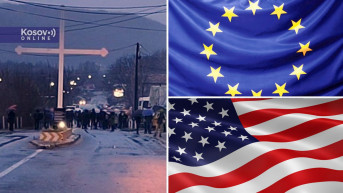
“All obligations from the dialogue must be fulfilled,” Western officials have reminded Belgrade and Pristina countless times. Is it now time for Belgrade to remind Brussels and Washington—if they have forgotten—of the guarantees given in 2022: that there would be no criminal prosecution lists targeting Serbs for participating in the barricades in the north? The wanted list issued by the Special Prosecutor's Office in Pristina for 11 Serbs who took part in the barricades confirms the powerlessness of the EU and the U.S. as mediators, analysts say. Incidentally, it also confirmed the foresight of one protest participant who said: “They’ll hunt us like rabbits.”
Written by: Dusica Radeka Djordjevic
“The only guarantee we gave is what Interior Minister Xhelal Sveçla already said—that the government and police of Kosovo have no lists for arrests. We have no lists of people we are monitoring or prosecuting,” stated Kosovo Prime Minister Albin Kurti on December 30, 2022, a day after the barricades were removed.
And yet, beyond the wanted list for 11 Serbs, Pristina is now conducting an investigation against around 50 individuals for criminal offenses including “obstructing an official in the performance of duties, inciting resistance, and participating in unconstitutional activities.”
Considering that proceedings against Serbs have already begun, interlocutors of Kosovo Online have differing views on whether they could be halted based on the guarantees Belgrade received from the EU and U.S. three years ago. They also interpret the nature of those promises differently. One view holds that the promises remain binding today, while another argues they probably carry little weight because they were never formally codified.
In a joint statement by the EU and U.S. dated December 28, 2022, regarding tensions in Kosovo, it was stated: “We welcome the assurances from Kosovo's leadership confirming that there are no lists of Kosovo Serbs for arrest or prosecution due to participation in peaceful protests/barricades.”
Associate professor at the Faculty of Law at the University of North Mitrovica, Dusko Celic, believes the warrants issued by the Special Prosecutor’s Office in Pristina for 11 Serbs could be revoked if Washington and Brussels reminded Pristina of the assurances it gave three years ago that there would be no such lists.
Even if Belgrade received only verbal guarantees from the U.S. and EU in 2022 that there would be no repressive measures against those involved in the barricades—guarantees based on which the barricades were taken down—Celic argues that, legally speaking, there is no reason not to respect them.
“If we interpret strictly according to the Vienna Convention on the Law of Treaties, even verbal agreements are binding. A verbal agreement is valid if both contracting parties agree to it. Such was, for example, the Tito-Brant agreement from 1973. We even had verbal agreements between Belgrade and Pristina over ID cards or license plates—all in verbal form. Therefore, it’s evident that part of the clauses here were also verbal, and it's to be expected that they be honored as such—especially as they were partly confirmed by the European Union and the U.S. State Department,” Celic told Kosovo Online.
However, he notes that when it comes to Serbs in Kosovo, the situation has long fallen into the realm of force, where law once again retreats and is defeated by politics and power.
“Legal experts, along with the Serbian negotiating team, should remind the international community of the guarantees it gave—of the verbal elements that were part of those agreements—which are equally legally binding and must be respected. Pristina must not treat this like a buffet, picking what it wants to honor and ignoring what it doesn’t, using the rest to prosecute Serbs. If allowed, hundreds or thousands of Serbs could be prosecuted by Pristina. This must not be allowed—there is no legal, political, or moral justification for it,” Celic emphasized.
He argues that Pristina, by issuing these warrants, is skillfully taking advantage of the current international momentum, where Kosovo is not a central concern for the U.S., but rather on the margins.
“It is up to Serbia to use all available diplomatic means to highlight that this is not only Pristina’s obligation but also that of Washington and Brussels, who assumed it during the negotiation process—whether as direct facilitators or as shadow players, as was the case with the U.S.—and to remind them that they too bear responsibility for the human rights situation of Serbs in Kosovo and Metohija,” Celic said.
Milica Andric Rakic, program manager at the NGO New Social Initiative, however, believes that the EU and U.S. statement was not a formal guarantee, although she admits that at the time there was sufficient belief in the international community’s ability to enforce even verbal commitments.
“Much has changed since then, and the Government in Pristina no longer collaborates with the international community in the same way. It feels emboldened to violate previous commitments, especially those not firmly formalized, and today it seems those promises no longer apply—unless the international community, specifically the EU or U.S., takes serious steps to remind the Kosovo government of the promise it made,” Andric Rakic told Kosovo Online.
She suggests that perhaps a more formal guarantee should have been insisted upon at the time, ideally something signed. Since then, she notes, both the EU and U.S. administrations have changed, making it more difficult to remind the new officials of what had transpired.
“Unfortunately for those who were on the barricades, this was not a formal guarantee by the U.S. and does not formally bind the new administration. I believe there are other diplomatic mechanisms that could be used to shift the situation and stabilize it, but the reality is that neither the EU nor the U.S. is currently willing to invest more resources or diplomatic effort—and it has been clear for years now that the amount of diplomatic pressure they are willing to apply to the Kosovo issue is insufficient,” said Andric Rakic.
As for what Serbia could do to protect the Serbs who were on the barricades and have been indicted, she said it could only pursue asymmetric approaches and adopt measures against Kosovo similar to those previously taken by Pristina against Belgrade, such as trade barriers or reciprocal actions.
“The problem for Serbia, however, is that any measure it might impose on Kosovo—particularly regarding trade or transit—would inevitably punish the Serbian community in Kosovo as well. Kosovo effectively holds 50,000 to 100,000 hostages, i.e., Kosovo Serbs, who would suffer just as much as the Kosovo administration under any such measures Serbia might impose. The other option is for Serbia to persuade the EU and U.S. to act in its stead, but so far, Serbia has been unable to convince them to take a firmer stance against the Kosovo authorities,” Andric Rakic pointed out.
Political scientist Ognjen Gogic also believes the promises and guarantees made in 2022 now mean very little and are not valid because they were never incorporated into Kosovo’s legal system.
“Such promises are wishful thinking. When guarantees are given, they must quickly be translated into legal norms. For example, there could have been a general amnesty for criminal prosecution related to participation in the barricades, and Kosovo’s institutions could have adopted a legal act to that effect. Anything short of that, as we’ve seen, is an empty promise,” Gogic told Kosovo Online.
He also believes that the initiated legal proceedings cannot now be halted.
“No one in the international community will now come out and say they oppose judicial proceedings, as that would imply interference in the judiciary. It is unrealistic to expect them to demand the halting of proceedings once they have been initiated. Those guarantees should have been used earlier to ensure that Kosovo adopted acts to shelve the matter,” Gogic added.
He also notes that there have been many unfulfilled promises by the EU and U.S. as guarantors of the dialogue, all of which “demonstrates their impotence as mediators.”
“They presented themselves as mediators capable of ensuring the implementation of agreed commitments—but that simply didn’t happen,” he concluded.
To recall, the barricades that led to the warrants against Serbs were set up on December 10, 2022, with protesters demanding the release of arrested compatriots and the withdrawal of special police units from the north. The barricades were removed on December 29 following an agreement with Belgrade, after Serbian President Aleksandar Vucic conveyed to Kosovo Serbs the assurances from the EU and U.S. that there were no lists for arrest or prosecution due to participation in peaceful protests.


0 comments