
What will the Constitutional Court tell the MPs, was there a misstep?
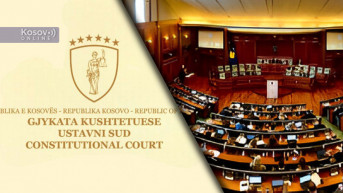
Is the Assembly of Kosovo considered constituted if its deputy speaker representing the Serbian community has not been elected? This dilemma, as well as whether the rules were violated during the vote for deputy speakers from minority ranks, is expected to be resolved by a decision of the Constitutional Court in the next two days. The Court could rule that the procedure for electing deputy speakers from non-majority communities was against the rules and return the voting process to the beginning, or it could decide that there was no violation, in which case the Serbian deputy speaker would be elected later, which is something that has not been the practice so far, interlocutors of Kosovo Online point out.
By: Dusica Radeka Djordjevic
The Self-Determination Movement expects the Constitutional Court to confirm the constitution of the Kosovo Assembly.
Researcher at the Kosovo Law Institute, Melos Kolshi, however, believes that the Assembly has not been constituted.
Analyst Bekim Kabashi warned that the Court will have to be very cautious, as it will deliver a decision that defines the protection of the constitutional order at its most sensitive point – the rights of communities.
To recall, MPs from the Serb List filed a complaint with the Constitutional Court on August 30, claiming serious violations of the rights of the Serbian people during Assembly sessions. This party essentially challenges the way the process of electing deputy speakers from minority communities was carried out, arguing that the vote for the two deputy speakers from non-majority communities – the Serbian and other communities – should have been held jointly. Holding separate votes, according to the Serb List, was not in line with applicable rules.
On the other hand, Self-Determination spokesperson Arlind Manxhuka believes it would be absurd for the Constitutional Court to challenge the election of Bosniak MP Emilija Rexhepi as deputy speaker of parliament, since her candidacy was voted on separately from the candidate who must represent the Serbian minority.
Who is interpreting Kosovo’s regulations correctly will ultimately be decided by the Constitutional Court, which, following the Serb List’s complaint, issued a temporary measure in effect until September 30, prohibiting MPs from undertaking any activities or initiating procedures for forming a new Government of Kosovo.
At the expiration of this temporary measure, three scenarios are possible, according to constitutional law professor Mazllum Baraliu.
“We expect the Constitutional Court to make a decision as it deems appropriate. Either it will decide that the Assembly has been constituted, in which case a representative of the Serbian minority community can be elected at one of the upcoming Assembly sessions, or it will say that the process was not completed and that, due to some provision of the Rules of Procedure, which is a bylaw of the Assembly, that process needs to be renewed. The third solution would be to call snap elections,” Baraliu told Kosovo Online.
He notes that the Court’s decision should be known immediately after the expiration of the temporary measure, although, as he says, it could be delayed by a few days or even a week.
“That depends on them, but we should have a decision because this is a very urgent matter, the constitution of the institutions, since both the Assembly and the Government have been prevented from functioning,” Baraliu says.
Basing his view on past practice in constituting the Assembly of Kosovo, when Serbian deputy speakers were always elected, Milos Pavkovic, Director of Strategy at the Center for European Policy in Belgrade, told Kosovo Online that one should expect the Constitutional Court to deliver a decision that “follows” the Serb List’s complaint, namely, to declare the constitutive session unconstitutional.
Such a decision, he added, would mean ordering a repeat election of the Assembly president and deputy speakers, which would include the election of a representative of the Serb community, i.e., from the Serb List.
Taking into account the Court’s earlier ruling that the election of the Assembly president must be by secret ballot and limited to a maximum of three attempts, he expects the process to return to the beginning, requiring the election of all deputy speakers as well as the Assembly president, within the constraints of the previous ruling.
“This means that either a decision will have to be made within a reasonable timeframe, or snap parliamentary elections will be called,” Pavkovic said.
He emphasized, however, that there is also another option, though in his view less likely.
“That would be for the Constitutional Court to say that no violation of the Constitution occurred and that the Assembly is considered constituted even without Serbian representatives. This is a less likely scenario because, in previous political practice regarding the Assembly’s constitution, such a situation has never occurred. So I would not expect the Constitutional Court to legitimize in this way a breach of parliamentary procedure and the Constitution of Kosovo,” Pavkovic believes.
Attorney Tome Gashi, on the other hand, regarding the expiration of the temporary measure on Tuesday, says the Court does not need to accept that only the Serb List represents the Serbian people living in Kosovo. At the same time, he argues that the Constitutional Court “seems to have become a political party,” as it has ruled three times on the formation of Kosovo’s institutions since the February 9 elections.
“Every Serbian political party has the right to represent Serbs. The deputy speaker of the Kosovo Assembly can be anyone who secures enough votes, be it Mr. Rasic or someone else who gets 61 votes in parliament. That person must be deputy speaker of parliament, not always someone from the Serb List,” Gashi told Kosovo Online.
However, the Rules of Procedure of the Kosovo Assembly are clear on this point. “The candidate for deputy speaker of the Assembly from the Serbian community shall be proposed by a majority of MPs from the Serbian community,” Article 12 of the Rules states.
Journalist from North Mitrovica, Lazar Stevic, stresses that the deputy speaker position reserved for the Serbian community is constitutionally guaranteed to the largest Serbian party in parliament, which in this case is the Serb List.
Stevic is convinced that Self-Determination will “continue with the same narrative it held even before the Court’s decision” after September 30, because, as he says, that party refuses to allow someone from the Serb List to become deputy speaker of the Assembly, even though this position is constitutionally guaranteed to the largest Serbian party in parliament.
“We’ll see what happens, whether the Assembly will elect a legitimate deputy speaker from the Serbian community, or whether Self-Determination and its coalition partners will continue playing this political game and pushing for representatives of the Serbian community who are a minority in parliament, and we all know that means Nenad Rasic and his party,” Stevic told Kosovo Online.
Self-Determination MP Mimoza Kusari Lila has already announced that the Serb List’s candidate will not get their votes.
“There will be no vote in favor of the Serb List or its representative within the Self-Determination, Guxho, and Alternativa parliamentary group,” she stated.
If such positions are a sign that the parliamentary deadlock will continue, Stevic sees new parliamentary elections as the logical next step.
“There are legal deadlines if it comes to that. Most likely, after the local elections, Kosovo will very soon also face new parliamentary elections,” he concluded.



0 comments