
Opposition: Large allocations for investment do not guarantee success, projects are years behind schedule
The draft budget envisages allocating more than €1 billion for capital investment next year, but the Democratic League of Kosovo (LDK) and the Alliance do not believe that such large figures guarantee that projects will actually be implemented, pointing out that some projects in Kosovo are already years behind schedule.
LDK MP Lutfi Haziri said that the planned figures were repeated year after year, while in reality they concerned the same projects.
“The same figures appear every budget year, and they concern projects that have already been launched and were initiated by previous governments. We are not talking about a single project that could be associated with this Government’s capital investments. The most scandalous example is the Pristina bypass, for which €1 million has been allocated,” Haziri told Ekonomia Online.
He said that infrastructure projects in Pristina, as well as in other regions, were facing problems with planning and financing.
“Pristina Mayor Perparim Rama has been working on the Pristina bypass project for some time. This has been going on for 10 years as part of the mayor’s responsibilities. All the necessary steps have been taken to approach the project seriously and move it forward. Unfortunately, it is evident that a certain degree of pressure continues through the policy of budgetary restrictions. More or less every region faces the same problem. We are still talking about the highway to Gjilan, which is significantly behind schedule. There is no plan, no adequate budget planning, nor is there any discussion of regional roads or EBRD loans,” Haziri said.
He said that, given such an approach to governance, it was unlikely that the projects would be implemented and completed or that other public investments would be launched.
Asked which investments should be addressed urgently, Haziri cited the completion of highways and the linking of regional roads, as well as wastewater treatment projects.
“Of course, there are also other public investment programs because, unfortunately, we have not seen this Government launch or complete any investment. Even the planning for next year is merely a repetition of figures, projects and promises that have no timeframe, no deadlines and no budget lines that would guarantee their implementation. We will address this issue,” Haziri added.
Alliance parliamentary group leader Besnik Tahiri also questioned the Kosovo Government’s ability to implement capital investments, stressing that the fact that only 35 to 40 percent of the funds earmarked for this category were being spent had a direct impact on economic development.
He said that the draft budget failed to address the main needs and problems facing Kosovo, assessing that its focus was more on social measures than on investments that would stimulate economic development.
“These funds have been carried over from the previous period. In other words, that €1 billion represents carried-over funds because no more than 40 percent of the funding earmarked for capital investment was spent in 2026,” Tahiri said.
He noted that not a single road whose construction began in 2021 had been fully completed.
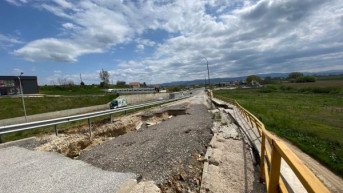
“The highway to Gjilan has not been completed. In fact, work has been suspended and is not currently being carried out. The Pristina–Gjilan road is a ‘road of death.’ The Pristina–Dollc–Gjakova road has also not been fully completed. It is a ‘road of darkness’—a road without any traffic signs, and only God knows how it functions, because the human hand, the hand of the Kosovo Government, has failed to do what it should have done: install the necessary signage and complete the works five years ago. Traffic is blocked at the intersection near Klina. The bridge in Vranidoll, which was supposed to ease traffic on the Pristina–Peja route, has not been completed. The situation remains unchanged. Most importantly, construction has not begun on a single new highway, including the Pristina bypass,” Tahiri said.
For that reason, he considers the infrastructure promises contained in the 2027 budget to be an electoral deception.
“It will simply be the same empty story, a continuation of the same practices we have seen so far,” Tahiri said.
Economist Fidan Qerimi assessed that a capital investment implementation rate of around 35 percent was extremely low, noting that unused funds were carried over from year to year, resulting in substantial amounts accumulating over time without providing any benefit to citizens.
He said that the Government should introduce legal, organizational and structural changes to increase the project implementation rate and ensure that citizens experience tangible benefits from these investments.
“The Kosovo Government should determine where the obstacles preventing the implementation of capital investments lie. An implementation rate of 35 percent is extremely low. In fact, this can be described as a failure by the Government to implement capital projects. It is necessary to identify where the bottlenecks occur, introduce appropriate changes—whether legal, organizational or structural—and improve the implementation rate. Once we increase the implementation rate of capital investments, the completed projects will become visible and tangible to citizens,” Qerimi said.

0 comments