
Old debts
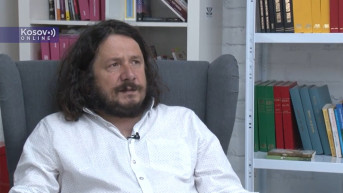
Writing for Kosovo Online: Muharem Bazdulj, writer and journalist
After the coronavirus pandemic and the accompanying inflation, which this war in Ukraine followed, is there anything else that can be bought for a hundred Serbian dinars? And just one hundred Serbian dinars was taken from me the other day by a book dealer from a flea market for the "Book of Poems of Younger Yugoslav Poets" published a year after my birth, in 1978, that is, in even, for today's circumstances, an almost unbelievable twenty thousand copies.
In this bookstore published jointly by “Nolit”, “Prosveta”, and the Public Institute for Textbooks, a total of seventy (then younger) poets from all Yugoslav nations and most nationalities were presented.
I haven't had a more inspiring book in my hands for a long time. Five or six monographs, a dozen films, fifteen or twenty radio or television shows, and fifty newspaper articles could be made based on this book. The Yugoslav poetic "young national team members" later played for various national teams, mostly in important positions.
The anthologist Aleksandar Petrov obviously did a good job. It is confirmed by time, time always tells. Those seventy names and surnames sound like a song today: Vladan Radovanovic, Franci Zagoricnik, Danijel Dragojevic, Petre Andreevski, Zeljko Falaut, Rajko Sjekloca, Bozidar Sujica, Radovan Pavlovski, Branislav Petrovic, Aleksandar Sekulic, Ivan Gadjanski, Zvonimir Mrkonjic, Zvonimir Majdak, Josip Sever, Azem Skrelji, Matija Beckovic, Bogomil Djuzel, Svetlana Makarovic, Dubravko Horvatic, Igor Zidic, Nikica Petrak, Bozidar Milidragovic, Tito Bilopavlovic, Milan Komnenic, Bosko Bogetic, Gojko Djogo, Miroljub Todorovic, Zarko Rosulj, Slavko Almazan, Oto Tolnai, Istvan Domonkos, Kalman Feher, Niko Grafenauer, Tomaz Salamun, Milutin Petrovic, Branislav Prelevic, Milan Milisic, Vujica Resin Tucic, Ranko Jovovic, Ali Podrimja, Adam Puslojic, Borben Vladovic, Vicazoslov Hronjec, Ahmed Muhamed Imamovic, Abdulah Sidran, Goran Babic, Istok Gajster Plamen, Ymer Shkreli, Ferenc Maurits, Josip Osti, Rajko Petrov Nogo, Miroslav Maksimovic, Simon Simonovic, Mirko Magarasevic, Isak Ahmeti, Atanas Vangelov, Eftim Kletnikov, Stevo Tontic, Dzemaludin Alic, Tomislav Marjan Bilosnic, Rasa Livada, Sonja Manojlovic , Branko Cucak, Ivo Svetina, Matjas Hanzer, Julian Tomas, Ljupco Siljanovski, Sabri Hamiti, Milan Jesih, Joan Flora.
The poets are ranked by age. The oldest was born in 1932, and the youngest in 1950. It is a good illustration of the poet's youth, at least as it was perceived in socialist Yugoslavia, from the age of twenty-eight to forty-six. Those younger than twenty-eight are still in the junior competition and not really suitable for anthologizing, and those older than forty-six are already bards or potential bards. Everyone in between belongs to "young poetry".
When you read the names and surnames from the list today, you are immediately aware that many are dead. Some of them left behind the legacy of the "greats of national literature", which is why prestigious literary awards are named after them. Some others, both in life and in death, remained on the noble sidelines. The same applies to the living: some "shake" academies and public life, while others cultivate their garden.
Some were forgotten by poetry, some forgot poetry. Regardless, however, an unusually large number of poems from this book have aged beautifully. And regardless of the initial context of the creation of any poem, the wonder of poetry comes largely from its potential universality.
Azem Shkreli is represented in this book with two poems. They were translated from Albanian to Serbian by Esad Mekuli. His younger brother Ymer Shkreli is represented with only one poem, and that poem was translated from Albanian to Serbian by himself, Ymer Shkreli. The poem is translated as follows:
PENDULUM
Don't touch my heart because I will give it away
I pay old debts with my skin
how will you fare this winter
I don't know why, but this song really hits me these days. This "pendulum" is unusual in today's Serbia and evokes the word "balance". (Edgar Allan Poe's famous story is translated in our country as "The Well and the Pendulum", i.e. "The Pit and the Pendulum", solutions that sound poetic in this mirrored way.)
I don't know if there are any broader social connotations in this poem, that is, if the poet took it into account when composing the verses. Today, however, it seems to describe the fate of the Serbs from Kosovo and Metohija.
I don't know if anyone remembers Ymer Shkreli today. The national award for literature awarded by the Pristina Ministry of Culture, Youth and Sports for lifetime achievement is named after his brother Azem.
In the books, however, which are over forty years old, Ymer's verses that he translated himself, as the people would say, "do the job". If there is literary immortality, it begins like this.

0 comments