
Rankovic and the Orthodox New Year in 1967
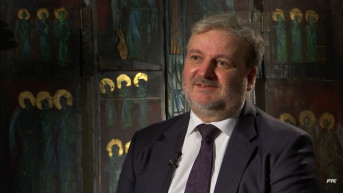
Writing for Kosovo Online: Dragan Bisenic, journalist
Not even four decades since the death of the former Vice President of Yugoslavia, Aleksandar Rankovic, have all the doubts and unclear circumstances that led to his dismissal at the Brijuni Plenum in 1966, and then the mythologizing of his personality into a national symbol, been clarified.
The fall of Aleksandar Rankovic Leka, a close associate of Josip Broz Tito, remained one of the most controversial events in the history of communism in Serbia and Yugoslavia. The Brijuni Plenum is considered one of the key events that reshaped the Yugoslav state and laid the foundations for its future disintegration, so Rankovic is also considered a symbol of the guardian of Yugoslavia's survival. Because of all this, there is almost undiminished public interest in almost everything related to these events. This particularly refers to the reputation of Aleksandar Rankovic as a protector of Kosovo Serbs, and on the other hand, his stigmatization in the eyes of Kosovo Albanians.
In the consciousness of Kosovo Albanians, the flourishing and revival of the national idea and the movement towards the creation of a state as an intermediate stage in unification with Albania began with the removal of Rankovic. When the Serbian question in Kosovo was raised in the early 80s, it got its strongest expression precisely at the mass funeral of Rankovic, where slogans about Rankovic and Kosovo were chanted.
Historical facts are very often quite different from what popular representations give.
The Albanians from Kosovo and Metohija strongly identified with the Italian-German occupiers, so the partisan units fought bitterly with them for the liberation of Kosovo and Metohija. Hostility towards Serbia and Yugoslavia will remain a permanent feature of political life in this province, and therefore, it was a special reason for the increased action of the security authorities.
Until his replacement at the Brijuni Plenum, Rankovic can be found in party roles that are fundamentally different. For example, Tito's wife Jovanka said on several occasions that immediately after the war, while there had been strong plans for the annexation of Albania to the Yugoslav Federation, Rankovic, together with others, had been in charge of the issue of the immigration of the Albanians from Albania to Kosovo.
In addition, Rankovic publicly opposed the emigration of the Albanians to Turkey based on the agreement concluded by Tito and the Minister of Foreign Affairs of Turkey Mehmet Fuat Koprulu in Split and based on which the wave of Albanian emigration started.
In his memoirs, Fadil Hoxha also writes about how he met with Aleksandar Rankovic, wanting to explain to him that equating the Albanians with the Turks is a "cultural legacy" and not an "ethnic denomination" of the Albanians. He was keen to discuss this issue with Rankovic who, since then, has been saying that the Albanians should not leave Yugoslavia, but only the Turks. According to independent estimates, more than 80,000 Albanians immigrated to Turkey between 1953 and 1966.
The real connection between Rankovic and Kosovo begins when, at the Brijoni Plenum; Kosovo and Metohija become an illustration and the central point of the indictment for deformations in the State Security Administration, which is identified with Rankovic, even though he has not had formal connections with it for several years.
After the removal of Rankovic, party leadership from Kosovo and Metohija began a wide-ranging crackdown on the security forces, and together with that, the disavowal of Serbian leaders as political patrons of such irregularities is rapidly progressing. Serbian leaders were replaced in waves, without the opportunity to influence their own destiny. Soon after, a few months later, they started to leave Kosovo and Metohija, followed by their relatives, followed by many others, which started the process of emigration of the Serbs from Kosovo that lasted until the breakup of Yugoslavia.
After the Fourth Plenum of the Central Committee of the League of Communists of Yugoslavia, the most important activity "on the interpretation and implementation of the tasks of the plenum" conducted in Kosovo and Metohija was "differentiation in the work of the State Security Service in the area of Kosovo and Metohija". Thus, in September 1966, from Pristina, the assessment of the Provincial Committee of the League of Communists of Serbia for Kosovo and Metohija on the differentiation in the security services was sent to the Central Committee of the League of Communists: "The most difficult differentiation related to the mistrust of the State Security towards Shqiptari as a suspicious element and dangerous for the socialist society".
As an example of this, the Prizren process was cited, as well as the existence of a large number of monitoring of party and other functionaries, the eavesdropping of the Provincial Committee of the League of Communists of Serbia members, the closure of the Secretariat of the Ministry of Internal Affairs and the State Security for cadres of "Shqiptar nationality".
The document has a total of 31 pages and it concludes that the State Security Service tried to form an opinion on the threat of Kosovo and Metohija. The most severe deformation, according to this report, was "the collection of weapons in the winter of 1956, which was initiated and prepared in the province, the Republic, and with the consent of Rankovic and Stefanovic. The goal was to portray the Shqiptars as hostile towards Yugoslavia. The action of collecting weapons is evaluated by the Provincial Committee of the League of Communists of Serbia for Kosovo and Metohija as a kind of pressure for the emigration of the Albanian minority, which is "a reckoning with the Shqiptar nationality".
"According to the available materials, the State Security Service authorities had a tolerant attitude towards the phenomena of Greater Serbian nationalism and the Greater Serbian reaction in general",
The identification of Rankovic and the Serbian issue in Kosovo, but in the opposite direction, as a Serbian protector, began very quickly. A decisive role in this was played by the celebration of the Orthodox New Year in 1967, when for the first time the dissatisfaction of Kosovo Serbs with the development of the situation in the province was explicitly expressed. In Pristina, Prizren, and several other cities in Kosovo, several dozen Serbs gathered to mark January 13, the beginning of the New Year according to the Orthodox calendar. The meaning of that event was that, since the end of the war, the Orthodox year was celebrated only in churches as a religious holiday.
In 1967, after more than two decades, these celebrations received a national mark. At those celebrations, Serbian songs from the First World War were sung, and church bells rang at midnight. During those celebrations, the crowd cheered for Aleksandar Rankovic and Milovan Djilas. What was curious and almost paradoxical was that they cheered not only for Aleksandar Rankovic, but also for Milovan Djilas, but this also in a way speaks of the drive and need of the Serbian population for someone to take them in for protection, after everything that happened in Kosovo since the end of the Brijuni Plenum. Because of this, the Serbs showed solidarity with the police and state security leaders who were immediately under investigation and who had already been convicted.
That could be understandable because it was the members of the Ministry of Internal Affairs who held the Albanian separatists and tried to ensure a tolerable level of personal security for the Serbs and Montenegrins in Kosovo.
Both of them were obviously cheered just because they were Serbs, that is, Montenegrins, so they became some kind of icons for a part of the Kosovo Serbs. A part of the Kosovo Serbs experienced their removal as revenge for their Serbian or Montenegrin origin. Rankovic was unjustifiably declared a Serbian nationalist, and Djilas was removed from all positions as early as 1954 due to criticism of the party from democratic positions and he always refused any manifestation of nationalism.
These celebrations were soon on the agenda of the Executive Committee of the Provincial Committee of the League of Communists of Serbia for Kosovo and Metohija. At the meeting held on January 20, it was assessed that this was an aggressive display of Serbian nationalism and an unacceptable expression of resistance to changes aimed at "establishing ethnic equality". The organizers of "Serbian nationalist excesses" were labeled as reactionary forces, which include "richer artisans, disaffected intelligentsia and unspecified forces operating outside the province".
These events were used as confirmation of the adopted new policy on "Serbian chauvinism" as the "main danger" that threatens social stability in Kosovo and Metohija, destroys ethnic harmony, and hinders the construction of socialism.
These events motivated the party leadership to once again urgently request a meeting with Tito. That meeting was requested at the end of the previous year. Tito met with the Kosovo and Metohija delegations on February 23, 1967. The delegation included Veli Deva, Ali Shukriu, Ilija Vakic, Luka Vlahovic, and Kadri Reufi, and was attended by Fadil Hoxha, a member of the Presidency of the Central Committee of the League of Communist of Yugoslavia, and the secretary of the Executive Committee of the Central Committee of Communist of Serbia, Stevan Doronjski.
Before this meeting, Tito spent almost 10 days in the Soviet Union and then spent five days in Austria in the middle of February, so the Yugoslav President hardly prepared at all for this meeting and participated very passively in the conversation. The main speech at the meeting was led by the Albanian participants, so it was basically a conversation between them and Tito because only Deva, Hoxha, and Shukriu spoke.
The President of the Kosovo-Metohija party, Veli Deva, emphasized that the results of the Brijuni Plenum met with massive approval and were widely accepted. Immediately after that, he moved on to an extensive explanation of the necessity to "correct previous irregularities" due to the illegal actions of the State Security Administration.
In the context of the "illegal actions" of the security authorities, Veli Deva spoke at length about the Prizren process. The main reason for this digression was the intention to convince Tito that State Security, together with Rankovic, constructed the entire process with the aim of discrediting Fadil Hoxha and Xhavit Nimani and removing them from political life.
In describing inter-ethnic relations, Deva declared a part of the Serbian population, especially officials, intelligentsia, and senior citizens, to be the source of the conflict.
Tito did not praise the leadership for their actions, but he devoted most of his speech to the issue of irregularities in the work of the security authorities, where he said that a "witch hunt" was not being launched and that "honorable policemen who protected their country in difficult times" were not being persecuted.
After this meeting, Tito visited Kosovo and Metohija in March 1967, and the idea of Kosovo as a republic in the Yugoslav Federation began to be formulated among the Albanian leaders, which would practically complete Kosovo's statehood. As early as next year, demonstrations will be organized in Kosovo where the slogans "Kosovo Republic" will appear.
Aleksandar Rankovic was monitored and monitored daily, on the basis of which the largest dossier of a Yugoslav citizen was created, and Tito was always referred to him in the context of Serbian nationalism. Hence, Rankovic and the Serbian position in Yugoslavia became inextricably linked and remain so to this day, regardless of how well-founded or unfounded it is in reality.
0 comments