
Dacic at the UN Security Council session: Kurti's goal is to expel all the Serbs from Kosovo and Metohija
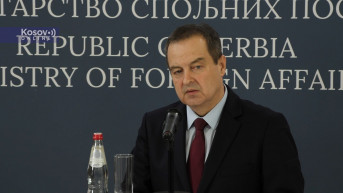
Serbian Deputy Prime Minister and Head of Diplomacy, Ivica Dacic, said at today's session of the UN Security Council that the Community of Serb-majority Municipalities had to be formed as soon as possible because it was the only possible mechanism to protect the rights and security of the Serbian community in Kosovo and Metohija. He added that, taking into account everything that had been done so far, "Albin Kurti will never fulfill the obligation to form the CSM, because his goal is not peace and the success of the dialogue, but to expel all the Serbs from Kosovo and Metohija".
The head of the Serbian diplomacy, Ivica Dacic, assessed in his speech before the UN Security Council that a "powerful minority" applies double standards in the interpretation of the UN Charter on Territorial Integrity, which implies that the same rules do not apply to Serbia as to some other countries, and called for the consistent application of Resolution 1244.
He assessed that the UNMIK report did not represent a basis on which the members of this body could create a picture of the situation in Kosovo and Metohija.
"On the ground, there is an atmosphere of fear and pressure towards the Serbs and other non-Albanians. It is necessary to consistently and fully implement the agreements from the Brussels Agreement," Dacic said in front of the ambassadors of the Security Council members.
"In this same hall on June 14, 2014, a session was held where the Brussels Agreement was assessed as historically important. The then Secretary-General Ban Ki-moon emphasized the importance of the Community of Serb-majority Municipalities, and the representatives of the US and France did the same," Dacic said.
He emphasized that Serbia would take all legal political and economic measures in order to protect the lives and basic human and political rights of the Serbs and other non-Albanians in Kosovo and that in order to continue the comprehensive social and economic progress of Serbian communities, the Government of Serbia through a special investment program would accelerate infrastructural development and increase financial support measures for the economy, farmers, youth and socially vulnerable categories.
Either respect Resolution 1244 or abolish it, and then you have abolished the UN
"I am addressing you at a time when calls to respect the Charter of the United Nations have never been heard louder in this respected body. It is exactly these appeals that the Republic of Serbia has been making continuously for the past twenty-four years, but with one small and significant difference. By the powerful minorities, we are led to believe that the example of Kosovo and Metohija is the so-called sui generis. Throughout history, it has been shown that such exceptions create precedents, and precedents greatly influence the existing rules and interpretations of norms of international law. It is obvious that there are double standards that lead to different looks at the universal principle of respect for the territorial integrity and sovereignty of each UN member state. This does not seem to apply to Serbia. That is why it is my duty to call for the consistent application of the valid, I repeat - the valid Security Council Resolution 1244, which, unfortunately, to this day has not been consistently and fully implemented. At the same time, in accordance with this resolution, we call for the undiminished presence and action of UNMIK in its unchanged capacity, full scope, and mandate. Resolution 1244 as your 1999 act is still in force. Either abolish it or respect it. And if you don't respect it, then the UN no longer exists," Dacic said.
He assessed that the agreements in Brussels on February 27 and Ohrid on March 18 had achieved the preservation of the dialogue process and that this process was at a decisive moment, and he also called for the implementation of the Brussels Agreement from 2013.
The Head of Diplomacy of Serbia reminded that after the signing of the Brussels Agreement, many in the UN Security Council had declared that the CSM had to be formed, but that even 10 years later that had not happened.
"We are aware that Pristina is deliberately avoiding this obligation, and it is devastating that they only start talking about this important topic on May 2, even though it is recognized as a key and first step in the implementation of the European plan, and that no less than by the high representative of the EU for the Foreign and Security policy Josep Borrell, who told the entire European community that the Community of Serb-majority Municipalities had to be formed immediately. We are sure that, considering everything that has been done so far, Kurti will never fulfill the obligation to form the Community of Serb-majority Municipalities, because his goal is not peace and the success of the dialogue, but to expel all the Serbs from Kosovo and Metohija. And as you know, the formation of the CSM is the first and necessary condition for the further implementation of the agreement from Brussels and Ohrid. In other words, it is necessary that all the people living in Kosovo and Metohija are ensured a dignified and normal life. I would like to emphasize that the Republic of Serbia will take all legal political and economic measures to protect the lives and basic human and political rights of the Serbs and other non-Albanians in Kosovo and Metohija. In order to continue the comprehensive social and economic progress of Serbian communities, the Government of Serbia, through a special investment program, will accelerate infrastructural development and increase financial support measures for the economy, farmers, young people, and socially vulnerable categories," Dacic said.
Kosovo and Metohija became an ethnically clean territory from a multi-ethnic environment in 20 years
"I will repeat the information that more than 40,000 Serbs lived in Pristina, and that today there are less than 100 of them. In the ancient imperial city of Prizren, where I was born, and which today I need permission to visit, there used to be more than 10,000 Serbs, there are about twenty left, and so on, and so on... What words would you use to describe this phenomenon, according to which the systematic elimination of all the Serbs is being done while taking away all their rights? Is there support for this kind of destructive action and who is providing it? It is devastating that after 24 years since the UN Security Council Resolution 1244, the Report still states the number of 200,000 displaced persons from Kosovo and Metohija, and that the return is at such a low level (in the report we are currently considering, 112 voluntary returns were recorded, of which 60 were Kosovo Serbs) that at this rate, we need centuries for all the exiles to return to their homes and to their hearths. You heard me right, centuries. The return, which is still less than 2 percent, is the lowest percentage of returnees in post-conflict areas in the world. Is this information the result of the democratic development of Pristina and its contribution to the peaceful coexistence of the Serbs and Albanians in Kosovo and Metohija," Dacic asked.
He said that we were all witnesses that the Serbian Orthodox spiritual heritage in Kosovo was subject to attacks by Kosovo Albanians on two grounds.
"They claim that heritage as medieval Albanian objects or falsely present it as Byzantine or Illyrian. In the 21st century, we are witnessing the erasure of history, the destruction of certain buildings of the Serbian Orthodox Church, the desecration of Orthodox cemeteries, and the denial of the right to freedom of religion. Is this the principle of self-determination some at the expense of eliminating others? Pristina's goal and intention to erase the traces of everything Serbian in Kosovo and Metohija is evident in this action. Add to that the current trend of frequent ethnically motivated attacks on religious holidays. The wounding of an eleven-year-old boy, Stefan Stojanovic, and his twenty-one-year-old cousin Milos Stojanovic, whose sin was celebrating the Orthodox Christmas and going to the forest to cut the holy Serbian Christmas tree, raise a question of what message we are sending to the remaining Serbs in Kosovo and Metohija? What opportunities have we created for the return of 200,000 Serbs who were exiled from Kosovo? What are the prospects for the remaining non-Albanian communities?", Dacic said.
Elections in the north lead to occupation
The Minister of Foreign Affairs of Serbia explained that the Serbs, revolted by this situation, had left the Kosovo institutions and insisted on the formation of the CSM and the withdrawal of Albanian forces from the north of Kosovo.
"Belgrade supported this type of peaceful protest and considers the demands of the Serbian community logical and legitimate. I would like to remind you that during the last year, the basic democratic right of the Serbs from Kosovo and Metohija was violated twice, when they were prevented from voting in the referendum and when, for the first time, no voting was conducted in the elections on April 3, which is in direct contradiction to Resolution 1244 and OSCE Decisions. Paradoxically, the current Pristina leadership insisted on the recent holding of special elections in four municipalities with a Serb majority community. Serbia is completely against the violent and illegal holding of extraordinary elections because the motive behind this decision by the current leadership of Pristina is completely clear to us - it is a clear attempt to forcibly take away the rights and competencies of the Serbian community and establish full control. And it is obvious that such a step has the support of some of the powerful minorities because recognizing extraordinary elections represents a kind of defeat of democracy, more precisely, it represents the occupation of the north of Kosovo and Metohija. I would like to remind you that the elections were held violently, with great pressure in the containers that were secured by the same persons who shoot at the Serbs and other non-Albanians. Naturally, only 13 persons of Serbian nationality and 1,566 Albanians voted in such elections out of a total of 45,095 people," Dacic said.
He asked those present whether they thought it was normal and legal that barely 2 percent of the population decided the fate of 98 percent of people at a time of pronounced inter-ethnic tensions.
"And all this at a time when consideration of Pristina's membership in the Council of Europe is forcefully imposed. This blackmail and political maneuver for delaying the formation of the Community of Serb-majority Municipalities for exactly ten years must be clearly and broadly condemned. The current Albanian leadership does not even care about the statutes, let alone for the common values of institutions whose membership they want to use to fulfill their mundane political goals. Pristina obviously believes that its precedent exceeds any right and that its every move will still be met with understanding. That may be true because visa liberalization with the EU which received does not include the Serbs from Kosovo and Metohija, rather it discriminates against Albanians. All the mechanisms of premature strengthening of Pristina's capacities only further complicate and disenfranchise the Serbian community. If the absence of reaction means approval, then one justifiably gets the impression of legitimizing and rewarding the destructiveness of the current Pristina leadership in the pressure on non-Albanian communities in Kosovo and Metohija. I believe you will agree that all this can hardly fall under the definition of compromise," Dacic said.
The process of Kosovo's admission to the Council of Europe undermines the dialogue
He warned that Pristina's behavior prevented constructive dialogue and the search for a peaceful solution to the situation.
"From my presentation so far, you had the opportunity to hear only part of the problems and the disturbed security situation in Kosovo and Metohija, with which the other side is deliberately preventing us from focusing our full attention on finding a compromise. A year is too much, and it is unacceptable to wait 10 years for the fulfillment of the assumed obligation. We must not neglect these obligations, because in this way we will completely let the people living in Kosovo and Metohija down. We must sincerely dedicate ourselves to the dialogue, but unfortunately, I am convinced that on this occasion, too, in the presentation of the representative of Pristina, we will hear a series of accusations against Serbia regarding the obviously different interpretations of the Ohrid agreement, as well as the fact that the focus will be on the consequences of the conflict in Kosovo and Metohija. On this occasion, too, Serbian responsibility will be invoked, and Serbia will be depicted as someone else's instrument. It is interesting that the representatives of Pristina talk so lightly about patronage, as well as that they always emphasize the sole responsibility of Serbia and Belgrade. What they ignore is the loudness that their silence leaves when not a single word is heard about their responsibility for the current security situation, but also the failure to fulfill their obligations such as the formation of the Community of Serb-majority Municipalities. I must once again clearly and unequivocally call for the unconditional and urgent formation of the Community of Serb-majority Municipalities in accordance with the Brussels Agreement. It is unacceptable that discussions on this important topic only start on May 2, while at the same time, an action is being carried out within the Council of Europe that directly undermines this dialogue," the Minister of Foreign Affairs of Serbia emphasized.
Kosovo is sui generis for Serbia because it was created there
Dacic emphasized that for the 25th time before the UN Security Council, he was talking about how important Kosovo is for the Serbs.
"The Serbs have lived and are living in Kosovo and Metohija for centuries. And they will live.... This is evidenced, among other things, by our historical, cultural, and religious heritage, which we cannot and will not renounce. We have heard that when you want to justify the violation of international law regarding recognition of the unilaterally proclaimed independence of Kosovo, you use the expression sui generis as an alibi. It is true. It is true that for Serbia Kosovo is sui generis. This is where Serbia was born; this is where the essence of Serbian history and Orthodoxy lies. The four Serbian medieval churches on the UNESCO World Heritage List are in Kosovo and Metohija - the Peja Patriarchate from the 13th century, the Virgin of Ljevis from 1307, Gracanica from 1321, and Visoki Decani from 1335, which have been on the UNESCO list of world heritage in danger since 2006, and Decani as of 2021, they are on the list of the seven most endangered cultural monuments in Europe. The people of Decani were pelted with grenades, and graffiti of the Islamic State was written on churches. Albanians in Kosovo do not respect the decisions of their courts regarding church property. The head of the Serbian Orthodox Church, Porfirije, was banned from entering and performing religious ceremonies in Kosovo, entering the Patriarchate of Peja, which has been the seat of the Serbian Orthodox Church since the 13th century. And that's democracy, that's human rights. It is true that for Serbia, Kosovo is sui generis. As Jerusalem is sui generis for the Jews. As Mecca is sui generis for Muslims. As the Vatican is sui generis for Catholics. That's why here at the UN headquarters, I want to clearly say that Serbia cannot and will never recognize the unilaterally declared independence of Kosovo, nor will it accept Kosovo becoming a member of the UN," Dacic said.
He emphasized that he had repeated many times that Serbia wanted peace, wanted to talk, and to contribute to achieving the long-desired normalization of conditions and peaceful coexistence of the Serbs and Albanians.
He repeated Serbia's request that the UN Charter be applied equally to all members of this organization.
"Today, unfortunately, we are all aware of the consequences of supporting the unilateral declaration of Kosovo's independence in 2008. We tried to warn of the negative effects of such a move, which came true, opening Pandora's Box in international relations. The independence of so-called Kosovo led to serious turbulence. in international relations, the division between countries, both globally and in all international organizations and political groups. Fifteen years after the declaration of so-called independence, I want to tell you very clearly that 28 countries have withdrawn recognition of Kosovo and that out of 193 UN members, only 84 recognize Kosovo. There is no way for Kosovo to become a member of the UN," Dacic said.
He once again expressed his gratitude to "the majority of member states of the United Nations that did not recognize the unilaterally declared independence of Kosovo, respecting international law, aware, as we are, of the danger that unilateral moves that lead to the violation of the sovereignty and territorial integrity of one state may spill over to other regions and countries in the world".
0 comments