
Djuric: The rights of Serbs in Kosovo are being destroyed, piece by piece — Support for UNMIK’s work
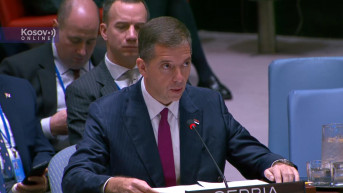
Serbia’s Minister of Foreign Affairs, Marko Djuric, told the UN Security Council today that the fundamental rights of Serbs in Kosovo are not only being neglected but are being systematically destroyed — piece by piece. He also warned that ethnically motivated attacks against Serbs in Kosovo have become routine. Djuric called on Security Council members to support UNMIK’s work, both to protect the basic rights of Serbs and to uphold international law as the foundation of peace and security.
“The rights of Serbs in Kosovo and Metohija are not only neglected — they are being systematically destroyed, piece by piece. This is not abstract — it is a fight for dignity, safety, and survival,” Djuric stated.
He expressed gratitude to UN Secretary-General António Guterres and UNMIK Deputy Head Milbert Dongjohn Shin for their report and commitment to fulfilling UNMIK’s mandate in line with UN Security Council Resolution 1244, as well as to former UNMIK head Caroline Ziadeh for her service.
Djuric highlighted that Kosovo has been witnessing ethnic attacks, systematic persecution, arrests, and violence against Serbs, calling it a direct challenge to the principles on which the European Union was founded.
He noted that the UNMIK report does not fully reflect the scale of tragedy experienced by the Serbian people, reminding the Council that Prime Minister Albin Kurti’s regime closed 128 key institutions in Serb-majority municipalities — including schools, healthcare centers, social service offices, the post, pension fund, employment agency, and even the Red Cross.
“The report notes that the Kosovo authorities continued shutting down institutions operating within Serbia’s system — including the city library, museum, and sports hall. It also mentions that international actors criticized these moves as obstacles to access to basic services, affecting the citizens’ social, economic, and cultural rights,” Djuric underlined.
He warned that ethnically motivated attacks have become routine, noting that there were 37 such incidents last year, including a recent attempted abduction of a young Serbian girl — whose attackers remain at large and unpunished.
“It sends a horrifying message to Serbs — that their lives are disposable. If you are Serbian, neither youth, vulnerability, nor innocence protects you. You are marked simply for being Serbian, for existing. This is a moral failure of the international community. What kind of future awaits children who grow up learning to hide their language?” Djuric asked.
He said these atrocities are not accidental, but rather the result of a policy of hatred embodied in Kurti’s doctrine of slow ethnic cleansing, whose goal is to expel Serbs from their homes, their holy sites, and the lands of their ancestors.
This, he warned, is further aggravated by the alarming militarization of Kosovo — including the rapid arming of the Kosovo Security Force (KSF) and the delivery of drones from Turkey.
“Such developments threaten the fragile regional security that has been maintained with great difficulty. Peace cannot be built by arming one side while ignoring the legitimate concerns of the other. This undermines the hard-won progress achieved during President Trump’s first term, which fostered hope for regional stability and partnership,” Djuric emphasized.
He noted that Kurti is not waging war against political opponents, but against an entire people.
“Politically motivated arrests, institutional abuse for intimidation, and secret warrants against Serbian representatives all undermine the rule of law and push the Serbian community into isolation,” the minister stressed.
Djuric also condemned the increasing attacks on Serbian Orthodox churches and monasteries, saying these are not acts of vandalism but deliberate attempts to erase the Serbian presence, sending the message that Serbs have no place in Kosovo.
“The regime in Pristina arrests priests and changes historical place names — as recorded in the report, which notes numerous incidents targeting Serbian Orthodox and Catholic sites in areas where Serbs are not the majority,” Djuric said, citing as an example the removal of the Cyrillic “Kosovska Mitrovica” sign with a red heart, replaced by an Albanian-language sign with green tones.
“This is symbolic warfare — suppression of language, rejection of Christian symbols, and erasure of Serbian traces. Add to that the renaming of Lake Trump — a name chosen by local Serbs in honor of peace efforts — and Kurti’s intolerance becomes clear,” Djuric remarked, recalling President Trump’s words that “if we want lasting peace, we must learn to see the world through the eyes of others.”
Djuric said that while Kurti refuses to do so, Serbia remains committed to mutual respect, justice, and coexistence.
He noted that the report also mentions Serbian murals and graffiti in four northern municipalities being painted over, as well as systematic violations of the Law on the Use of Languages, with traffic signs appearing only in Albanian.
In this climate of fear, over 20% of Serbs have left Kosovo in recent years, while only 17 returns were recorded during the reporting period.
“Since 1999, more than 230,000 Serbs have been displaced. Is that a multi-ethnic society?” Djuric asked.
Still, he stressed that the Serbian spirit in Kosovo remains unbroken, as demonstrated by recent local elections where the Serb List (Srpska lista) won in 9 out of 10 municipalities in the first round.
“This is not just a political result — it is an act of resistance,” he said, noting that even many Albanians in Kosovo are now rejecting Kurti’s radicalism and choosing peace over division.
Djuric addressed the Serbs in Kosovo, saying their perseverance is an inspiration to all, and that Serbia stands firmly with them, committed to their safety and progress.
He reminded that Kurti tried to ban the Serb List and deny Serbs the right to vote, violating even Kosovo’s so-called constitution by imposing political loyalists and annulling the will of the electorate.
“The Central Election Commission refused to certify the Serb List and Serbian Democracy, but the Quint countries, the EU Office in Pristina, and UNMIK all criticized this decision, warning that it undermines democratic principles and erodes trust in Kosovo’s institutions,” Djuric added.
He reiterated that Serbia remains committed to the EU-mediated dialogue, under President Aleksandar Vučić, working to preserve stability and development, seeking compromise instead of conflict, protection instead of dominance, and dialogue that requires the other side’s good will.
“We clearly state that Pristina must establish the Community of Serb-Majority Municipalities (CSM). This is not a request from Serbia — it is Pristina’s obligation, assumed before the EU and its own institutions,” the minister reminded.
Djuric accused Kurti of sabotaging dialogue, violating the Brussels and Washington Agreements, halting joint projects, refusing to recognize diplomas, endangering religious freedoms, and undermining Trump’s peace legacy, reigniting tensions in the Balkans.
“Serbia stands for stability, partnership over provocation, and dialogue over discord. We firmly defend our people and our rights. Peace must rest on justice, and every attempt at historical revisionism meets our unshakable truth,” he declared.
UNMIK’s role is irreplaceable
Djuric emphasized that UNMIK’s role is irreplaceable and that its mandate must not be questioned.
“Its presence in Kosovo and Metohija guarantees peace and the protection of human rights. Serbia firmly insists on UNMIK’s continued presence and on open Security Council sessions, because transparency is the only way to overcome manipulation. Serbia is not an obstacle — it is part of the solution, a reliable partner,” he said.
He added that the report acknowledged the concerns of non-majority communities, particularly Serbs in the north, over the closure of institutions providing basic services, stressing that these issues must be addressed, and that protecting the economic and social rights of minority communities is of crucial importance.
Kosovo’s authorities, he noted, must protect and promote human rights in accordance with international standards and the Convention on the Rights of the Child.
Djuric expressed his belief that Serb-Albanian friendship is possible in the future, as shown by positive bilateral steps between Serbia and Albania — once freed from Kurti’s apartheid-like nationalism.
“Let this session renew the UN’s eighty-year mission — to defend justice, peace, and human dignity. Ignoring the violations of Serbs’ rights undermines the world order. Serbia believes in dialogue, values peace, and seeks compromise — but silence in the face of injustice is complicity. Therefore, Serbia calls on this Council and the world: fully support UNMIK, condemn the violations of Serb rights, and defend international law as the foundation of security,” concluded Minister Djuric, adding that Serbia extends its hand for dialogue but will resolutely protect the Serbian people, their dignity, and sovereignty.


0 comments