
Djuric: Until the elections, Kurti will stop at nothing in pressuring Serbs and the Serb List
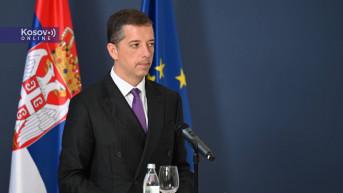
Serbian Foreign Minister Marko Djuric stated today that the decision of the Election Panel to uphold the Serb List’s appeal against the CEC’s refusal to certify its participation in local elections is not the end of troubles for that party and for the Serbian people, convinced that Albin Kurti will stop at nothing in pressuring the Serb List. He added that Kosovo is not a democracy, but rather turning into a defeat of democracy itself, precisely because of Kurti’s regime.
“I do not expect this to be the end of troubles for the Serb List and the Serbian people in Kosovo and Metohija. I am convinced that until election day itself, and even on election day, Albin Kurti will attempt to prevent Serbs from voting, from regaining control over institutions in the north, and that he will attack candidates of the Serb List,” Djuric told Newsmax Balkans.
In this context, he recalled what he described as a bombing attack on one of Serb List’s candidates, as well as arson targeting property and vehicles, which are acts, he added, that can reasonably be assumed to have been inspired by Kurti’s policies.
He emphasized that even the attempt to ban the registration of the Serb List for local elections shows that Kurti will stop at nothing, adding that Goran Rakic, former president of the Serb List, has also ended up on a wanted list of the Kosovo Police.
“I expect further persecution of Serb List candidates for mayor,” Djuric said.
He added that he expects Pristina to “push this matter all the way to the so-called Supreme Court” in an attempt to overturn Serb List’s candidacy.
Recalling that Kosovo’s acting Minister of Justice Albulena Haxhiu had called the CEC’s decision not to certify the Serb List’s participation in elections a “triumph of democracy,” Djuric said that something is needed to “open the eyes of those who may be used to viewing Kosovo on autopilot as a democratic project.”
“This is not a democratic project; Kosovo and Metohija is turning into a defeat of democracy thanks to Albin Kurti’s regime,” Djuric underlined.
He stressed that Serbs in Kosovo are the strongest guarantee of Serbia’s survival in that territory, which is why, he said, Kurti is targeting them.
At the same time, he highlighted that Serbia’s material support for the survival of the Serbian people there is greater than at any time in the past.
“This includes salaries, allowances, and various other forms of financial assistance. Serbia stands behind them,” Minister Djuric stressed.
He reiterated that Serbian officials use every meeting with representatives of the international community to point out the difficult situation of Serbs in Kosovo and to “unmask the apartheid policy carried out by Kurti’s regime.”
That will also be the case, he added, in today’s meeting with the EU Special Envoy for Dialogue, Peter Sorensen, who is visiting Belgrade.
Speaking about yesterday’s meeting with the OSCE High Commissioner on National Minorities, Christophe Kamp, Djuric said that he also conveyed to him what Serbs in Kosovo are facing.
“We had a long discussion, illustrating the consequences of shutting down 125 Serbian institutions in Kosovo and Metohija over two and a half years, from registries, sports halls, and archives preserving memory, to preventing the Patriarch of the Serbian Orthodox Church from visiting monasteries that are UNESCO world heritage sites, the expulsion of priests, and even attempts to seize churches. All of this amounts to attacks on the Serbian survival in Kosovo and Metohija,” Djuric said, noting that Serbia’s material assistance goes hand in hand with constant diplomatic activity aimed at raising awareness in the international community.
The Minister stressed that a new dynamic is needed, a turning of the page in the international community.
“If we want the international community not to suffer a fiasco with the concept of a multiethnic society in Kosovo and Metohija, the moment has come to support Serbia, the Serbian position, so that later on, some kind of solution could be reached in dialogue,” Djuric said.
He noted that the OSCE commissioner expressed concern over reports from the field.
“He is in Pristina today, expected to meet with Kurti, and I expect him, on behalf of the OSCE, to deliver strong messages to Pristina’s representatives,” Djuric said, adding that OSCE’s field reports serve as a basis for Serbia to demand that major powers adjust their approach to the situation.
When asked about the arrests of Serbs, the Minister said that the issue of political prisoners is something that must be addressed within the dialogue.
“I think the issue of political prisoners, of whom there are unfortunately several dozen at the moment, will have to be resolved politically within the dialogue. We currently have several dozen people imprisoned in Kosovo, some of whom have been serving time for years without due legal process,” Djuric pointed out.
He emphasized that it is impossible to imagine normalization of relations and improved cooperation without addressing these issues.
He recalled that in the past there had been several cycles of general amnesties, agreements, and laws.
“When a new and different government is formed in Pristina, it would be in the interest of all nationalities to open discussions on this matter and find a solution. From Kurti, I expect nothing,” Djuric stressed.
He assessed that Kurti’s approach to relations with Serbs and Belgrade harms the future of the Albanian people as well.
Serbia, he reminded, has in previous years shown respect for the Albanian people, which can be seen through improved relations with Albania.
He stressed that Serbia seeks to create a stable, peaceful, and secure environment for Serbs and does not want to use interethnic relations as a weapon.
“My goal is for Serbia to have an excellent, friendly, and good environment in which the rights of Serbs are respected wherever they live,” Djuric emphasized.
Asked about Serbia’s EU path, Djuric said he had a good initial conversation with the new Head of the EU Delegation in Belgrade and that it is very important for Serbia to have a Delegation that correctly understands the processes taking place in the country and recognizes the potential of Serbian society.
He said that he constantly tells his European interlocutors that if they want a new impulse for Europe’s growth and the rounding off of the European project, they must include Serbia, located at the key crossroads of the Balkans, as an equal partner at the table.
“And that means Serbia’s full membership in the EU, with voting rights at the table, which remains a major, absolutely essential priority for our country. We will continue to work on reforms,” Djuric said.
Speaking about the political situation in Serbia, Djuric noted that foreign diplomats have shown understanding for the efforts to stabilize the situation in the country.
Djuric said that in a recent conversation with US Deputy Secretary of State Marco Rubio, he felt great respect for Serbia and that the doors to a strategic dialogue between the two countries are open, which will cover a wide range of topics, from economy, energy, and security to science, education, and culture.
“And in contact with other US officials, I have heard much understanding for Serbia’s efforts to stabilize the situation in the country and to fully realize bilateral cooperation. I have heard directly from US officials strong support for Serbia and for what we are trying to achieve here, to stabilize the situation and establish an atmosphere favorable to economic growth and regional stability,” Djuric said.

0 comments