
Escobar: Agreement on normalization not on recognition; The CSM will be established with or without it
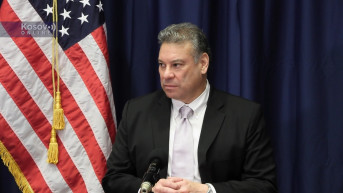
The European proposal for an agreement on the normalization of relations between Serbia and Kosovo represented one of the best opportunities for the region to move forward, and he called on the parties to be very serious in seeking an agreement, to find ways to be flexible, constructive and have a vision, and to take advantage of the opportunity offered to them, the US Special Envoy, Gabriel Escobar, said today for the Western Balkans.
Escobar, in a conversation with journalists in Belgrade, said that the purpose of today's visit was to talk with political leaders in the region on the topic of finding ways to progress with the proposal of a European agreement for the normalization of relations between Kosovo and Serbia.
"The US believes that this proposed agreement provides one of the best opportunities for the region to move forward, to create peaceful conditions for all people in the region. We want both parties to be very serious about finding a solution, to find ways to be flexible and constructive, to have a vision, and to take advantage of the opportunity that is presented to them. Not only Europe and the US stand behind the proposal, but the entire transatlantic community," he underlined.
Escobar said that the US expected that the parties would meet in Ohrid and discuss and face the fact of how to move towards an agreement on the normalization of relations, to think about how to overcome obstacles, to leave the meeting with the understanding that the process would continue until a solution was found.
We want Kosovo in the European integration
He emphasized that it was an agreement on the normalization of relations, not recognition.
"The American position is that Kosovo is a country with territorial integrity and sovereignty. We believe that the region would benefit from mutual recognition. As for membership in the UN, we think that the value of the agreement would be the faster integration of Serbia and Kosovo, and the entire region," Escobar added.
He pointed out that the purpose of the agreement was to intensify the process that would bring the entire region closer to Europe, both economically and politically.
When asked what was the difference between the talks of a month ago and those of a year ago, Escobar said that now they were "real talks within the states and among the people, in Kosovo and Serbia", about what it would mean to have peaceful, predictable and constructive relations, which would benefit everyone in the region.
"That's a difference and it's something real, real possibilities are being discussed," Escobar said.
To the statement that Kosovo's membership in the UN was mostly mentioned, and the question of what about other international organizations, the American diplomat replied that this agreement encouraged greater integration not only of Kosovo but also of Serbia in all international processes.
"If we talk about where Kosovo is moving, in which direction in terms of integration into international structures, we definitely want to see Kosovo in the process of European integration because that would benefit everyone in the region," Escobar said.
He pointed out that the specificity of the Western Balkans was the economic opportunities, which would greatly increase if all six countries of the Western Balkans were on the path of the EU, the path on which they would harmonize legal systems, and market laws, with European processes.
"It is about the integration of Serbia, Kosovo, and the other four countries into the EU," Escobar said.
When asked what the chances of reaching a sustainable agreement in Ohrid were and what if nothing happened, he answered that it was important that both sides saw the benefits of the agreement, which were great.
"People need it, and the Serbs in Kosovo need it the most, who are at the center of confrontation and tensions. I hope that we will strengthen the position of the Serbs in Kosovo and through the CSM, this is something that the EU and the US and both sides recognize and that is good," Escobar said.
I don't expect signings in Ohrid
He stated that he did not expect that there would be any signing (in Ohrid) at this moment, but that the way for further progress would be opened.
"I wouldn't talk about those negative aspects, what if it doesn't happen, I'd like to focus on the possibilities. If we go down that path, those opportunities are very positive for the region," Escobar said.
"What we would like to see in Ohrid is recognition that the CSM is an important part of the relationship between Serbia and Kosovo. And when I talk about it as a request, I don't want to provoke a confrontation or pose it as a challenge. The fact is that the CSM is part of the Brussels Agreement, it is part of the conclusions of the European Council, and it is part of the US policy. It will come true, the only question is how quickly it will happen and which model will be applied," Escobar said.
He reminded that Miroslav Lajcak had given several different examples of how this type of community functioned in the European Union, in order to give the rights to minorities to decide their own fate.
It should help bring the countries closer and we would like one of those models to serve as a model for the CSM, Escobar added.
We want the return of the Serbs to the institutions
"Regarding our expectations from Ohrid, when that topic is on the agenda, we expect and would like to see the largest possible participation of the Serbs in the Kosovo elections, and as candidates, to see political leaders in Kosovo from the Serbian community. And we hope to understand what they need in order to participate in the democratic process, to see them participate in the elections," Escobar said.
Asked whether it could be said, after his and EU Envoy Lajcak's visit, that we were closer to establishing the CSM, Escobar said, "we are much closer than a few weeks ago".
"I can say we are. Our talks with the government of Kosovo are becoming more and more realistic and productive. They are beginning to realize that this legally binding part of the agreement, and the agreement in general, will bring them closer to Europe. We are much closer to that than a few weeks ago," he underlined.
Asked how the agreement in Ohrid would contribute to the citizens, Escobar said that the most significant characteristics of the Western Balkans were its economic opportunities.
"This part of Europe is the fastest growing. The region is seen to be a leader in the 21st century in areas such as renewable energy sources, IT, and all the sectors that would be most important in this century. But people living in the region don't believe it. In the Western Balkans, people believe that it is a region of conflict, and ethnic rivalry and some think that there will be a new war in the Balkans. We know that it is a region with enormous potential, which may be promising, and that this agreement will contribute a lot," he emphasized, adding that people in Europe and the international business community already understood this.
According to him, the most significant outcome of the agreement would be a better investment climate.
The agreement, he says, opens the door to better economic integration, so that the region is not just six small countries, but a large whole with an economy worth 125 billion, with a growth rate that is five times higher than its neighbors.
"That's what can be achieved and those are the opportunities we're focusing on. It is important that people, including leaders, understand what the agreement can contribute," Escobar said, emphasizing that there were political problems that were an obstacle to where the Balkans could be in 25 years.
When asked what the "carrot" that was being offered was, Escobar indicated that the wish was for the agreement to open the door to greater integration of the Western Balkans into European structures, and immediately.
"We could, for example, use the new Berlin process to open the borders between the EU and the Western Balkans, to standardize identity cards and license plates of the region so that citizens can use them to enter the EU faster, without waiting in line at the border. Given the technology at our disposal, it is completely possible.”
The CSM must be formed regardless of whether there is a new agreement
When asked whether the CSM was part of the new agreement or not, Escobar underlined that the basic agreement on the normalization of relations included all the Brussels agreements.
"Everything that has already been agreed upon will not be discussed further, and that includes the CSM. What needs to be done according to the Brussels Agreement must be done and it is time to do it," the US envoy was clear.
He said that the CSM had to be implemented regardless of whether or not there was a new agreement.
Asked when he expected a new agreement to be reached, Escobar said he would like to see it happen this calendar year.
"I think it is possible," he emphasized.
In conclusion, Escobar said that the agreement was something that should not be feared.
"We hope that it will not radically change someone's life, but will enable peace and stability in the region. It is not intended to create new obstacles but on the contrary. We want it to be good not only for Serbia and Kosovo but to create opportunities for their neighbors, who want to see good relations between the two countries. Serbia and Kosovo together represent the largest part of the Western Balkans, and the neighbors want those two countries to have good relations. I think that would be very positive. If the people of this region, and the two governments see the opportunities provided for peace, for the first time in a long period of time, that would be good," the US envoy said.


0 comments