
Vucic: Belgrade is the constructive side; Pristina is only seeking recognition and does not want the CSM
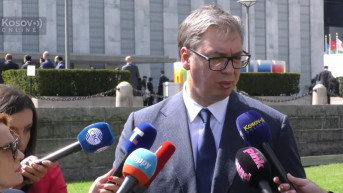
President of Serbia Aleksandar Vucic pointed out that Belgrade had always been the constructive side in the dialogue, while Pristina, even after 10 years, despite its commitment from the Brussels Agreement, had not yet formed the Community of Serb-majority Municipalities and was unwilling to move forward with the formation but only seeking recognition.
Vucic, in an interview with Sky News, responded to the question of why Belgrade did not normalize relations with Pristina, stating that Belgrade was doing its best, and that the Serbian delegation in Brussels had accepted everything proposed by EU mediators Josep Borrell and Miroslav Lajčak.
"Pristina has not yet formed the Community of Serb-majority Municipalities, which was agreed upon 10 or 11 years ago.
They just don't want to move forward with that and have always sought recognition and nothing more. They have not wanted to fulfill their obligations regarding the CSM," Vucic said.
He added that if the Brussels Agreement had been fully implemented, there would be Serbian policemen in Kosovo, as agreed upon, rather than Albanian police.
When asked whether former Vice President of the Serb List, Milan Radoicic, was his friend, Vucic replied that he could not say they were friends, but when asked if he was a close associate, Vucic replied that there was no doubt, as he had been Vice President of the Serb List.
"It was a big, huge criminal act," Vucic said.
On the question of why Belgrade does not extradite Radoicic to Pristina, Vucic emphasized that Serbia did not recognize Kosovo's independence.
"Are you joking or what? You know we cannot deliver anyone to Kosovo because we do not recognize Kosovo's independence," Vucic said.
When the journalist noted that these were serious accusations, Vucic said that they were, but there had been thousands of serious crimes and that, even though Serbia was a member of the UN, no one had been extradited to Belgrade.
Vucic believes that everything happening in Kosovo is the fault of Kosovo Prime Minister Albin Kurti.
He reminded that there had been 14,000 soldiers near the administrative line with Kosovo last year, and at the time of the incident in Banjska, there had been 8,400, which was significantly fewer.
When asked if the army had been moved, he answered affirmatively, emphasizing that the number of soldiers had increased, but he had not given the order to raise combat readiness.
"Because we believed it was a difficult situation, as any army in the world would do, but with no intention of attacking anyone. Just as we didn't," Vucic pointed out, adding that there were now about 4,400 soldiers on the administrative line.
He disagrees with assessments that this had a destabilizing effect but believes that the root of the problem must be addressed, something nobody wants to do.
"I understand your approach because it is always easier to criticize and label someone when you have a superficial approach about good and bad guys... It's not quite like that. We must consider the real problems, and nobody wants to do that," Vucic warned.
Regarding the "ambush" in Banjska and how he responds to accusations that it was orchestrated from Belgrade, he stated that it was the easiest thing to say because it was easy to believe. However, he emphasized that what had happened was unnecessary for anyone, especially noting that it was not a real ambush.
"It was not an ambush. A policeman died from an explosive device that connected two trucks they set up as a barricade.
They said there were 20, then 30, then 60 people... However many there were, it was unnecessary for anyone. These people (Serbs) were mostly expelled from their homes," the President of Serbia emphasized.
When criticized that he "sympathizes with these people," he replied that he did not sympathize and that he had publicly condemned everything that had happened but had to address the essence of the problem.
"Of course, I condemn it. You cannot kill anyone, no matter what happens in northern Kosovo. I strongly condemn it, and I have condemned it publicly. But you're talking about a policeman, and three Serbs were also killed," Vucic pointed out.
He added that people living in Kosovo, who wanted to return to their homes, could not be called terrorists.
"What happened to the seven Serbs who were shot before that, including an 11-year-old child? There is no investigation into that," Vucic said.
He reiterated that he did not justify what had happened but was talking about the root of the problem.
"I'm not justifying anything; I'm talking about the core of the problem, the reason why some people want to do something, regardless of how bad it was. I'm not justifying it, but I can understand them because they were driven from their homes, many of them were injured by the Kosovo Police, even an 11-year-old child, and no one took that into account... There is no investigation into the shooting of Dragisa Galjak from northern Kosovo, the attempted murder. The Serbs live with this; you have to understand what is happening. It's not as easy as it may seem," Vucic stressed.
Regarding the question of the used weapons, which were produced in Serbia, Vucic said that was indeed the case, just as most of the weapons of the Kosovo Police were produced in Serbia, but Serbia had not sold it to them.
"Even those who persecuted the Serbs carried weapons made in Kragujevac. That doesn't mean much," Vucic said.
He added that it was easy to obtain weapons on the black market, but even aside from that, people from central Serbia would always support those in Kosovo who wanted to defend themselves because, from Serbia's perspective, Kosovo was a part of it, as per the Constitution.
"I'm saying that it's not difficult to acquire weapons. Even during the interrogations, Radoicic said he had bought some in Serbia, some in Croatia, some in Bosnia. We will investigate," Vucic said.
Regarding the situation with barricades at the end of last year, Vucic says he made a mistake then because the barricades were removed because he guaranteed the Serbs in Kosovo that there would be no repression and terror.
"I received all the guarantees from the EU, the US, Radoicic, and others were angry and dissatisfied with the fact that I asked them to remove the barricades. But I told them we had nothing else to do because they had fulfilled all our demands and promised that the Serbs would not be prosecuted by the regime of Albin Kurti. They told me they had no guarantees for that, and I told them - I guarantee it, and it turned out that I lied to them because repression and terror continued, and that's 100% true," Vucic explained.
When asked where Russia fit into all of this, given accusations from Pristina that Serbia supported Russia in the separation of Donbas, Vucic said that it was easy to debunk that story because a part of Serbia's territory had been occupied.
"It's not us who occupied anyone else's territory; how can you say we support the separation of Donbas? They did that to us. Before this started happening in Ukraine, I met or talked with President Vladimir Putin 19 or 20 times, and after that, I haven't seen him or talked to him, unlike many European leaders," he said.
He emphasized that he could not say that relations between Serbia and Russia were bad, but when asked if they had been damaged because of Ukraine, he stated that they had and that there was no doubt about it.
"We respect the territorial integrity and sovereignty of Ukraine, and we will continue to do so. For us, Donbas is a part of Ukraine," Vucic said.

comments