
Is Rama right: What is the difference between Kosovo and Kosova?
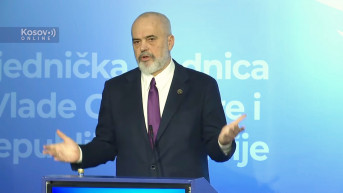
The remark of the Prime Minister of Albania, Edi Rama, made in London during a debate at the Royal Institute of International Relations last week, that is not correct to say "Kosovo", but "Kosova", according to the opinion of several professors of philology, interlocutors of Kosovo Online, is an expression of the desire to impose the Albanian form of the name Kosovo on the plan, and even announced the persecution of the Serbian name from international terminology.
This was not the first time for the Albanian prime minister to promote the Albanian pronunciation of the name Kosovo. During his address before the Parliamentary Assembly of the Council of Europe in October last year, he said that "the time has come to write Kosovo as 'Kosova', as it is called, and not as 'Kosovo'".
Academician, and philologist, Aleksandar Loma, says for Kosovo Online that for "the self-proclaimed republic of Kosovo, those who recognize it use the Serbian name Kosovo or the English Republic of Kosovo", and that Edi Rama's statement is an expression of the desire to change that and impose the Albanian form of the name on the international level.
He explains that the name Kosovo originally refers to the Kosovo field as a geographical term and means "a field where there are (a lot of) blackbirds", and that the word "kos" is universally Slavic.
"The echo of the Battle of Kosovo in 1389, and then another in 1448, spread the Serbian toponym throughout Europe, so it was translated into foreign languages, in Latin as Campus merularum (Campus merularum, merula "blackbird"), in Italian as “Piana dei Merli” (Piana dei Merli "field of blackbirds"), in German as Amselfeld (Amselfeld: Amsel "blackbird"). Italians and Germans still use these translated names today. Albanians took this name from the Slavs and did not translate it, they just changed its gender from neuter to feminine: Kosóvë (where ë is pronounced silently, like a semivowel, in a certain form with the article Kosóva. The change of gender was probably prompted by the feminine gender of the Albanian word fusa (fúsha) "field". It is interesting that among the numerous toponyms of Slavic origin on the soil of Albania itself, there are two villages of Kosovo," Professor Loma says.
He reminds that it is not an isolated case that at the request of individual countries their name is changed in other languages.
"Today we call the former Ceylon Sri Lanka, the former Burma - Myanmar, the former Rhodesia - Zimbabwe. It would not be surprising if the Kosovar Albanians impose their official name on at least part of the world, either Kosova or perhaps Dardania, after the ancient region on the territory of Kosovo and Metohija. as Ibrahim Rugova wanted," Professor Loma says.
On the occasion of Rama's "language interventions", a professor at the Faculty of Philology in Belgrade Vanja Stanisic tells our portal that this is a new step in severing ties between the territory of Kosovo and the Serbs.
"It is the announcement of the persecution of our name Kosovo from international terminology, i.e. a new step in severing the ties of this territory with the Serbs. Not only have we been ethnically cleansed from the territory of Kosovo, but now it is time to persecute our form of its name. The Albanian form of Kosovo is, by the way, the Albanian pronunciation of our name with the postpositive definite article -a, for example, the same as the Albanian form of Dibra for the Macedonian Debar (border mountain area between Albania and today's North Macedonia. In both cases, it is an Albanian pronunciation of originally Slavic names. In the case of the Macedonian Debar, name for the dense forest area (as well as our Dabar), and in the case of our Kosovo for the Kosovo field, from where the name Kosovo spread to the entire territory. It is not excluded that some future step could be the renaming of the name of Kosovo itself, which even in its Albanianized form still keeps the connection with us," Stanisic says.
Since Kosovo is a Slavic word, linguist Professor, Milos Kovacevic, believes that it is logical that the Slavic form has priority over the Albanian, which, he says, is only morphologically modified.
"In this particular case, Rama referred to the Albanian language, but the danger is greater when one does not say 'Kosovo and Metohija'. When only Kosovo is pronounced, the abbreviation made by the Albanians is accepted, and then one also agrees to accept the Albanian status, which abolishes Metohija. If only Kosovo is said, then the Albanian point of view has already been taken," Professor Kovacevic points out.
comments